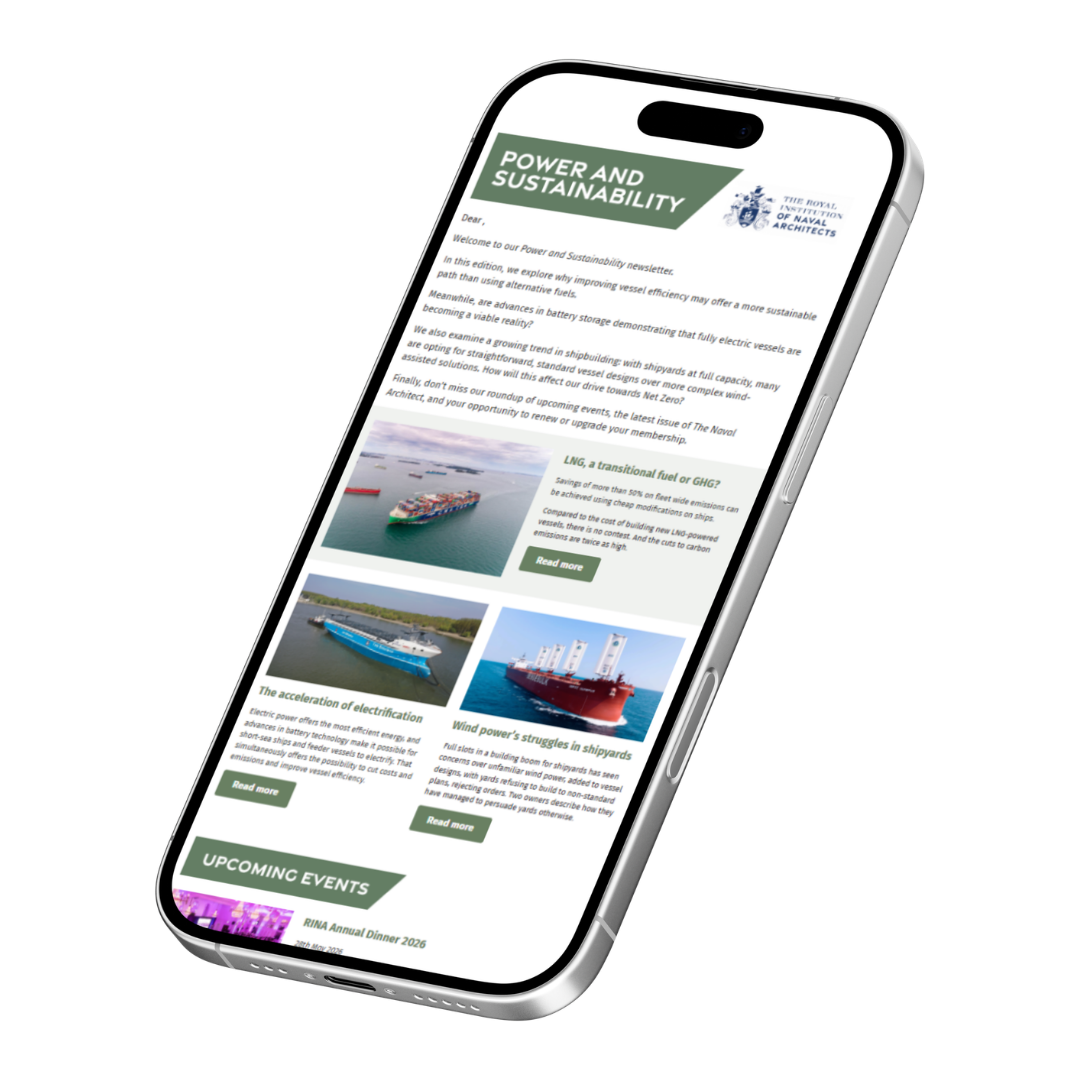
The Naval Architect provides in-depth information on all aspects of vessel design, construction and engineering. Practical applications of latest technology and case studies are accompanied by analysis and foresights. Published every two months, the magazine covers everything from superyachts and short-hop ferries to tankers and heavy-lift vessels; from battery pack installations and sail-assisted solutions to LNG tank retrofits; and from offshore safety to warship resilience.
Significant Ships of 2024
Significant Ships
Now includes vessels under & over 100m LOA
HOW UR E26 AND E27 COULD AND SHOULD APPLY TO DRONES AND AUTONOMOUS VESSELS?
Autonomous Ships
Maritime cybersecurity is moving from best practice to strategic necessity. By examining the drivers behind UR E26 and UR E27, this analysis highlights critical vulnerabilities, implementation challenges and regulatory gaps. The findings explore how interoperable frameworks, stronger collaboration and complementary standards can enhance resilience across increasingly connected fleets worldwide today.
SAFETY ASSURANCE OF AUTONOMOUS SURFACE VESSELS
Autonomous Ships
Safety assurance is emerging as a critical enabler of maritime autonomy as AI and other disruptive technologies reshape vessel operations. Building on functional safety engineering and established risk management practices, evolving frameworks are addressing autonomous system risks, offering practical pathways to robust safety cases and trusted deployment of next-generation autonomous vessels.
LOW LATENCY VIDEO COMMUNICATION AT 5G NTN FOR SHIP REMOTE CONTROL
Autonomous Ships
Low Earth Orbit satellites and emerging 5G non-terrestrial networks are reshaping the future of autonomous maritime operations. By exploring low-latency video transmission, resilient connectivity and remote-control architectures for MASS, this research identifies key communication challenges and innovations needed to deliver reliable situational awareness and effective shore-based vessel control.
AN INVESTIGATION INTO THE EFFECTS OF TRAINING ON THE FAULT DIAGNOSTIC SKILLS OF NAVIGATIONAL SEAFARERS
Autonomous Ships
As autonomous shipping advances, human expertise remains central to safe operations. Simulator-based research reveals that behavioural training can outperform technical instruction in helping officers diagnose automation failures. Using event tree analysis and bridge watchkeeping scenarios, the findings offer valuable insights for developing future competencies and training strategies for autonomous maritime operations.
UNLOCKING KEY ACCEPTANCE CRITERIA FOR SAFE SITUATIONAL AWARENESS SYSTEMS USING SHIP MANOUVRABILLITY CHARACTERISTICS
Autonomous Ships
Autonomous maritime operations depend on reliable external awareness, making detection performance a critical safety requirement. By linking sensor effectiveness to vessel manoeuvrability and collision avoidance capability, this research introduces deterministic and probabilistic methods to define minimum safe detection distances, providing a practical foundation for safer, risk-informed autonomous navigation systems.
BUSINESS ECOSYSTEMS IN AUTONOMOUS SHIPPING: A REVIEW-BASED ACTOR MAPPING
Autonomous Ships
Autonomous shipping will succeed or fail as part of a broader business ecosystem, not as a standalone technology. Emerging research maps shifting relationships among industry stakeholders, revealing new roles, disappearing functions and alignment challenges. The findings underscore why ecosystem coordination is critical to unlocking the transformative potential of autonomous vessels.
CLASSIFICATION AND DEFINITIONS OF UNCREWED MARITIME SYSTEMS
Autonomous Ships
As uncrewed maritime systems proliferate, growing gaps between technology and policy are creating urgent legal and operational challenges. Examining vessel definitions, classification frameworks and international precedents, this analysis clarifies how uncrewed systems may be treated under maritime law, highlighting implications for regulation, sovereignty, security and future deployment across contested waters.
ENVIRONMENTAL POTENTIAL OF REMOTE CONTROL TECHNOLOGIES: USE CASE REMOTE PILOTAGE
Autonomous Ships
Remote pilotage offers a practical pathway to realise the benefits of maritime remote-control technologies before full autonomous regulation is established. By combining MASS-enabled capabilities with AIS-based operational analysis, this research quantifies potential fuel and emissions savings, while exploring the operational conditions needed to safely transform pilotage services and maritime efficiency.
CONCEPT DESIGN ON A LARGE UNMANNED SURFACE VEHICLE (LUSV)
Autonomous Ships
Large Uncrewed Surface Vessels are redefining naval platform design by replacing onboard crews with advanced autonomy, remote control and intelligent system management. This concept explores safety-driven architectures, redundant systems and automated operations, revealing how future patrol-class vessels could deliver comparable capability, resilience and performance while reducing personnel requirements and operational constraints.
MUM - AN EXTRA LARGE UNMANNED UNDERWATER VEHICLE (XLUUV)
Autonomous Ships
The MUM project is advancing a new generation of highly modular extra-large uncrewed underwater vehicles, designed to adapt rapidly to diverse mission requirements. By combining autonomous surface and underwater navigation, risk-informed engineering and early regulatory engagement, the programme is addressing key design challenges while establishing foundations for future validation and operational deployment
AUTONOMOUS SWATH VESSELS FOR WIND FARM INSPECTIONS: A COMPARATIVE STUDY ON OPERATIONAL EFFICIENCY
Autonomous Ships
Autonomous SWATH vessels could transform offshore wind farm support operations by combining hybrid fuel cell-battery propulsion with highly stable hull designs. Through numerical simulation and real-world operating scenarios, the research demonstrates superior availability and ROV deployment performance in harsh sea conditions, highlighting a promising solution for safer, more efficient and sustainable offshore maintenance.
Newsletters
Stay connected with the global maritime community through RINA’s newsletters.
Whether you are a member or not, you can receive updates from The Naval Architect, alongside selected RINA news, events and industry insights. Members also gain access to a wider portfolio of exclusive newsletters on key topics in the maritime industry.