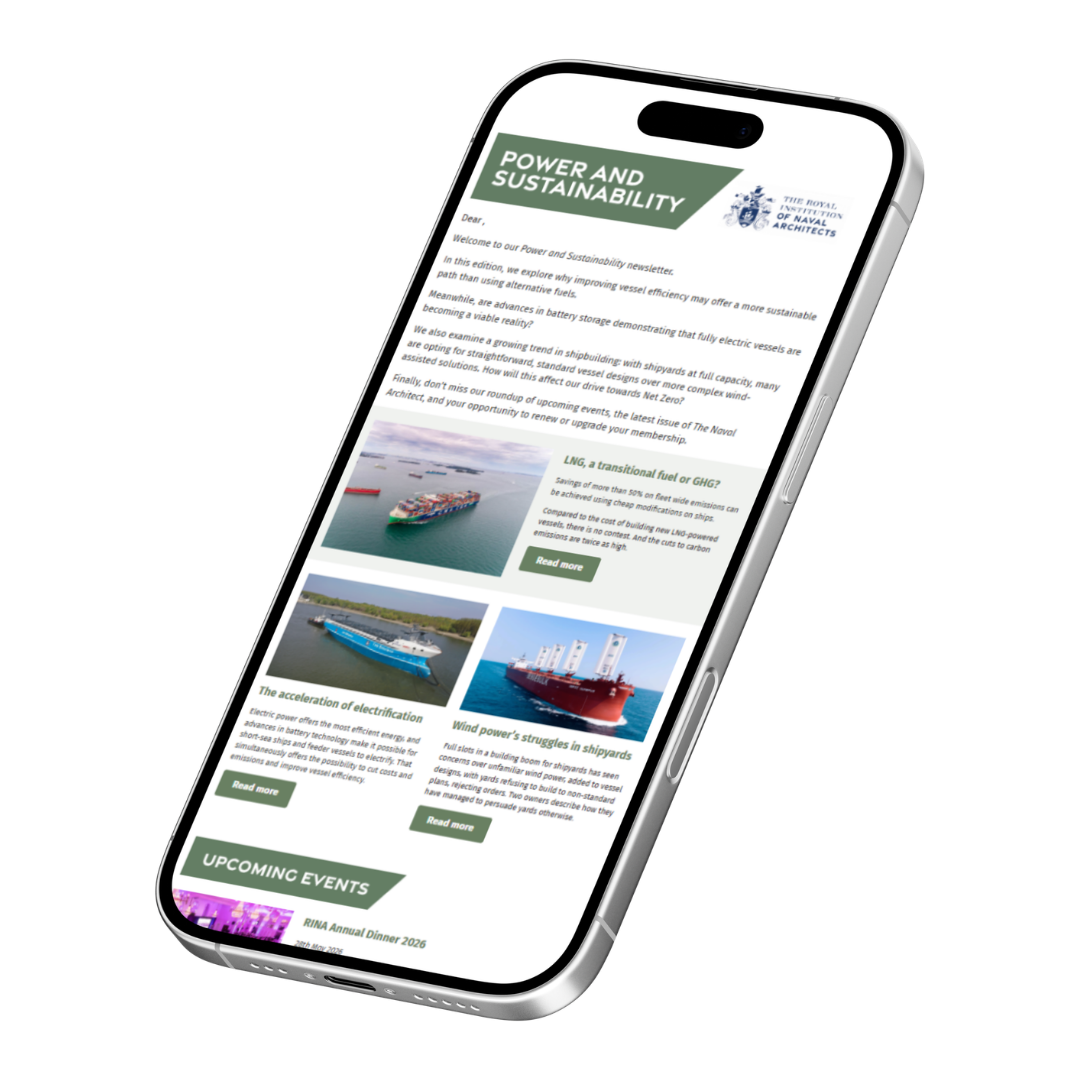
The Naval Architect provides in-depth information on all aspects of vessel design, construction and engineering. Practical applications of latest technology and case studies are accompanied by analysis and foresights. Published every two months, the magazine covers everything from superyachts and short-hop ferries to tankers and heavy-lift vessels; from battery pack installations and sail-assisted solutions to LNG tank retrofits; and from offshore safety to warship resilience.
DESIGN AND DEVELOPMENT OF AN EFFICIENT COMPUTER SIMULATION MODEL FOR RESPONSE ANALYSIS OF A MOORED SEMI-SUBMERSIBLE
Transactions
An integrated computer simulation model is advancing semi-submersible design by combining computational and experimental modules to capture six-degree-of-freedom dynamics and mooring-structure interactions. Validated against physical data, the framework reveals performance trade-offs between fibre and steel moorings, supporting optimisation, stability assessment and more resilient offshore platform development for future operating conditions.
AN INTEGRATED SHIP RE-DESIGN/MODIFICATION STRATEGY
Transactions
A novel CAD-CFD redesign strategy demonstrates how targeted bow and stern modifications can unlock meaningful efficiency gains without altering core vessel characteristics. Validated against industry standards and applied to the KRISO container ship, the integrated approach delivers resistance and propulsion improvements, highlighting practical pathways to lower operating costs and emissions.
INTERNATIONAL DEVELOPMENT AND VALIDATION OF A DISTRIBUTED SIMULATION FOR NAVAL SHIP REPLENISHMENT AT SEA
Transactions
How can allied navies accurately model one of maritime operations’ most demanding tasks? A multinational team built and validated a distributed HLA-based simulation capturing seaway conditions, ship interactions and payload transfer dynamics. Proven against experimental data, the platform delivers valuable insights for system integration, operational planning and future naval capability development.
STATIC CONTROL OF DRAG-REDUCING AIR CAVITIES WITH VARIABLE CAVITATOR SHAPE
Transactions
Air-cavity drag reduction is moving closer to practical deployment through research linking cavity performance to controllable hydrodynamic actuators and wedge-shaped cavitators. Using potential-flow modelling, new insights into optimal operating conditions reveal how flow speed and hull trim influence efficiency gains, supporting more energy-efficient ship designs.
THE RE-DESIGN OF A MARINE ENGINE ROOM SIMULATOR IN CONSIDERATION TO ERGONOMICS DESIGN PRINCIPLES
Transactions
How can simulator design influence engineering competence? By applying ergonomic principles to a full-mission engine room simulator, a redesigned mimic panel improved realism, usability and training effectiveness. The experience highlights how human-centred design can enhance operational learning environments and strengthen the quality of marine engineering education and professional preparedness.
THE SOPHISTICATION OF EARLY STAGE DESIGN FOR COMPLEX VESSELS
Transactions
Early-stage design decisions continue to shape the cost, capability and long-term success of complex naval and specialist vessels. As digital tools enable the rapid generation of design alternatives, greater emphasis is being placed on more holistic concept exploration, helping manage risk, address emerging requirements and improve outcomes across the ship design lifecycle.
Discussion: THE SOPHISTICATION OF EARLY STAGE DESIGN FOR COMPLEX VESSELS
Transactions
Early-stage ship design remains central to the successful development of complex naval and specialist vessels. Ongoing debate around requirements definition, design complexity, systems engineering and concept exploration highlights the value of holistic, collaborative design approaches that balance capability, risk and affordability while shaping more effective and adaptable solutions for future maritime operations.
EFFECTS OF MARINE CONDITION ON THE SPEED AND FUEL CONSUMPTION OF A FULLY - LOADED VLCC
Transactions
Fuel consumption remains a critical focus for ship operators seeking greater efficiency in varying sea conditions. Analysis of operational voyage data reveals how wind, waves and vessel heading influence speed loss and performance, providing a practical foundation for improved fuel-use forecasting, voyage planning and more cost-effective fleet management.
RISK ASSESSMENT MODEL OF COASTAL SEA POLLUTION BY BLACK (SEWAGE) WATERS FROM VESSELS
Transactions
Environmental protection in coastal waters requires risk assessments that capture the complexity of vessel operations and local sensitivities. Pollution threats from ship discharges are shaped by vessel characteristics, treatment capabilities and location-specific factors, making robust risk evaluation increasingly important for safeguarding marine ecosystems, public health and coastal economic activities.
PERFORMANCE PREDICTION OF A 112M WAVE-PIERCING CATAMARAN
Transactions
Accurately predicting the power requirements of high-speed catamarans remains a critical challenge for designers seeking performance, efficiency and operational certainty. Strong correlation between model-scale testing and full-scale vessel performance reinforces the strategic value of proven extrapolation methods, supporting more reliable design decisions and greater confidence in powering assessments for advanced fast-ferry concepts.
DRY-DOCKING TIME AND LABOUR
Transactions
Dry-docking efficiency remains a critical commercial consideration for both shipowners and shipyards. Better understanding of how vessel size, age and type influence maintenance time and labour requirements can support more accurate planning, reduce operational costs and improve resource utilisation, helping organisations maximise availability while minimising time spent out of service.
AN APPLICATION OF MACHINE LEARNING TO SHIPPING EMISSION INVENTORY
Transactions
Maritime decarbonisation and air-quality management increasingly depend on accurate emission measurement and forecasting. Machine learning is emerging as a powerful tool for enhancing shipping emission inventories, improving the estimation of vessel-generated pollutants across different operating conditions and supporting more informed environmental reporting, regulatory compliance and emissions-reduction strategies.
Newsletters
Stay connected with the global maritime community through RINA’s newsletters.
Whether you are a member or not, you can receive updates from The Naval Architect, alongside selected RINA news, events and industry insights. Members also gain access to a wider portfolio of exclusive newsletters on key topics in the maritime industry.