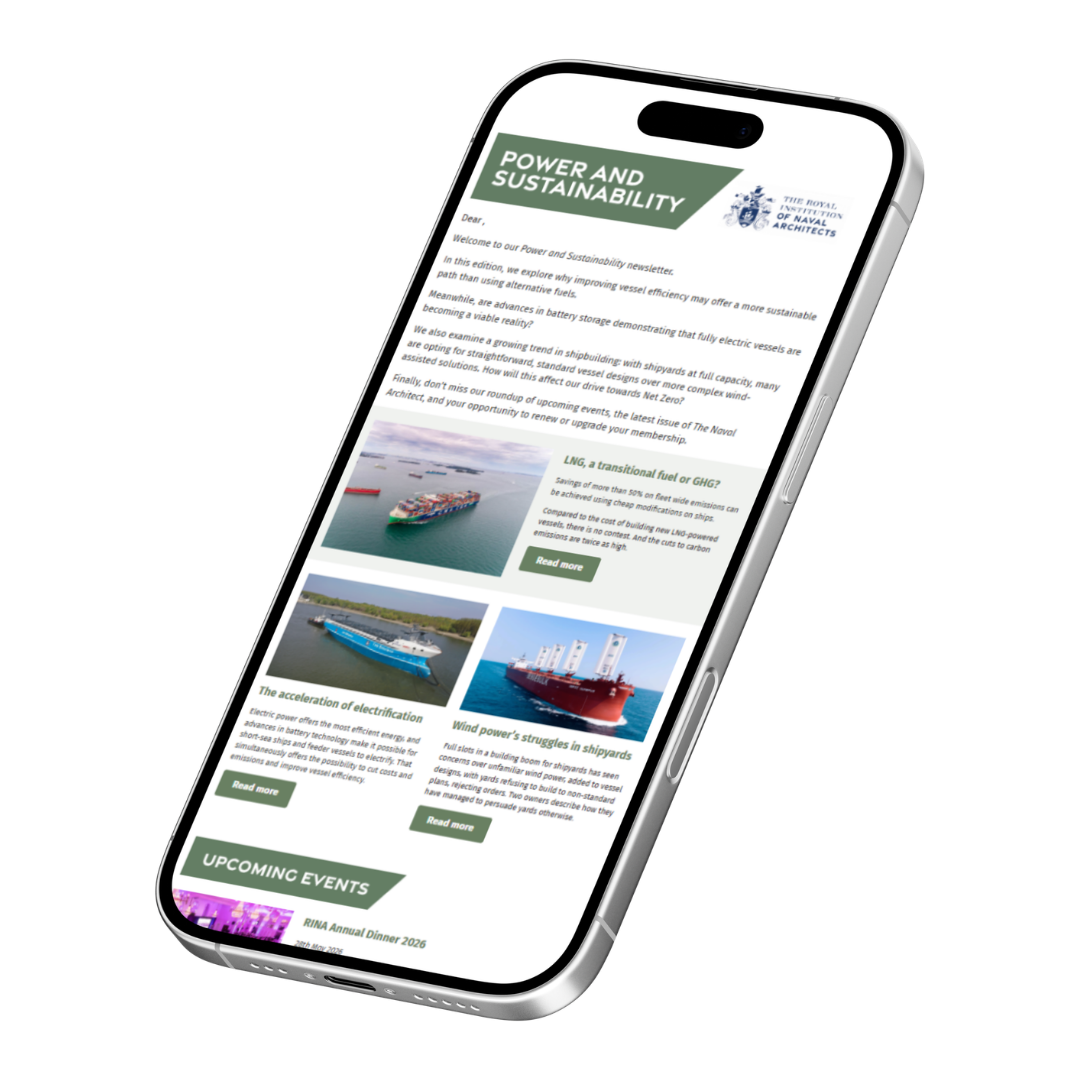
The Naval Architect provides in-depth information on all aspects of vessel design, construction and engineering. Practical applications of latest technology and case studies are accompanied by analysis and foresights. Published every two months, the magazine covers everything from superyachts and short-hop ferries to tankers and heavy-lift vessels; from battery pack installations and sail-assisted solutions to LNG tank retrofits; and from offshore safety to warship resilience.
MODEL-BASED SUSTAINMENT: DIGITAL SOLUTIONS FOR IMPROVING ASSET AVAILABILITY
Warship
Digital transformation is reshaping naval sustainment through shipbuilding-specific lifecycle management, digital twins and model-based maintenance. By creating a connected digital thread across design, production and in-service support, emerging approaches reduce lifecycle costs, improve fleet availability and accelerate maintenance planning, helping navies enhance readiness for evolving operational demands.
SUSTAINABILITY OF NEXT GENERATION POWER PLANTS OF DEFENCE ASSETS
Warship
Advanced waste heat recovery and energy storage technologies are set to redefine power efficiency in future defence platforms. By identifying high-impact, operationally viable solutions and modelling integrated power plant architectures, researchers demonstrate potential efficiency gains of up to 20%, supporting sustainability goals, reducing energy losses and strengthening long-term operational effectiveness.
WHAT RISK?
Warship
As autonomous military systems evolve, understanding risk to human life is becoming more complex than simply removing people from hazardous environments. This perspective examines emerging challenges in human-machine interaction, command authority and learning systems, exploring how military organisations can identify, assess and manage life-critical risks in future defence technologies.
ADVANCING SMART, SUSTAINABLE, AND AUTONOMOUS FLEETS WITH DIGITAL INNOVATION TOOLS
Warship
Digital technologies are accelerating the maritime sector’s transformation toward smarter, cleaner and more autonomous operations. By combining digital twins, advanced simulation, lifecycle management and AI-driven predictive analytics, organisations can optimise performance, meet sustainability goals and enhance safety, revealing new opportunities for the next generation of intelligent maritime capabilities.
EVERY FRIGATE A SQUADRON: STUDIES OF LARGE UNCREWED SURFACE VESSELS
Warship
Medium and Large Uncrewed Surface Vessels are emerging as versatile force multipliers for future naval operations. By adapting commercial vessel designs and applying mission-focused sizing methods, new concepts demonstrate how mixed crewed-uncrewed fleets could expand capability, accelerate deployment and deliver flexible, cost-effective support across a broad range of maritime tasks.
ON THE BENEFIT OF ADJUSTABLE STERN ENERGY SAVING DEVICES FOR FAST WARSHIPS
Warship
Stern energy-saving devices could significantly improve warship efficiency without compromising high-speed performance. Using high-fidelity computational fluid dynamics and virtual towing tank analysis, researchers compare fixed and adjustable stern-mounted technologies, identifying solutions that deliver the greatest energy savings across operational profiles while supporting future demands for sustainability and naval capability.
PROBABILISTIC SAFETY OF ESTUARY VESSELS BASED ON NONLINEAR ROLLING IN WIND AND WAVES - Copy
Transactions
THE NEXT VERSION OF CII - WHAT MIGHT IT LOOK LIKE?
CII
The Carbon Intensity Indicator is entering a critical phase of review as industry experience reveals anomalies that may affect fairness, effectiveness and operational decision-making. With regulatory refinements under active consideration, emerging proposals could reshape how maritime emissions performance is measured, creating important implications for compliance, fleet efficiency and decarbonisation strategies.
THE GREENHOUSE GAS EMISSIONS OF WARSHIPS
Warship
Warships face a unique decarbonisation challenge that cannot be measured using commercial shipping models alone. By examining whole-life emissions across design, construction and operations, emerging research reveals new opportunities to reduce environmental impact, helping naval programmes balance sustainability goals with mission effectiveness, capability requirements and complex supply chains.
RECOVERABILITY OF ALTERNATIVE FUELS
Warship
Alternative fuels are set to transform maritime operations, but recoverability remains a critical challenge. Examining ammonia, methanol and hydrogen, this research evaluates fire, toxicity and damage-response risks arising from accidents or hostile action. The findings outline practical mitigation strategies to help future navies safely integrate low-carbon fuels while preserving resilience.
FUTURE BATTERY PROTECTION STRATEGIES FOR NAVAL VESSELS
Warship
Immersion cooling could offer a significant advancement in maritime energy storage safety, helping prevent thermal runaway from escalating across lithium-ion battery systems. Drawing on lessons from automotive and data centre applications, this research explores integration challenges, battery chemistry considerations and decentralised architectures, revealing new pathways to safer naval electrification.
INTEGRATING SHIELD AND SOAM FOR SYSTEMIC HUMAN FACTORS ANALYSIS IN MARITIME COLLISIONS: THE HELGE INGSTAD CASE
Warship
Human factors remain a leading contributor to maritime incidents, demanding more effective methods to understand complex failures. By combining SHIELD-HFACS, influence weighting and causal mapping through SOAM, a new framework exposes how organisational, supervisory and operational weaknesses interact, enabling deeper safety insights and supporting more targeted, evidence-based risk reduction strategies.
Newsletters
Stay connected with the global maritime community through RINA’s newsletters.
Whether you are a member or not, you can receive updates from The Naval Architect, alongside selected RINA news, events and industry insights. Members also gain access to a wider portfolio of exclusive newsletters on key topics in the maritime industry.