The Naval Architect provides in-depth information on all aspects of vessel design, construction and engineering. Practical applications of latest technology and case studies are accompanied by analysis and foresights. Published every two months, the magazine covers everything from superyachts and short-hop ferries to tankers and heavy-lift vessels; from battery pack installations and sail-assisted solutions to LNG tank retrofits; and from offshore safety to warship resilience.
MODELLING THE HEAVE OSCILLATIONS OF VERTICAL CYLINDERS WITH DAMPING PLATES
Transactions
Understanding how offshore structures respond to wave-induced motion remains central to efficient and reliable marine design. Advanced numerical modelling of oscillating cylinders with damping plates reveals how geometry influences hydrodynamic behaviour across operating conditions, demonstrating the growing role of high-fidelity simulation in optimising motion control and validating complex fluid interactions.
EXPERIMENTAL INVESTIGATION INTO FACTORS AFFECTING THE TRANSIENT FLOW OF FLUID THROUGH AN ORIFICE IN REALISTIC CONDITIONS
Transactions
Flooding incidents remain a critical challenge for vessel safety, where rapid understanding of water ingress can determine the outcome of an emergency. New investigation into discharge behaviour reveals that commonly used assumptions may not adequately reflect real conditions, raising important questions for damage assessment, stability management, and environmental protection strategies.
SAFETY CRITICAL MARITIME INFRASTRUCTURE SYSTEMS RESILIENCE: A CRITICAL REVIEW
Transactions
As maritime infrastructure becomes increasingly interconnected, resilience is emerging as a strategic priority alongside safety and security. The growing complexity of stakeholder networks, operational dependencies, and evolving threat landscapes is exposing new vulnerabilities, reinforcing the need for more adaptive risk governance and resilience-focused approaches to safeguarding critical maritime operations.
AN EVALUATION APPROACH FOR ELIMINATING THE FAILURE EFFECT IN GAS TURBINE USING FUZZY MULTIPLE CRITERIA
Transactions
As gas turbines become increasingly important to marine propulsion and other critical industries, improving maintenance decision-making is essential for controlling cost and operational risk. Advanced fuzzy multi-criteria assessment techniques offer a more structured approach to uncertainty, highlighting the components most likely to influence reliability, performance, and long-term asset management strategies.
CONTINUOUS TUNING OF SHIP PROPULSION SYSTEM BY MEANS OF PNEUMATIC TUNER OF TORSIONAL OSCILLATION
Transactions
Controlling vibration remains a persistent challenge in marine and industrial drivetrain systems, where torsional oscillations can affect reliability, efficiency, and equipment life. An emerging self-regulating pneumatic coupling concept offers a new approach to system tuning, highlighting the potential for adaptive mechanical solutions to manage dynamic loads and improve operational performance.
INVESTIGATION OF WELDER SELECTION PARAMETERS BASED ON FUZZY ANALYTIC HIERARCHY PROCESS IN SHIPBUILDING
Transactions
In a highly competitive shipbuilding market, workforce capability is becoming a key source of competitive advantage. A structured approach to welder selection highlights the skills and attributes most valued by shipyards, underscoring how talent evaluation, workmanship quality, and targeted skills development can strengthen productivity, quality performance, and long-term industry competitiveness.
BUCKLING AND POST-BUCKLING OF ISOTROPIC AND COMPOSITE STIFFENED PANELS: A REVIEW ON OPTIMISATION (2000-2015)
Transactions
As lightweight, high-performance structures become increasingly important across maritime and aerospace sectors, optimisation is reshaping how engineers address strength and stability challenges. Advances in buckling and post-buckling design methods are revealing new opportunities to maximise structural efficiency, while highlighting the complex trade-offs that continue to define next-generation stiffened panel development.
DECISION SUPPORT SYSTEM FOR POWER GENERATION MANAGEMENT FOR AN 110000+ GRT CRUISE SHIP
Transactions
As cruise operators face mounting pressure to improve efficiency and reduce emissions, smarter power management is becoming a strategic priority. Combining electrical load modelling with operational data reveals opportunities to optimise diesel-generator performance, uncover hidden inefficiencies, and enhance energy utilisation, supporting more sustainable and cost-effective ship operations.
A COMPARISON OF EXPERIMENTAL AND NUMERICAL BEHAVIOUR CHARACTERISTICS OF A SHIP ENTERING A LOCK USING BENCHMARK TEST DATA
Transactions
Managing ships in locks and confined waterways remains one of maritime engineering’s most demanding challenges. Comparative analysis of advanced numerical and experimental approaches shows steady progress in predicting complex hydrodynamic forces, while underscoring the continued value of physical testing. Together, these capabilities are shaping more reliable tools for navigation and infrastructure planning.
AN INHERENTLY SAFER LAYOUT DESIGN FOR THE LIQUEFACTION PROCESS OF AN FLNG PLANT
Transactions
As FLNG facilities grow in scale and complexity, safety is increasingly being designed into operations from the outset rather than added later. An innovative layout optimisation approach balances risk, space constraints, and economics, reducing potential domino-effect losses while providing a practical framework for safer, more resilient offshore energy infrastructure.
STRESS DISTRIBUTION IN THE HOLLOW STIFFENED HYBRID LAMINATED COMPOSITE PANELS IN SHIP STRUCTURES UNDER SINUSOIDAL LOADING
Transactions
Advanced composite materials are creating new opportunities to reduce weight, cost, and structural risk in marine construction. By combining GFRP and CFRP laminates with sophisticated stress-modelling techniques, engineers gain deeper insight into structural performance, enabling more efficient stiffened panel designs while balancing strength, durability, and economic considerations.
LOADING RESPONSE OF STERN TAB MOTION CONTROLS IN SHALLOW WATER
Transactions
Shallow-water operations may be influencing high-speed vessel performance far more than traditionally assumed. New findings reveal significant changes in active stern-tab lift behaviour as water depth decreases, with direct implications for ride control, trim optimisation, and manoeuvrability. The interaction between vessel control systems and confined-water hydrodynamics emerges as a critical design consideration.
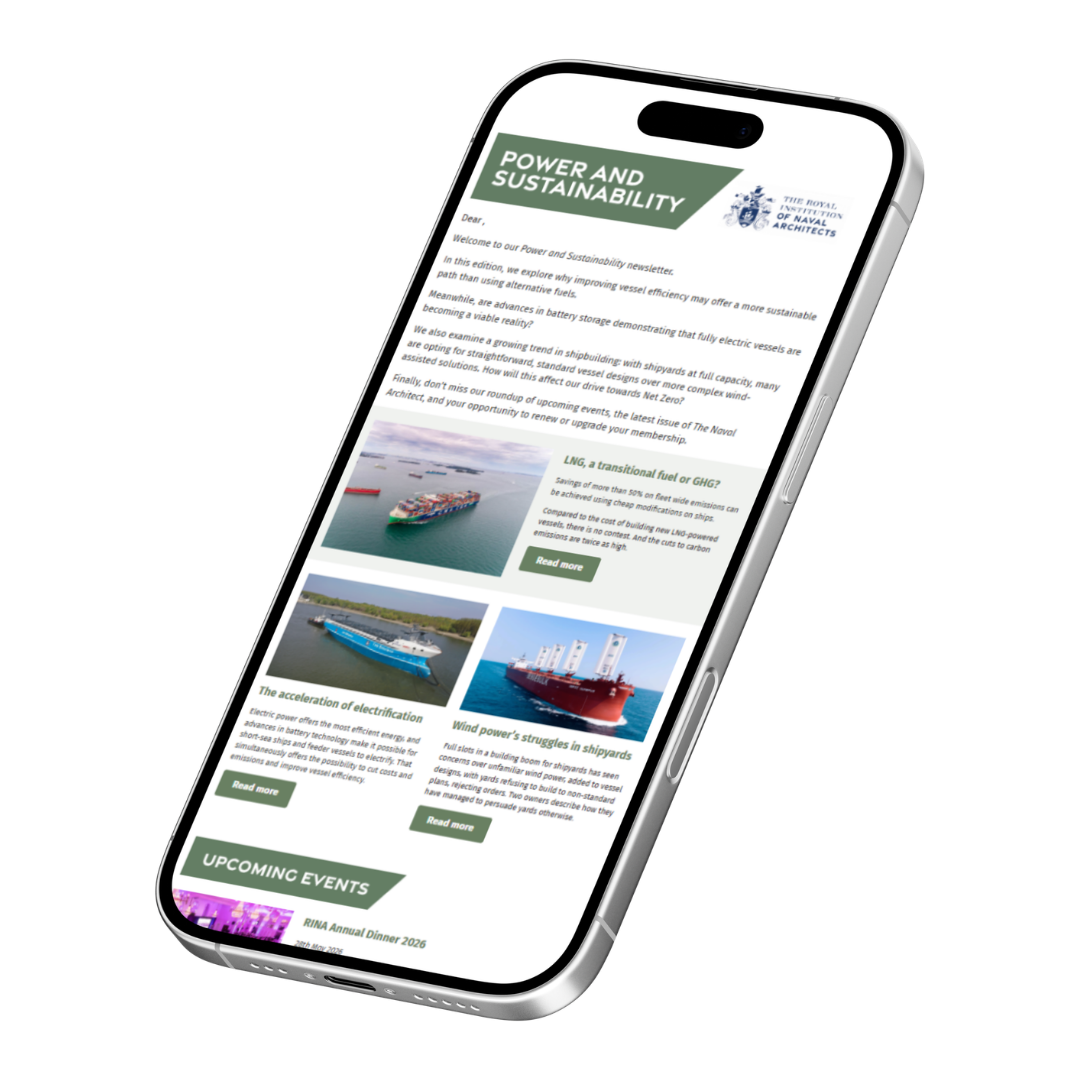
Newsletters
Stay connected with the global maritime community through RINA’s newsletters.
Whether you are a member or not, you can receive updates from The Naval Architect, alongside selected RINA news, events and industry insights. Members also gain access to a wider portfolio of exclusive newsletters on key topics in the maritime industry.