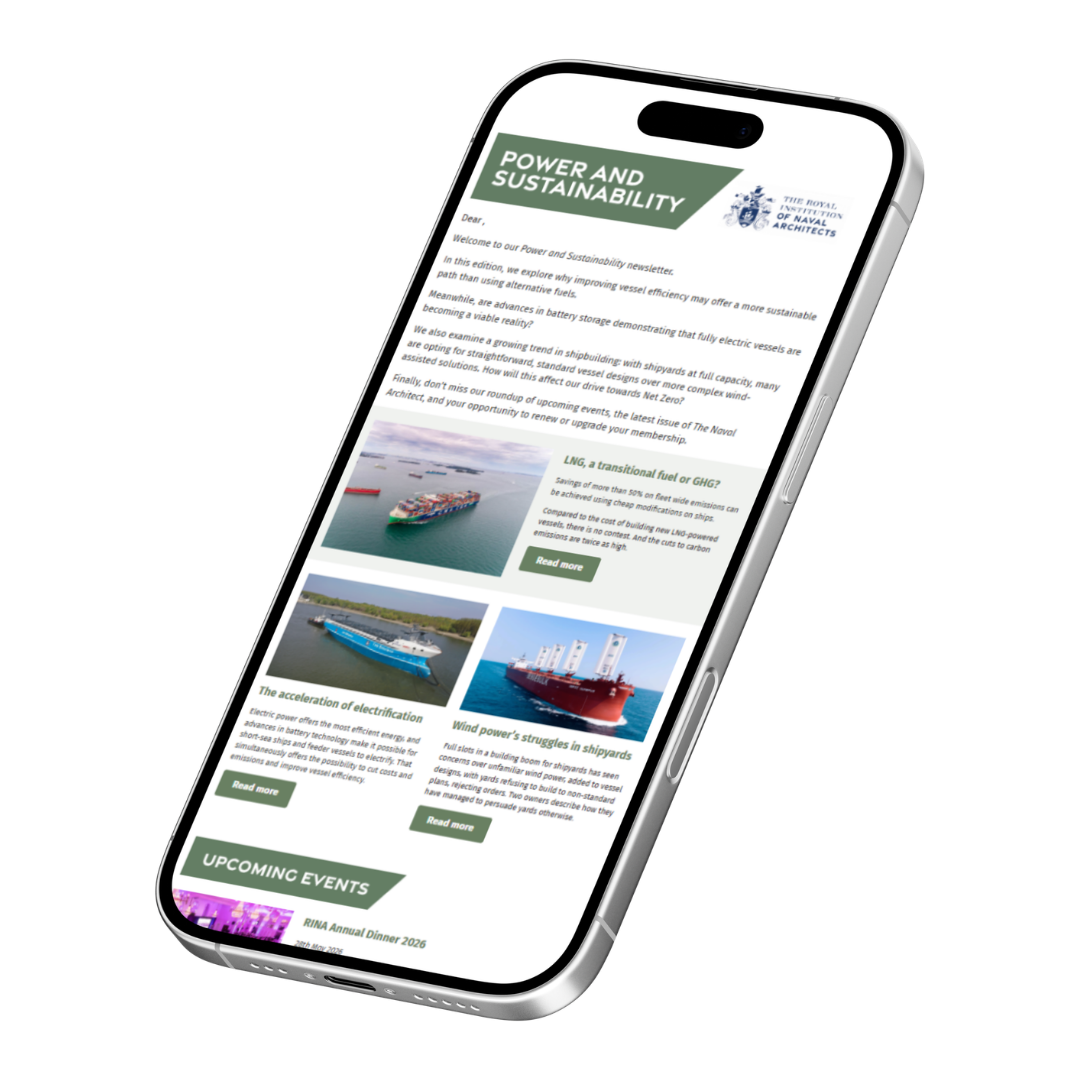
The Naval Architect provides in-depth information on all aspects of vessel design, construction and engineering. Practical applications of latest technology and case studies are accompanied by analysis and foresights. Published every two months, the magazine covers everything from superyachts and short-hop ferries to tankers and heavy-lift vessels; from battery pack installations and sail-assisted solutions to LNG tank retrofits; and from offshore safety to warship resilience.
DETERMINATION OF WAVE SLAMMING LOADS ON HIGH-SPEED CATAMARANS BY HYDROELASTIC SEGMENTED MODEL EXPERIMENTS
Transactions
Understanding the slamming behaviour of high-speed catamarans remains essential as operators seek to balance performance, structural integrity, and passenger comfort in demanding sea conditions. Enhanced knowledge of the relationship between vessel motions, wave conditions, and impact loads is supporting more accurate prediction of slamming events, helping to improve design methods and operational guidance for large wave-piercing catamarans.
OPPORTUNITIES FOR IMPROVED EFFICIENCY AND REDUCED CO2 EMISSIONS IN DRY BULK SHIPPING STEMMING FROM THE RELAXATION OF THE PANAMAX BEAM CONSTRAINT
Transactions
The expansion of the Panama Canal is creating new opportunities for vessel optimisation, allowing designers to move beyond longstanding dimensional constraints that have shaped ship development for decades. Growing interest in larger and more efficient dry bulk carriers highlights the potential for improved transport efficiency and reduced emissions, while wider benefits across other shipping sectors are expected to emerge as fleet designs evolve.
FATIGUE RELIABILITY ASSESSMENT OF WELDED JOINTS OF VERY FAST FERRY ACCOUNTING FOR VEHICLE LOADS
Transactions
Maintaining the long-term structural reliability of high-speed ferries requires careful assessment of fatigue damage under complex operational loading conditions. Increasing use of reliability-based design methods is improving understanding of how wave loads, transient operational effects, and corrosion influence fatigue performance, supporting more robust structural details and informed lifecycle management of lightweight marine structures.
COATINGS AND PERMANENT MEANS OF ACCESS - THE ANTI-CORROSION CHALLENGES
Transactions
New requirements for permanent means of access are increasing the complexity of ship structural design, construction, and lifecycle maintenance. Growing attention to accessibility, safety, and inspection requirements is driving the development of more integrated design approaches, balancing regulatory compliance with the practical challenges of coating application, cargo operations, structural integrity, and long-term vessel maintenance.
EFFECT OF DOUBLE BOTTOM HEIGHT ON THE STRUCTURAL BEHAVIOUR OF BULK CARRIERS
Transactions
The introduction of Common Structural Rules has renewed focus on the relationship between regulatory requirements and the long-term structural reliability of bulk carriers. Growing recognition of the safety implications of key design parameters, such as double-bottom height, is encouraging more robust design standards that balance structural efficiency with appropriate margins of reliability and operational safety.
PROPELLER CAVITATION AND INDUCED VIBRATION
Transactions
Growing demand for more efficient propeller designs is pushing marine propulsion systems closer to their performance limits, increasing the importance of managing cavitation, vibration, and noise. Greater understanding of propeller-hull interactions and mitigation technologies is helping designers improve propulsion efficiency while maintaining acceptable levels of structural integrity, operational reliability, and onboard comfort.
MODELING AND MEASUREMENT OF PARTICULATE MATTER (PM) COLLECTION FROM BOILER EXHAUST GAS IN ELECTROSTATIC WATER SPRAYING SCRUBBER
Transactions
Reducing emissions from combustion processes is becoming increasingly important as environmental regulations place tighter limits on particulate matter and other air pollutants. Advances in scrubber technology are improving the effectiveness of exhaust gas cleaning, with electrostatically enhanced systems demonstrating the potential to achieve high particulate-removal efficiencies while supporting cleaner and more sustainable industrial and maritime operations.
THE EXTENSION OF SYSTEM BOUNDARIES IN SHIP DESIGN
Transactions
Growing pressure to reduce greenhouse gas emissions is reshaping the way ships are designed, operated, and integrated into wider transport networks. Increasing emphasis on whole-system efficiency is encouraging closer alignment between vessel design and operational performance, driving the development of new design approaches that consider energy-saving technologies within the context of real-world transport requirements.
THEORETICAL METHOD OF THE OPTIMUM DESIGN OF A SUPERCAVITATING PROPELLER BLADE WITH SPOILER MOUNTED ON THE TRAILING EDGE
Transactions
Advances in high-performance propeller technology are driving the search for blade designs that can deliver greater efficiency under demanding operating conditions. Growing use of numerical optimisation and computational fluid dynamics is improving the development of supercavitating propellers, enabling designers to refine blade geometries and control devices to enhance hydrodynamic performance while accounting for complex flow effects.
Discussion: PROBABILISTIC SAFETY OF ESTUARY VESSELS BASED ON NONLINEAR ROLLING IN WIND AND WAVES
Transactions
Risk-based approaches to ship stability assessment are advancing understanding of how vessels respond to the combined effects of wind and waves in real operating environments. Growing confidence in probabilistic, performance-based methods is supporting the development of more flexible and realistic safety regulations, while encouraging closer integration of seakeeping analysis into operational decision-making and voyage planning.
Discussion: THE EXTENSION OF SYSTEM BOUNDARIES IN SHIP DESIGN
Transactions
Growing recognition that ship performance is shaped by factors extending well beyond the vessel itself is encouraging more holistic approaches to maritime system design. Increasing emphasis on lifecycle efficiency, transport networks, operational flexibility, and environmental performance is driving the expansion of ship design boundaries, supporting more integrated and sustainable solutions across the wider maritime sector.
AERODYNAMIC LIFT FORCES ON MULTIHULLED MARINE VEHICLES
Transactions
Growing interest in high-speed marine transport is driving the development of hybrid vessel concepts that combine the payload capacity of ships with some of the aerodynamic advantages of aircraft. Advances in aerodynamic lift-assisted hull design are demonstrating the potential for substantial reductions in resistance and energy demand, supporting more efficient operation of future high-speed craft.
Newsletters
Stay connected with the global maritime community through RINA’s newsletters.
Whether you are a member or not, you can receive updates from The Naval Architect, alongside selected RINA news, events and industry insights. Members also gain access to a wider portfolio of exclusive newsletters on key topics in the maritime industry.