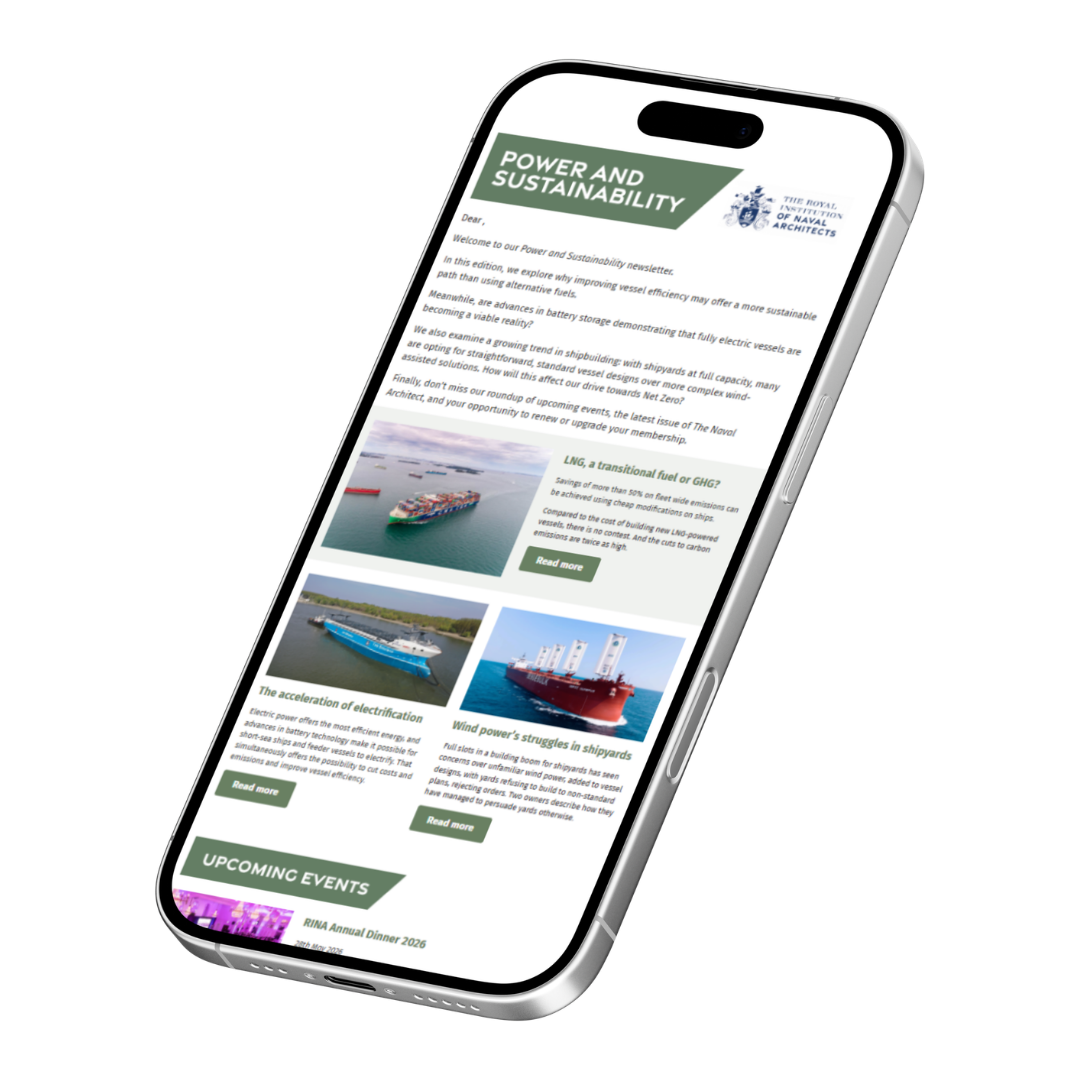
The Naval Architect provides in-depth information on all aspects of vessel design, construction and engineering. Practical applications of latest technology and case studies are accompanied by analysis and foresights. Published every two months, the magazine covers everything from superyachts and short-hop ferries to tankers and heavy-lift vessels; from battery pack installations and sail-assisted solutions to LNG tank retrofits; and from offshore safety to warship resilience.
AN EXPERIMENTAL STUDY OF SHIP MOTIONS DURING REPLENISHMENT AT SEA OPERATIONS BETWEEN A SUPPLY VESSEL AND A LANDING HELICOPTER DOCK
Transactions
Hydrodynamic interactions remain a key operational challenge during replenishment at sea, where vessel proximity can significantly influence motion and station-keeping performance. Understanding the effects of ship separation and wave conditions is essential for improving operator guidance, reducing operational risk and enhancing the safety and effectiveness of complex naval support operations.
PRESSURE-IMPULSE DIAGRAM OF THE FLNG TANKS UNDER SLOSHING LOADS
Transactions
Managing sloshing loads is a critical challenge for floating LNG production and storage facilities, where repeated impacts can threaten cargo tank integrity. Advanced probabilistic assessment and nonlinear structural analysis are improving understanding of damage tolerance, supporting more resilient containment system designs and enhancing confidence in the safe operation of offshore LNG assets.
FRICTIONAL DRAG REDUCTION: REVIEW AND NUMERICAL INVESTIGATION OF MICROBUBBLE DRAG REDUCTION IN A CHANNEL FLOW
Transactions
Reducing frictional resistance remains one of the maritime sector’s most promising routes to lower emissions and operating costs. Microbubble drag reduction is attracting growing interest, with advances in air-lubrication technology and numerical modelling improving understanding of bubble behaviour, system performance and the practical challenges of translating drag reduction into net energy savings.
A FUZZY DEMATEL MODEL PROPOSAL FOR THE CAUSE AND EFFECT OF THE FAULT OCCURRING IN THE AUXILIARY SYSTEMS OF THE SHIPS' MAIN ENGINE
Transactions
Engine room reliability depends not only on fault detection but also on understanding how failures propagate across interconnected systems. Advanced cause-and-effect analysis highlights the critical influence of fuel and cooling-system components, supporting more informed maintenance priorities, improved operational resilience and stronger protection against costly equipment failures at sea.
EFFECT OF THE BOUNDARY CONDITIONS ON THE DYNAMIC BEHAVIOURS OF SUBSEA FREE-SPANNING PIPELINES
Transactions
Subsea free-spanning pipelines face complex vibration and stability challenges when exposed to ocean currents and fluid flow. Advanced fluid-structure interaction modelling and analytical techniques are enhancing the prediction of dynamic behaviour across varying support conditions, supporting more reliable infrastructure design, improved integrity management and safer long-term operation of critical subsea assets.
ANALYTICAL AND EXPERIMENTAL INVESTIGATION ON THE FREE VIBRATION OF SUBMERGED STIFFENED STEEL PLATE
Transactions
Understanding how submerged structures respond to fluid interaction is essential for reliable marine and offshore design. By combining experimental testing, analytical modelling and numerical simulation, improved prediction of vibration characteristics and added-mass effects is helping engineers enhance structural performance, validate design assumptions and increase confidence in complex underwater applications.
Discussion: VISCOSITY IN SEAKEEPING
Transactions
Achieving accurate seakeeping predictions requires careful consideration of the balance between physical realism and computational complexity. Ongoing debate around viscosity, turbulence modelling and hydrodynamic damping reflects broader challenges in naval hydrodynamics, with implications for CFD practice, ship motion prediction and the future development of efficient analysis methods.
A RESEARCH ON TECHNIQUES, MODELS AND METHODS PROPOSED FOR SHIP COLLISION AVOIDANCE PATH PLANNING PROBLEM
Transactions
Improving ship collision avoidance remains a key priority as maritime operations become increasingly complex and autonomous. Artificial intelligence, fuzzy logic and heuristic optimisation techniques are playing an expanding role in path planning, enabling safer navigation and greater fuel efficiency while shaping the next generation of intelligent decision-support and autonomous vessel technologies.
VISCOSITY IN SEAKEEPING
Transactions
Accurate prediction of ship motions in waves depends on reliable estimation of hydrodynamic coefficients and the physical assumptions that underpin them. Questions around the role of viscosity, turbulence modelling and computational efficiency continue to influence seakeeping analysis, with implications for simulation accuracy, software application and the development of practical engineering methodologies.
PERSPECTIVES FOR A WIND ASSISTED SHIP PROPULSION
Transactions
Wind-assisted propulsion is emerging as a viable pathway to reducing fuel consumption and emissions in commercial shipping. Technologies such as kites, Flettner rotors and Dynarig sails can deliver greater benefits when paired with route optimisation, creating new opportunities to balance operational efficiency, voyage planning and evolving environmental requirements.
AN ICOR APPROACH TOWARDS SHIP MAINTENANCE SOFTWARE DEVELOPMENT
Transactions
Effective maintenance remains fundamental to safe, reliable and efficient ship operations. Opportunities to improve workload balancing, scheduling and onboard safety are driving the evolution of planned maintenance systems, while smarter software-enabled processes are helping operators enhance equipment reliability, streamline maintenance activities and support more effective fleet management.
A METHODOLOGY TO SUPPORT EARLY STAGE OFF-THE-SHELF NAVAL VESSEL ACQUISITIONS
Transactions
Model-Based Systems Engineering is helping bring greater rigour and traceability to naval vessel acquisition. By combining set-based design, requirements exploration and multi-criteria decision-making, the approach supports more informed evaluation of off-the-shelf solutions, reducing acquisition risk while improving alignment between capability needs, procurement decisions and long-term operational objectives.
Newsletters
Stay connected with the global maritime community through RINA’s newsletters.
Whether you are a member or not, you can receive updates from The Naval Architect, alongside selected RINA news, events and industry insights. Members also gain access to a wider portfolio of exclusive newsletters on key topics in the maritime industry.