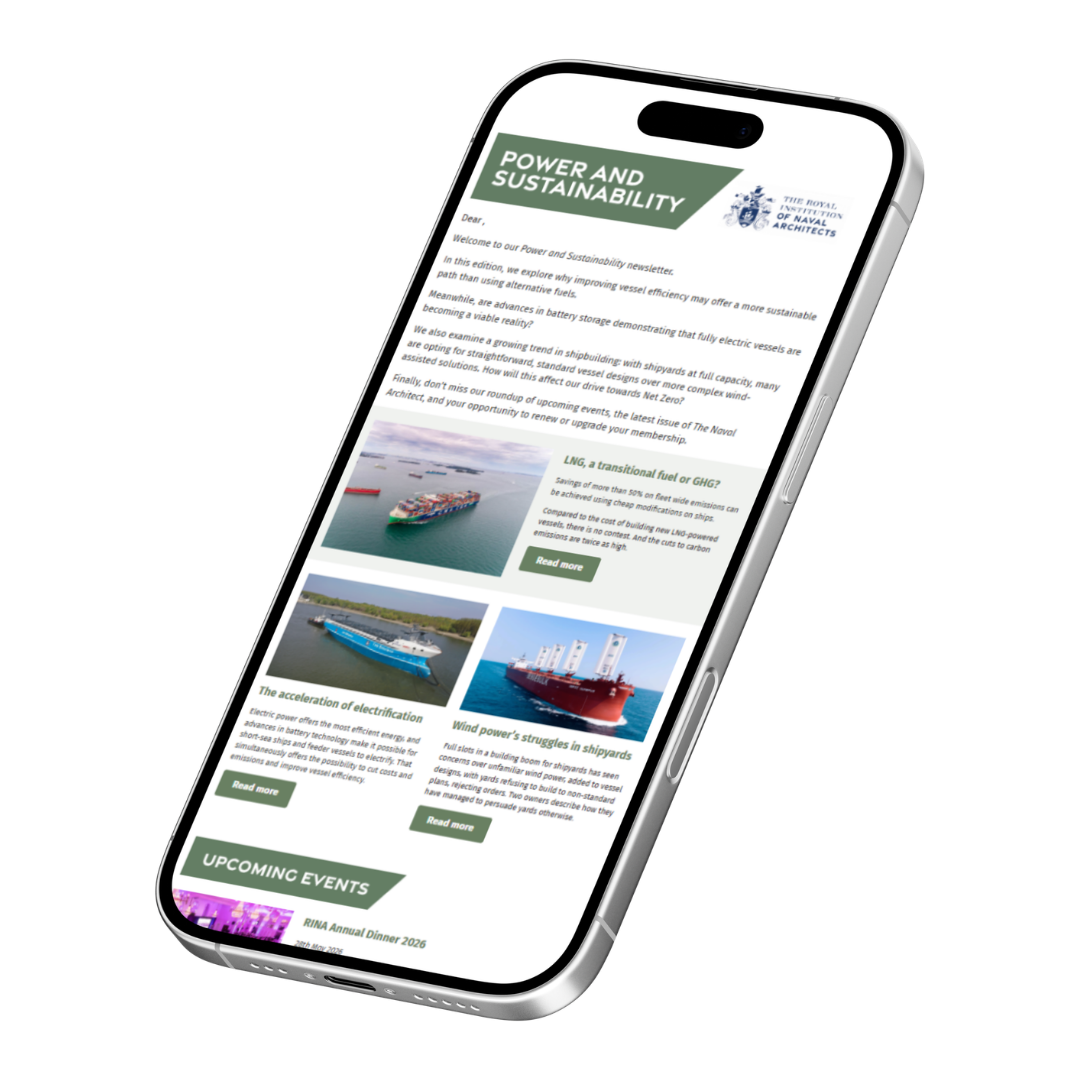
The Naval Architect provides in-depth information on all aspects of vessel design, construction and engineering. Practical applications of latest technology and case studies are accompanied by analysis and foresights. Published every two months, the magazine covers everything from superyachts and short-hop ferries to tankers and heavy-lift vessels; from battery pack installations and sail-assisted solutions to LNG tank retrofits; and from offshore safety to warship resilience.
STUDY OF AIRFLOW AROUND SHIP WITH RIGID SAIL ARRAY AND POTENTIAL ARRAY PROPULSIVE POWER
Transactions
Harnessing wind as a supplementary propulsion source, rigid sail technology offers a promising route to lower fuel consumption and emissions in commercial shipping. Advanced virtual wind tunnel and CFD modelling reveal how multi-sail configurations can generate meaningful propulsive forces, supporting the transition towards more energy-efficient and sustainable vessel operations.
HIGH-SPEED WAVE-PIERCING CATAMARAN GLOBAL LOADS DETERMINED BY FEA AND SEA TRIALS
Transactions
Accurately predicting global loads remains a critical challenge for high-speed wave-piercing catamarans operating in realistic sea conditions. Combining full-scale trial data, strain sensing and finite-element modelling improves understanding of complex structural loads, supporting more efficient designs, enhanced reliability and greater confidence in the load assumptions used during vessel development.
AN EFFICIENT GRAPH THEORY-BASED ALGORITHM FOR SHIP TRAJECTORY PLANNING
Transactions
Autonomous navigation is advancing through fast, graph-based path planning techniques designed for dynamic marine environments. By combining visibility graphs with the A* algorithm, the approach delivers collision-free route optimisation within seconds, offering a practical foundation for intelligent ship control systems operating amid changing conditions and navigational constraints.
ENERGY EFFICIENCY BASED OPERATION OF COMPRESSED AIR SYSTEM ON SHIPS TO REDUCE FUEL CONSUMPTION AND CO2 EMISSION
Transactions
Compressed air systems represent a significant opportunity to improve maritime energy efficiency. Optimising operating pressure and reducing leakage can deliver substantial savings in power, fuel and emissions, while improving system performance. Greater attention to compressed air management could unlock meaningful operational and environmental benefits as ship operators pursue lower costs and improved sustainability.
CONTROL OF REMOTELY OPERATED UNDERWATER VEHICLE USING MODEL PREDICTIVE CONTROL
Transactions
Autonomous and remotely operated underwater systems are benefiting from more advanced control techniques capable of handling complex, nonlinear behaviour and operational uncertainty. Model predictive control offers enhanced trajectory tracking and stability compared with traditional approaches, strengthening the capabilities of underwater vehicles used in scientific research, defence operations and ocean exploration.
DEVELOPMENT OF A MATHEMATICAL MODEL FOR PERFORMANCE PREDICTION OF PLANING CATAMARAN IN CALM WATER
Transactions
High-speed planing catamarans present unique hydrodynamic challenges, where interactions between closely spaced hulls can significantly influence performance. Improved prediction of lift, resistance and trim behaviour supports more efficient hull optimisation, while insights into hull geometry and separation effects offer opportunities to enhance speed, stability and overall vessel efficiency.
Technical Note: FLAME SPREAD AND SMOKE & TOXICITY TESTING INTERPRETATIONS FOR PLASTIC PIPES
Transactions
Lightweight composite materials are creating new opportunities for ship design, but questions remain around the consistency of fire-safety assessment and regulatory interpretation. Flame spread, smoke and toxicity performance are critical considerations, with greater clarity needed to support safe adoption, consistent compliance and broader use of advanced materials across the maritime sector.
THE CLASSIFICATION OF PIPE-LAY VESSELS AND HEAVY-LIFT CRANE VESSELS
Transactions
Specialist pipe-lay and heavy-lift vessels present unique safety and assurance challenges that extend beyond conventional ship operations. Classification choices, station-keeping performance, structural integrity, safety-critical systems and onboard chemical management all play vital roles in reducing risk, protecting the environment and enabling increasingly complex offshore operations.
Discussion: EXPERIMENTAL AND NUMERICAL MODAL ANALYSIS OF COMPOSITE LAMINATED SHELLS WITH CUT-OUT
Transactions
How do cutouts affect the performance of laminated composite shells in demanding marine and aerospace environments? Combining laboratory resin-infusion manufacturing, free-vibration testing and validated numerical simulation, researchers revealed key dynamic behaviour patterns. Advanced mass-matrix modelling with rotary inertia and modal assurance verification offers insights for more reliable, maintainable structural designs.
Discussion: EXPERIMENTAL AND NUMERICAL MODAL ANALYSIS OF COMPOSITE LAMINATED SHELLS WITH CUT-OUT - Copy
Transactions
How do cutouts affect the performance of laminated composite shells in demanding marine and aerospace environments? Combining laboratory resin-infusion manufacturing, free-vibration testing and validated numerical simulation, researchers revealed key dynamic behaviour patterns. Advanced mass-matrix modelling with rotary inertia and modal assurance verification offers insights for more reliable, maintainable structural designs.
THE RE-DESIGN OF A MARINE ENGINE ROOM SIMULATOR IN CONSIDERATION TO ERGONOMICS DESIGN PRINCIPLES - Copy
Transactions
How can simulator design influence engineering competence? By applying ergonomic principles to a full-mission engine room simulator, a redesigned mimic panel improved realism, usability and training effectiveness. The experience highlights how human-centred design can enhance operational learning environments and strengthen the quality of marine engineering education and professional preparedness.
STATIC CONTROL OF DRAG-REDUCING AIR CAVITIES WITH VARIABLE CAVITATOR SHAPE - Copy
Transactions
Air-cavity drag reduction is moving closer to practical deployment through research linking cavity performance to controllable hydrodynamic actuators and wedge-shaped cavitators. Using potential-flow modelling, new insights into optimal operating conditions reveal how flow speed and hull trim influence efficiency gains, supporting more energy-efficient ship designs.
Newsletters
Stay connected with the global maritime community through RINA’s newsletters.
Whether you are a member or not, you can receive updates from The Naval Architect, alongside selected RINA news, events and industry insights. Members also gain access to a wider portfolio of exclusive newsletters on key topics in the maritime industry.