

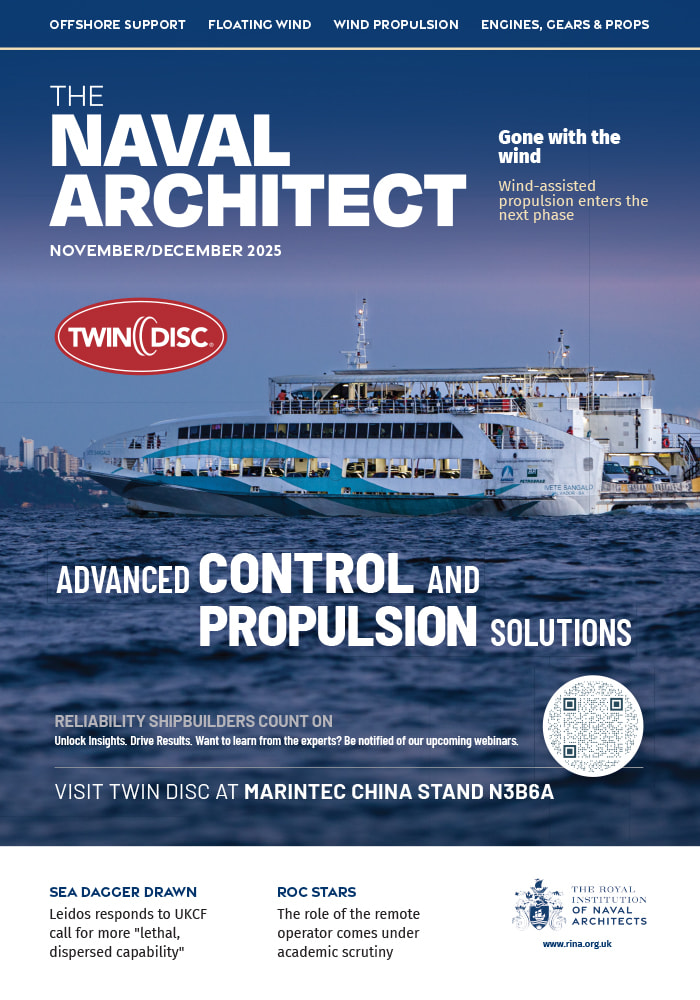
November/December 2025
The last issue of this year's Naval Architect is now available to read online and in print. Highlights from this issue:
Offshore Support
Floating Wind
Wind Propulsion
Engines, Gears & Props
Want to keep up to date with the latest news and developments in the maritime industry? Full articles and in-depth analysis are exclusively available to all RINA members & subscribers.
Discussion: PREDICTION OF NAVAL SHIP BALLAST TANK CORROSION USING OPERATIONAL PROFILES
Transactions
Effective management of structural degradation is becoming increasingly important as ship owners and operators seek to extend vessel service life while maintaining safety, reliability, and cost efficiency. Advances in corrosion prediction methodologies that incorporate operational profiles and environmental exposure are improving the ability to forecast structural deterioration, supporting more informed maintenance planning, risk management, and lifecycle optimisation of marine assets.
Technical note: PERFORMANCE MAPPING OF BUBBLY WATER RAMJET
Transactions
Novel marine propulsion concepts continue to attract interest as designers seek alternatives that can deliver high efficiency, reduced emissions, and improved performance across a range of operating conditions. Theoretical investigations into two-phase bubbly water ramjet propulsion are expanding understanding of unconventional propulsion mechanisms, demonstrating the potential for high propulsive efficiencies and providing a foundation for future evaluation of their practical application to marine vehicles.
THE ART AND SCIENCE OF SHIP DESIGN
Transactions
Ship design has long been regarded as a discipline that combines rigorous engineering analysis with creative problem-solving. While scientific methods underpin the prediction of performance, strength, stability, and seakeeping, the synthesis of these diverse requirements into a coherent vessel concept remains a fundamentally creative endeavour. Advances in computer-aided design, interactive visualisation, and simulation technologies are increasingly integrating the artistic and scientific aspects of ship design, enabling designers to explore innovative solutions more effectively while maintaining robust engineering foundations.
RECOMMENDATIONS ON THE NATURE OF THE PASSENGER RESPONSE TIME DISTRIBUTION TO BE USED IN THE MSC 1033 ASSEMBLY TIME ANALYSIS BASED ON DATA DERIVED FROM SEA TRIALS
Transactions
Efficient evacuation and passenger assembly procedures are fundamental to the safety of modern passenger ships, making it essential that assessment methodologies reflect realistic human behaviour during emergencies. Evidence from full-scale trials is improving understanding of passenger response characteristics, highlighting the importance of data-driven response-time models and supporting the refinement of evacuation analyses used in maritime safety regulations and passenger ship design.
A PRACTICAL AND ROBUST METHOD TO EXPERIMENTALLY DETERMINE THE LOCATION OF THE REGION OF TRANSITION FROM LAMINAR TO TURBULENT FLOW ON A TOWED BODY
Transactions
Accurate identification of laminar-to-turbulent flow transition remains important in hydrodynamic testing, as the extent of turbulent flow can significantly influence drag measurements and the scaling of model-test results to full-size vessels. The development of practical and robust transition-detection techniques for towing-tank experiments is improving understanding of boundary-layer behaviour, supporting more reliable resistance assessments and enhancing the quality of experimental hydrodynamic investigations.