

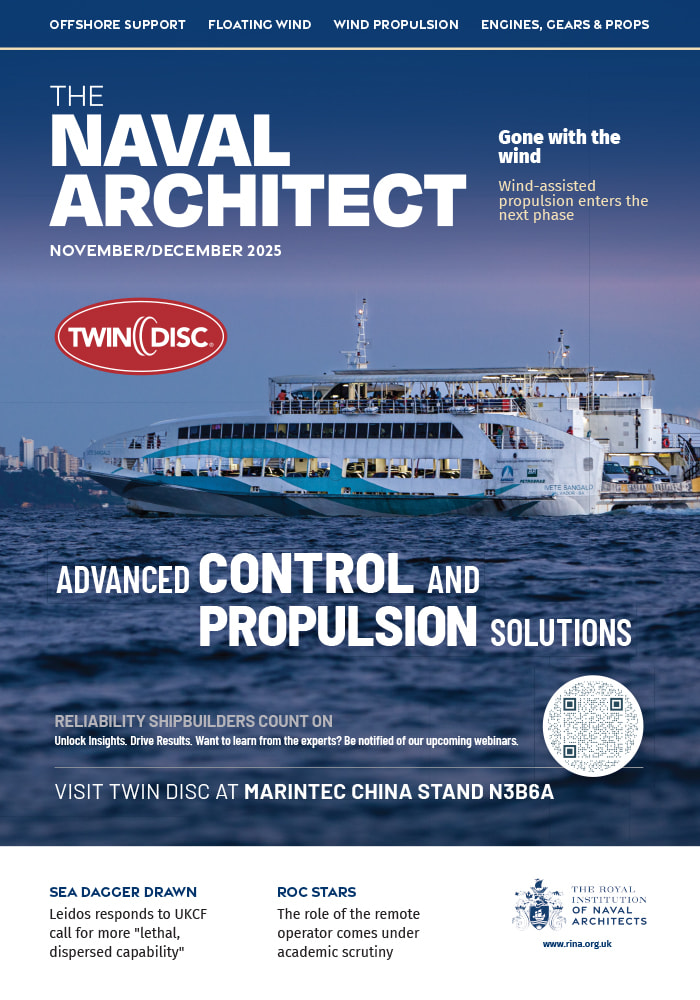
November/December 2025
The last issue of this year's Naval Architect is now available to read online and in print. Highlights from this issue:
Offshore Support
Floating Wind
Wind Propulsion
Engines, Gears & Props
Want to keep up to date with the latest news and developments in the maritime industry? Full articles and in-depth analysis are exclusively available to all RINA members & subscribers.
Discussion: NAVAL ARCHITECTURE AND SYSTEM ENGINEERING: A DEAL FOR NAVAL SHIP DESIGN EVOLUTION
Transactions
The integration of systems engineering principles into naval ship design reflects the growing complexity of modern warships and the need for more holistic approaches to capability development. Increasing recognition of the importance of lifecycle thinking, multidisciplinary collaboration, and informed decision-making is encouraging closer alignment between systems engineering and naval architecture, while reinforcing the continuing central role of human judgement, creativity, and professional expertise in the ship design process.
THE VIBRATORY RESPONSE OF HIGH-SPEED CATAMARANS TO SLAMMING INVESTIGATED BY HYDROELASTIC SEGMENTED MODEL EXPERIMENTS
Transactions
High-speed catamarans are particularly susceptible to slamming-induced structural vibrations, making accurate prediction of hydroelastic responses an important aspect of vessel design and operational assessment. Continued research into whipping behaviour, structural dynamics, and fluid-structure interaction is improving understanding of how factors such as stiffness, mass distribution, forward speed, and wave conditions influence vibratory loading, supporting the development of safer, more reliable, and more efficient high-speed craft.
MARITIME VOYAGE DATA RECORDER STUDY BY THE EUROPEAN MARITIME DATA MANAGEMENT PROJECT
Transactions
Advances in voyage data recording technology are creating new opportunities to enhance maritime safety, operational performance, and accident investigation. Growing interest in using Voyage Data Recorder information for proactive monitoring, automated analysis, and human-factors assessment is supporting a transition from purely investigative applications towards tools that can help operators identify risks, improve decision-making, and strengthen safety management practices.
SIMULATING POSSIBLE SAVINGS OF THE SKYSAILS-SYSTEM ON INTERNATIONAL MERCHANT SHIP FLEETS
Transactions
Growing pressure to reduce fuel consumption and greenhouse-gas emissions is driving renewed interest in wind-assisted propulsion technologies as practical supplements to conventional marine power systems. Full-scale evaluation of automated towing-kite systems has demonstrated their potential to harness renewable wind energy, enabling meaningful reductions in fuel use, operating costs, and emissions while supporting more sustainable and energy-efficient shipping operations.
AN SPH TECHNIQUE FOR EVALUATING THE BEHAVIOUR OF SHIPS IN EXTREME OCEAN WAVES
Transactions
As ships are increasingly required to operate safely in extreme sea states, the ability to accurately predict the complex interaction between large waves and vessel structures has become a key area of research. Advances in coupled hydrodynamic and structural simulation techniques are enhancing understanding of wave-induced loads, structural responses, and wave-breaking effects, supporting improved assessments of ship safety, survivability, and structural performance in severe ocean conditions.