

November/December 2025
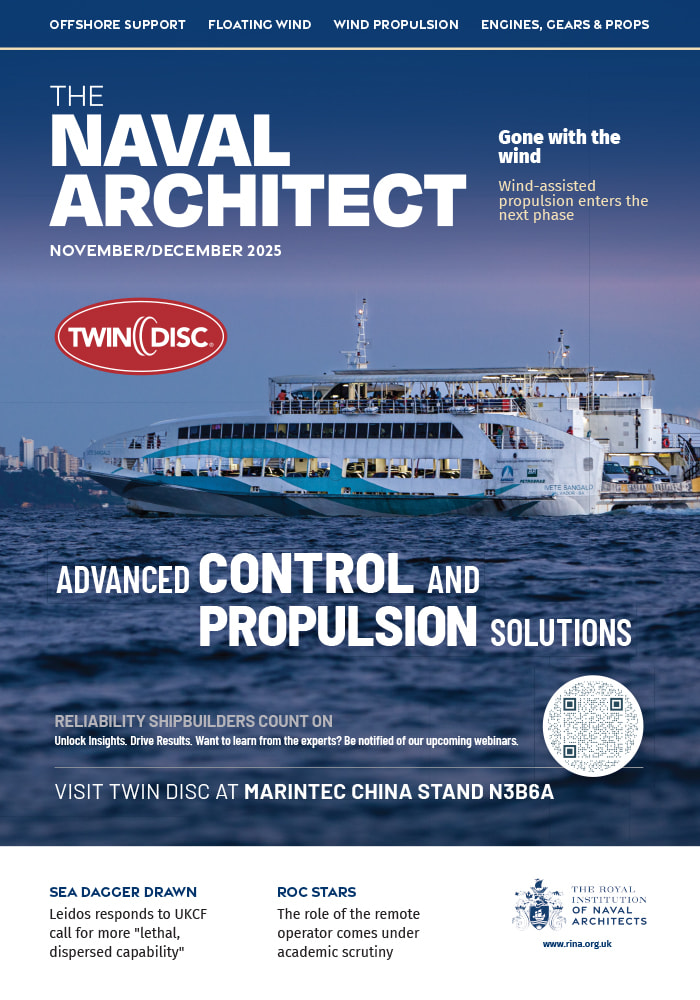
The last issue of this year's Naval Architect is now available to read online and in print. Highlights from this issue:
Offshore Support
Floating Wind
Wind Propulsion
Engines, Gears & Props
Want to keep up to date with the latest news and developments in the maritime industry? Full articles and in-depth analysis are exclusively available to all RINA members & subscribers.
Discussion: OFFSHORE AND COASTAL FLOATING HOTELS: FLOTELS
Transactions
Growing demand for offshore accommodation is driving the development of increasingly specialised floating hotel concepts, tailored to environments ranging from sheltered coastal locations to deep-water energy developments. Emerging designs are placing greater emphasis on operability, comfort, and cost efficiency, reflecting the expanding role of floating accommodation in offshore industry, infrastructure, and maritime development.
SUBCRITICAL WAVE WAKE UNSTEADINESS
Transactions
Technical Note: STATIC STABILITY OF AERODYNAMICALLY SUPPORTED PLATFORMS MOVING ABOVE WATER
Transactions
Understanding the stability of high-speed marine vehicles that rely on aerodynamic lift remains a critical challenge as designers explore alternative concepts for fast and efficient over-water transport. Improved insight into the interaction between vehicle geometry, operating conditions, and surface effects is helping to refine stability assessments, supporting the development of safer and more effective ground-effect and air-cushioned marine platforms.
COMPARISON OF LAND-BASED TEST SETUPS FOR A BALLAST WATER MANAGEMENT SYSTEM
Transactions
Effective ballast water management is becoming increasingly important as regulators and operators seek to prevent the spread of invasive aquatic species through global shipping networks. Experience from land-based testing is highlighting the importance of consistent testing procedures and facility configurations, demonstrating how variations in test conditions can influence system performance assessments and regulatory compliance outcomes.
DETERMINATION OF WAVE SLAMMING LOADS ON HIGH-SPEED CATAMARANS BY HYDROELASTIC SEGMENTED MODEL EXPERIMENTS
Transactions
Understanding the slamming behaviour of high-speed catamarans remains essential as operators seek to balance performance, structural integrity, and passenger comfort in demanding sea conditions. Enhanced knowledge of the relationship between vessel motions, wave conditions, and impact loads is supporting more accurate prediction of slamming events, helping to improve design methods and operational guidance for large wave-piercing catamarans.