

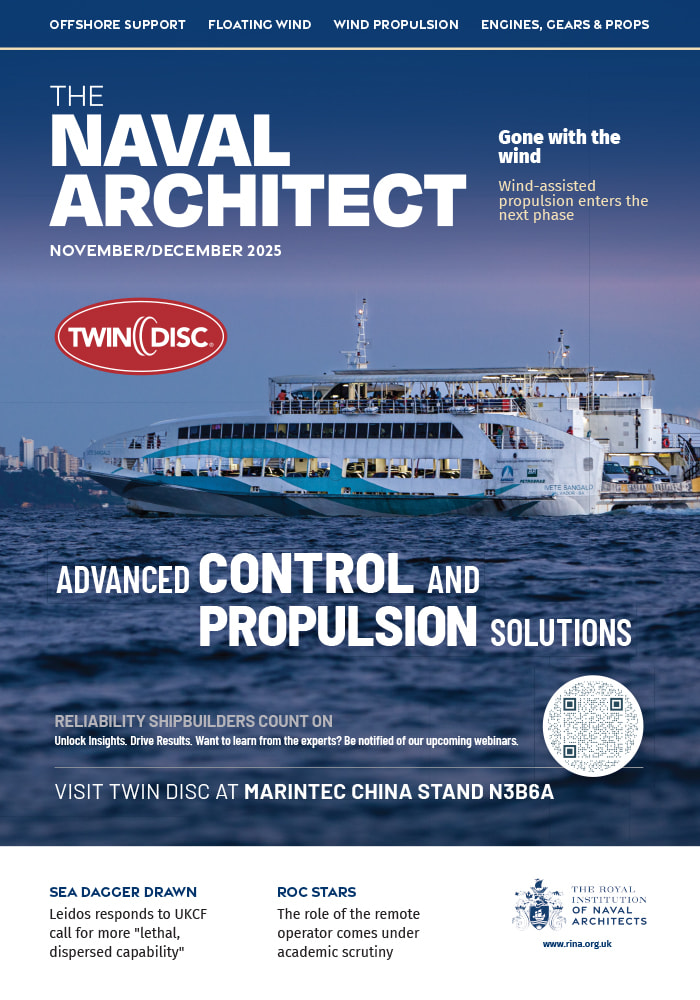
November/December 2025
The last issue of this year's Naval Architect is now available to read online and in print. Highlights from this issue:
Offshore Support
Floating Wind
Wind Propulsion
Engines, Gears & Props
Want to keep up to date with the latest news and developments in the maritime industry? Full articles and in-depth analysis are exclusively available to all RINA members & subscribers.
Discussion: 150 YEARS OF SHIP DESIGN
Transactions
Discussion: EXPERIMENTAL AND NUMERICAL STUDY ON PROGRESSIVE FLOODING IN FULL-SCALE
Transactions
Improving confidence in damage-stability assessments depends on a clear understanding of how flooding progresses through complex internal spaces and how accurately this behaviour can be modelled. Growing reliance on numerical flooding simulations is increasing the demand for robust validation data, with full-scale experiments playing an important role in refining prediction methods and supporting more reliable survivability assessments.
SOLAS 2009 STABILITY REQUIREMENTS: IMPLEMENTATION
Transactions
The transition towards risk-based safety regulation is reshaping the way ship survivability is assessed, particularly for complex vessel types such as passenger ships. Growing industry experience with probabilistic damage-stability requirements is highlighting both the opportunities and challenges of implementing performance-based approaches, driving ongoing development of assessment methodologies, approval processes, and supporting design standards.
SHAFT LOADS ON AZIMUTH PROPULSORS IN OBLIQUE FLOW AND WAVES
Transactions
As propulsion systems become more advanced and manoeuvrability demands increase, understanding the loads acting on azimuth thrusters is essential for reliable vessel design. Greater insight into the influence of hull wake, operating conditions, and sea state is helping to improve the mechanical design and sizing of propulsion components, supporting more robust and efficient vessel operations.
Technical Note: OFFSHORE AND COASTAL FLOATING HOTELS: FLOTELS
Transactions
Providing accommodation at sea has evolved into a highly specialised sector, with floating accommodation solutions adapting to a wide range of operational and environmental requirements. Growing demand for offshore support and waterfront development is driving the use of increasingly diverse flotel concepts, highlighting how vessel design must be tailored to location, operating conditions, and intended use.
MARINE REQUIREMENTS ELUCIDATION AND THE NATURE OF PRELIMINARY SHIP DESIGN
Transactions
Defining requirements for complex naval vessels remains one of the most challenging aspects of ship acquisition, requiring a balance between operational aspirations, technical feasibility, and affordability. Growing recognition of the iterative relationship between requirements and design is encouraging more integrated approaches to concept development, where stakeholder needs and potential solutions evolve together to inform better long-term decisions.