

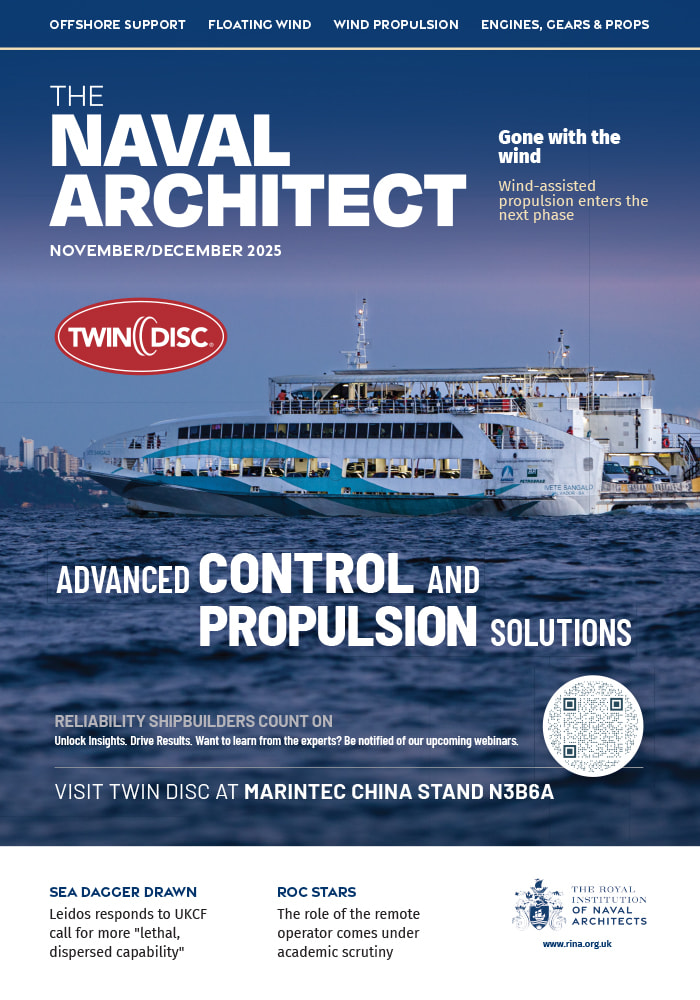
November/December 2025
The last issue of this year's Naval Architect is now available to read online and in print. Highlights from this issue:
Offshore Support
Floating Wind
Wind Propulsion
Engines, Gears & Props
Want to keep up to date with the latest news and developments in the maritime industry? Full articles and in-depth analysis are exclusively available to all RINA members & subscribers.
MEASURED LOADING RESPONSE OF MODEL MOTION CONTROL STERN TABS
Transactions
Active trim tabs are a key element of ride control systems on high-speed catamarans, but their hydrodynamic behaviour is more complex than conventional assumptions suggest. Experimental testing reveals that stern-tab effectiveness depends not only on tab angle and speed but also on pressure interactions beneath the hull, offering important insights for improving vessel stability, efficiency, and motion-control performance.
FATIGUE ASSESSMENT OF CORRODED DECK LONGITUDINALS OF TANKERS
Transactions
Structural ageing and fatigue remain major challenges for oil tankers, where long-term crack growth can threaten reliability and safety. By combining fracture-mechanics modelling with corrosion progression analysis, engineers gain a clearer understanding of how degradation influences structural life, highlighting the importance of integrating fatigue and corrosion effects into maintenance planning, inspection strategies, and asset management.
FAULT TREE ANALYSIS (FTA) - FORMAL SAFETY ASSESSMENT (FSA) IN SHIP REPAIR INDUSTRY A MADE EASY APPROACH
Transactions
As shipyard operations become increasingly complex, understanding and managing safety risks requires approaches that go beyond traditional incident analysis. By combining fault-tree modelling with Formal Safety Assessment in a more structured framework, new methods are identifying hidden interactions and systemic causes of accidents, supporting more effective risk management, regulatory development, and workplace safety improvement.
PASSENGER RESPONSE TIME DATA-SETS FOR LARGE PASSENGER FERRIES AND CRUISE SHIPS DERIVED FROM SEA TRIALS
Transactions
Passenger safety analysis is becoming increasingly data-driven as evacuation modelling plays a larger role in vessel design and regulation. Drawing on the largest collection of full-scale passenger response data gathered at sea, new evidence suggests that evacuation behaviour varies significantly between ship types, challenging one-size-fits-all assumptions and supporting more realistic emergency preparedness standards.