

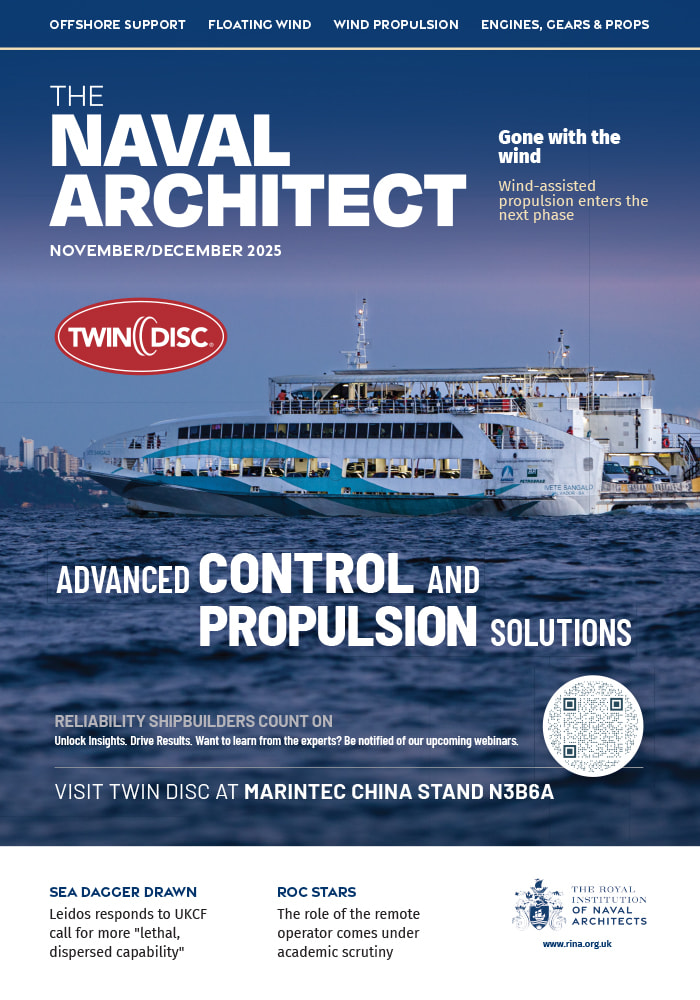
November/December 2025
The last issue of this year's Naval Architect is now available to read online and in print. Highlights from this issue:
Offshore Support
Floating Wind
Wind Propulsion
Engines, Gears & Props
Want to keep up to date with the latest news and developments in the maritime industry? Full articles and in-depth analysis are exclusively available to all RINA members & subscribers.
SPECIAL CONSUMPTION TAX INCENTIVE ON MARINE BUNKERS AND CARGO SHIFTING TO SHORT SEA SHIPPING IN TURKISH CABOTAGE ROUTES
Transactions
As governments and industries seek practical pathways to lower carbon emissions, transport mode selection is gaining renewed strategic importance. Analysis of maritime fuel use and freight movement patterns highlights the environmental advantages of shipping, underscoring how modal shifts and fuel-efficiency improvements could play a significant role in broader decarbonisation efforts.
ANCHOR WINDLASSES: A DESIGN PROPOSAL TO STANDARDISE REGULATIONS
Transactions
As shipbuilders seek to balance customisation, compliance, and cost competitiveness, standardisation is emerging as a powerful lever for efficiency. Harmonising regulatory requirements and equipment design could reduce complexity, unlock economies of scale, and help manufacturers deliver more cost-effective solutions without compromising the operational needs of vessel owners.
APPLICATION OF FUZZY ANALYTIC HIERARCHY PROSES FOR ERROR DETECTION OF AUXILARY SYSTEMS OF SHIP MAIN DIESEL ENGINES
Transactions
Engine room reliability remains fundamental to safe and efficient vessel operations, where minor faults can quickly escalate into costly failures. Applying fuzzy decision-making techniques to fault diagnosis and maintenance planning helps prioritise critical systems, highlighting the growing role of data-driven decision support in improving operational resilience and engineering performance.
INVESTIGATION OF OIL TANKER ACCIDENTS BY USING GIS
Transactions
Oil tanker safety remains a critical concern at key global trade chokepoints, where navigational complexity and traffic density can amplify operational risk. By transforming historical accident records into geospatial intelligence, emerging analytical approaches are uncovering patterns in accident occurrence, offering fresh perspectives on risk concentration, route management, and maritime safety planning.
COMPARISON BETWEEN DIFFERENT SURVIVABILITY MEASURES ON A GENERIC FRIGATE
Transactions
Ship survivability is increasingly recognised as a design challenge that extends far beyond structural protection alone. Emerging approaches show that survivability outcomes depend heavily on how threats are defined and assessed, highlighting the importance of evaluating impacts across multiple ship functions and incorporating uncertainty into early-stage design decisions.