

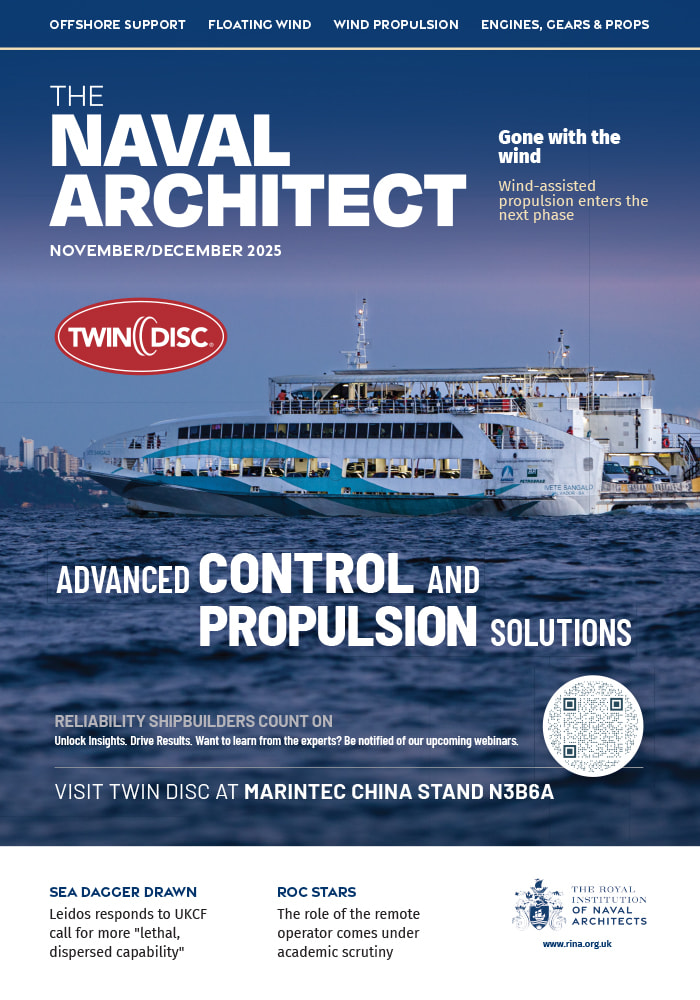
November/December 2025
The last issue of this year's Naval Architect is now available to read online and in print. Highlights from this issue:
Offshore Support
Floating Wind
Wind Propulsion
Engines, Gears & Props
Want to keep up to date with the latest news and developments in the maritime industry? Full articles and in-depth analysis are exclusively available to all RINA members & subscribers.
ON THE SAFE PILOTAGE OF SHIP'S WITH PROPULSION THAT CAN AZIMUTH FOR STEERING
Transactions
As azimuth propulsion transforms vessel manoeuvrability across the maritime sector, operational practices and workforce knowledge are struggling to keep pace with technological change. Growing experience from accidents, incidents, and training initiatives highlights the need for greater standardisation, stronger competency development, and closer alignment between ship design and operational reality.
BUCKLING AND POST-BUCKLING OF ISOTROPIC AND COMPOSITE STIFFENED PANELS: A REVIEW ON ANALYSIS AND EXPERIMENT (2000-2012)
Transactions
As demand grows for lighter and stronger engineering structures, understanding buckling behaviour is becoming increasingly important to design performance and safety. Advances in the analysis of stiffened metallic and composite panels are reshaping approaches to structural optimisation, revealing new opportunities to balance weight reduction, load capacity, and long-term structural resilience.
PRESSURE DISTRIBUTION DUE TO STERN TAB DEFLECTION AT MODEL SCALE
Transactions
Trim tabs play a vital role in improving the performance and efficiency of high-speed vessels, yet the forces they generate remain more complex than conventional assumptions suggest. Combining physical testing with CFD analysis reveals important pressure-distribution effects that influence lift generation, offering fresh insight into motion control, resistance reduction, and vessel optimisation.
RANS-BASED CFD PREDICTION OF THE HYDRODYNAMIC COEFFICIENTS OF DARPA SUBOFF GEOMETRY IN STRAIGHT-LINE AND ROTATING ARM MANOEUVRES
Transactions
As CFD becomes an increasingly important tool in underwater vehicle design, confidence in simulation results depends heavily on modelling choices. Analysis of manoeuvring hydrodynamics highlights how turbulence models, mesh quality, and boundary conditions can significantly influence accuracy, reinforcing the importance of robust simulation practices in engineering decision-making.
AN OVERVIEW: ENVIRONMENTAL AND ECONOMIC STRATEGIES FOR IMPROVING QUALITY OF SHIPS EXHAUST GASES
Transactions
As pressure mounts on the maritime sector to curb emissions, shipowners face increasingly complex choices between environmental performance, regulatory compliance, and operating costs. Comparative assessment of leading emissions-reduction technologies highlights the trade-offs shaping fleet decarbonisation strategies, with fuel choice and retrofit investments emerging as critical determinants of future sustainability.
OPERATIONAL ANALYSIS IN SYSTEM DESIGN OF SUBMARINES DURING THE EARLY PHASES
Transactions
Simulation-based design is reshaping how complex naval systems are conceived, enabling operational effectiveness to influence decisions from the earliest design stages. By integrating requirements analysis, capability assessment, and stakeholder input into a unified framework, designers can explore broader solution spaces and make more informed trade-offs beyond cost and technical performance alone.