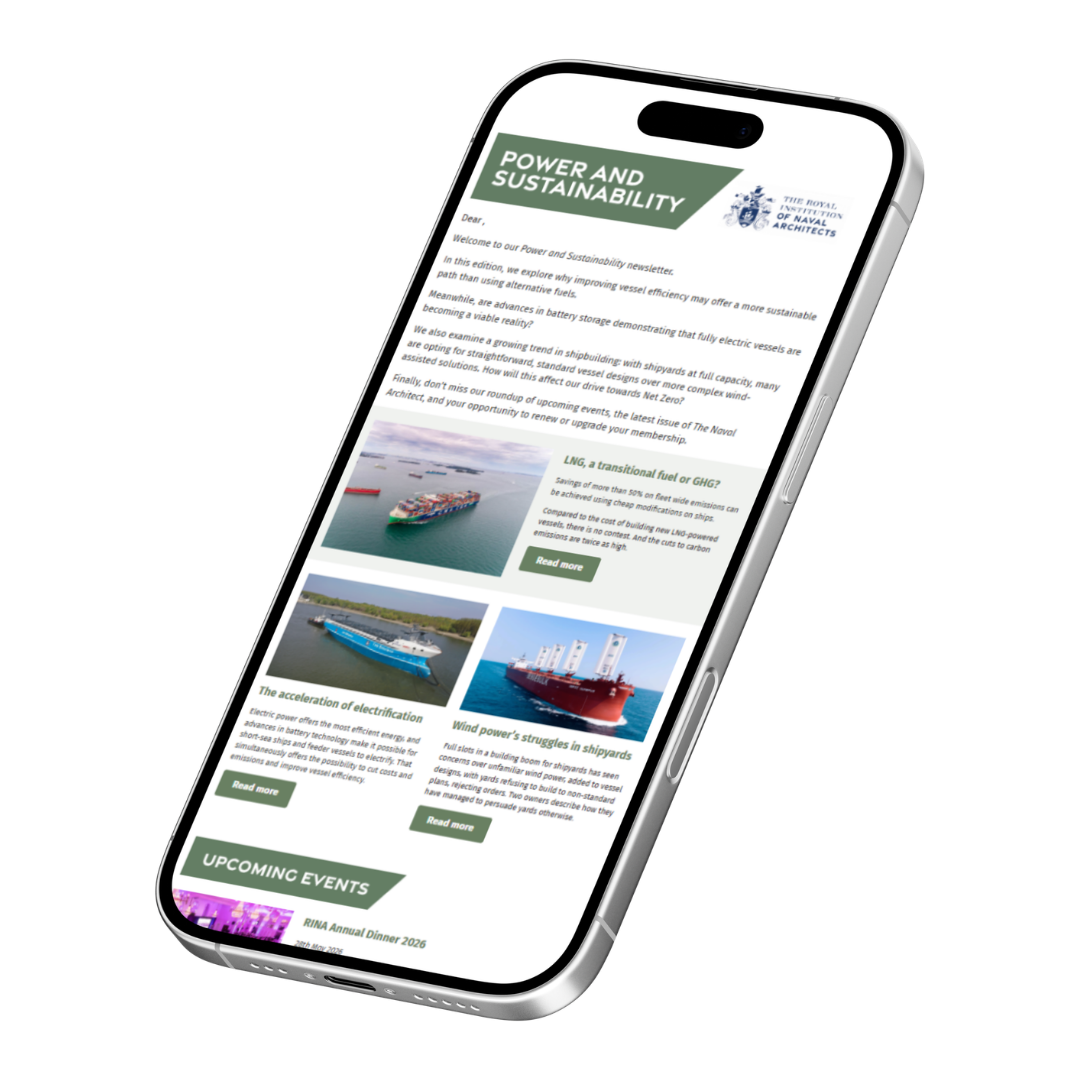
The Naval Architect provides in-depth information on all aspects of vessel design, construction and engineering. Practical applications of latest technology and case studies are accompanied by analysis and foresights. Published every two months, the magazine covers everything from superyachts and short-hop ferries to tankers and heavy-lift vessels; from battery pack installations and sail-assisted solutions to LNG tank retrofits; and from offshore safety to warship resilience.
SLIDING MODE BASED PREDICTIVE CONTROLLER OF A SPHEROIDAL UNDERWATER VEHICLE
Transactions
Autonomous underwater vehicles are expanding their role in inspection, security and surveillance missions, creating demand for control systems capable of managing highly unstable underwater dynamics. Combining sliding-mode and model predictive control techniques enhances vehicle stability and manoeuvring performance, supporting more reliable operation of next-generation underwater robotics in challenging marine environments.
MODEL- AND FULL-SCALE RANS SIMULATIONS FOR A DRIFT TANKER
Transactions
Understanding scale effects remains essential for accurate prediction of ship manoeuvring and hydrodynamic performance. Advanced full-scale and model-scale CFD simulations are providing deeper insight into viscous flow behaviour, helping improve the reliability of performance assessments while strengthening confidence in the methods used to support ship design and operational analysis.
BACKSTEPPING CONTROL OF NONLINEAR ROLL MOTION FOR A TRAWLER WITH FIN STABILIZER
Transactions
Roll stabilisation remains essential for improving safety, comfort and operational effectiveness in fishing vessels operating in challenging sea conditions. Combining advanced CFD-based hydrodynamic analysis with nonlinear control techniques enables more effective fin stabiliser performance, supporting reduced roll motion, enhanced vessel stability and improved seakeeping capabilities.
THE STABILITY OF A FREELY FLOATING SHIP
Transactions
Ship stability assessment becomes more complex when vessels are allowed to trim freely while heeling. Understanding how different balancing assumptions influence righting-arm calculations is essential for accurate stability evaluation, with important implications for interpreting GZ curves, assessing safety margins and supporting more robust ship design and regulatory analysis.
SHOCK RESILIENCE OF STRUCTURAL PILLARS IN NAVAL VESSELS
Transactions
Open-plan spaces can offer significant operational advantages aboard naval vessels, yet concerns over shock resistance have long limited the use of structural pillars. Re-examining their behaviour under underwater explosion loading suggests new opportunities to balance survivability, spatial efficiency and design flexibility, challenging conventional assumptions in warship architecture.
STABILITY FAILURE ANALYSIS IN THE OPERATIONS OF FLOATING DRY DOCKS
Transactions
Floating dry docks present unique safety and stability challenges, often in environments where historical failure data is limited. Combining fuzzy logic and evidential reasoning strengthens hazard assessment and decision-making, helping operators better understand risk, enhance safety management and support more reliable dry dock operations in complex maritime settings.
OPTIMAL NAVAL PATH PLANNING IN ICE-COVERED WATERS
Transactions
The Northern Sea Route is attracting growing attention as changing Arctic conditions create new possibilities for global trade. Advanced graph-based navigation methods are helping address the operational challenges of ice-covered waters, supporting safer route optimisation, improved voyage efficiency and more informed decision-making as Arctic shipping opportunities continue to expand.
HYDRODYNAMIC INTERACTION BETWEEN SHIPS AND RESTRICTED WATERWAYS
Transactions
Navigating in shallow and restricted waterways requires careful management of complex hydrodynamic forces that can significantly affect vessel control and safety. Enhanced understanding of bank effects, supported by extensive testing and advanced modelling, is strengthening simulator realism, improving mariner training and supporting safer, more efficient operation of ports and inland waterways.
HUMAN FACTOR ANALYSIS OF CONTAINER VESSEL'S GROUNDING ACCIDENTS
Transactions
Understanding why container ships run aground remains essential to improving maritime safety and operational performance. Analysis of accident investigations highlights the significant influence of human factors, voyage management and team coordination, reinforcing the need for stronger decision-making practices, crew performance management and risk mitigation strategies across the shipping industry.
Technical Note: HYBRID COMMUNICATION NETWORK FOR THE PURPOSE OF MARITIME APPLICATIONS
Transactions
Reliable connectivity is becoming increasingly important as shipping embraces digitalisation, automation and data-driven operations. Hybrid maritime communication systems that seamlessly switch between multiple network technologies offer the potential for more resilient, flexible and efficient connectivity at sea, supporting enhanced information sharing, operational awareness and future smart shipping capabilities.
APPLICATION OF FUZZY FMEA TO PERFORM AN EXTENSIVE RISK ANALYSIS IN MARITIME TRANSPORTATION ENGINEERING
Transactions
Maritime safety depends on the ability to identify and address equipment failures before they lead to costly incidents or operational disruption. Advanced risk assessment techniques are strengthening understanding of hatch cover reliability, helping operators prioritise maintenance, reduce failure risk and enhance the safe, efficient operation of bulk carrier fleets.
INTERVAL-VALUED INTUITIONISTIC FUZZY TOPSIS-BASED MODEL FOR TROUBLESHOOTING MARINE DIESEL ENGINE AUXILIARY SYSTEM
Transactions
Marine engine reliability remains critical to safe and efficient ship operations, particularly where complex auxiliary systems create interconnected failure risks. Advanced fuzzy decision-making techniques are enhancing fault diagnosis and root-cause identification, supporting more proactive maintenance strategies, improved system performance and greater operational resilience across maritime engineering applications.
Newsletters
Stay connected with the global maritime community through RINA’s newsletters.
Whether you are a member or not, you can receive updates from The Naval Architect, alongside selected RINA news, events and industry insights. Members also gain access to a wider portfolio of exclusive newsletters on key topics in the maritime industry.