The Naval Architect provides in-depth information on all aspects of vessel design, construction and engineering. Practical applications of latest technology and case studies are accompanied by analysis and foresights. Published every two months, the magazine covers everything from superyachts and short-hop ferries to tankers and heavy-lift vessels; from battery pack installations and sail-assisted solutions to LNG tank retrofits; and from offshore safety to warship resilience.
APPLICATION OF FUZZY FMEA TO PERFORM AN EXTENSIVE RISK ANALYSIS IN MARITIME TRANSPORTATION ENGINEERING
Transactions
Maritime safety depends on the ability to identify and address equipment failures before they lead to costly incidents or operational disruption. Advanced risk assessment techniques are strengthening understanding of hatch cover reliability, helping operators prioritise maintenance, reduce failure risk and enhance the safe, efficient operation of bulk carrier fleets.
INTERVAL-VALUED INTUITIONISTIC FUZZY TOPSIS-BASED MODEL FOR TROUBLESHOOTING MARINE DIESEL ENGINE AUXILIARY SYSTEM
Transactions
Marine engine reliability remains critical to safe and efficient ship operations, particularly where complex auxiliary systems create interconnected failure risks. Advanced fuzzy decision-making techniques are enhancing fault diagnosis and root-cause identification, supporting more proactive maintenance strategies, improved system performance and greater operational resilience across maritime engineering applications.
RELIABILITY OF DETERIORATED MARINE STRUCTURES BASED ON MEASURED DATA
Transactions
Structural integrity is increasingly being shaped by how engineers understand and manage long-term degradation. Advanced reliability modelling of tanker deck corrosion combines stochastic analysis, time-dependent prediction, and Bayesian updating to improve inspection planning and risk assessment, supporting more informed decisions on asset life extension, maintenance strategy, and safety assurance.
CFD-BASED SIMULATION OF THE FLOW AROUND A SHIP IN OBLIQUE MOTION AT LOW SPEED
Transactions
As maritime operations increasingly shift toward low-speed manoeuvring in ports, offshore facilities, and confined waters, understanding vessel behaviour beyond conventional standards is becoming essential. Advanced CFD techniques are providing new insight into complex flow dynamics at extreme drift angles, helping to address critical safety, control, and operational challenges in modern ship handling.
METHODOLOGIES TO PREDICT HYDRODYNAMIC CHARACTERISTICS OF PUSHER AND PULLER PODDED PROPULSORS IN OBLIQUE FLOWS
Transactions
Podded propulsion systems are valued for their manoeuvrability, but accurately predicting performance across varying operating conditions remains a complex engineering challenge. High-fidelity CFD modelling is demonstrating near-experimental levels of accuracy, providing deeper insight into thrust, torque, and azimuthing behaviour while advancing the design and optimisation of next-generation marine propulsion systems.
CHARACTERIZATION AND ANALYSES ON RESIDUAL STRESS AND DEFORMATION DISTRIBUTION IN LINE HEAT PROCESS
Transactions
Line heating remains a cornerstone of shipbuilding, yet the mechanics behind plate deformation are still yielding new insights. By combining finite element simulation with experimental validation, engineers are gaining a clearer understanding of residual stress formation and heating-sequence effects, helping to improve forming accuracy, process control, and manufacturing efficiency.
RESPONSE OF A HIGH-SPEED WAVE-PIERCING CATAMARAN TO AN ACTIVE RIDE CONTROL SYSTEM
Transactions
As expectations for passenger comfort and vessel performance continue to rise, advanced ride control systems are becoming a key differentiator for high-speed craft. Combining experimental testing with motion-response modelling is improving understanding of heave and pitch control, creating a foundation for more intelligent, responsive, and efficient vessel stabilisation technologies.
FAHP FOR SELECTING TRANSPORT MODES OF TAIWAN OFF-SHORE ISLANDS' MILITARY LOGISTICS
Transactions
Reliable logistics can be a decisive factor in sustaining operations where geography, weather, and supply constraints converge. By applying fuzzy decision-making techniques to transport mode selection, organisations can better balance efficiency, cost, and operational resilience, illustrating how advanced analytics are helping modern logistics systems navigate uncertainty and complexity.
A POLICY-MAKING FRAMEWORK FOR ENHANCING THE KAOHSIUNG PORT'S ECONOMIC RESILIENCE
Transactions
As ports face growing economic and competitive pressures, resilience is becoming a strategic concern rather than an operational afterthought. A structured decision-making framework highlights how policy reform, market adaptability, and targeted incentives can strengthen long-term performance, underscoring the increasingly important link between governance, competitiveness, and port sustainability.
APPLICATION OF INTERVAL TYPE-2 FUZZY SETS DEMATEL METHODS IN MARITIME TRANSPORTATION: THE CASE OF SHIP COLLISION
Transactions
Despite decades of safety improvements, marine accidents continue to expose the complexity of risk across modern shipping operations. Advanced decision-analysis techniques are enabling a more proactive understanding of accident causation, helping to untangle complex cause-and-effect relationships and supporting more informed strategies for preventing collisions and strengthening maritime safety performance.
DETERMINING ROBUST PARAMETERS IN STABILIZING SET OF BACKSTEPPING BASED NONLINEAR CONTROLLER FOR SHIP COURSE KEEPING
Transactions
As autonomous vessel control becomes more sophisticated, ensuring robust performance under real-world operating conditions remains a persistent challenge. A new approach to parameter selection combines manoeuvring knowledge with closed-loop design principles, narrowing uncertainty and strengthening stability, with results pointing to more reliable and resilient ship steering systems.
REVIEW OF PRACTICAL ASPECTS OF SHALLOW WATER AND BANK EFFECTS
Transactions
Navigating confined and shallow waterways remains as much an operational challenge as a scientific one. Diverging views on how vessels respond to reduced water depth and nearby banks continue to shape industry practice, highlighting persistent uncertainty around manoeuvrability, steering behaviour, and hydrodynamic effects with significant implications for navigation safety and simulation fidelity.
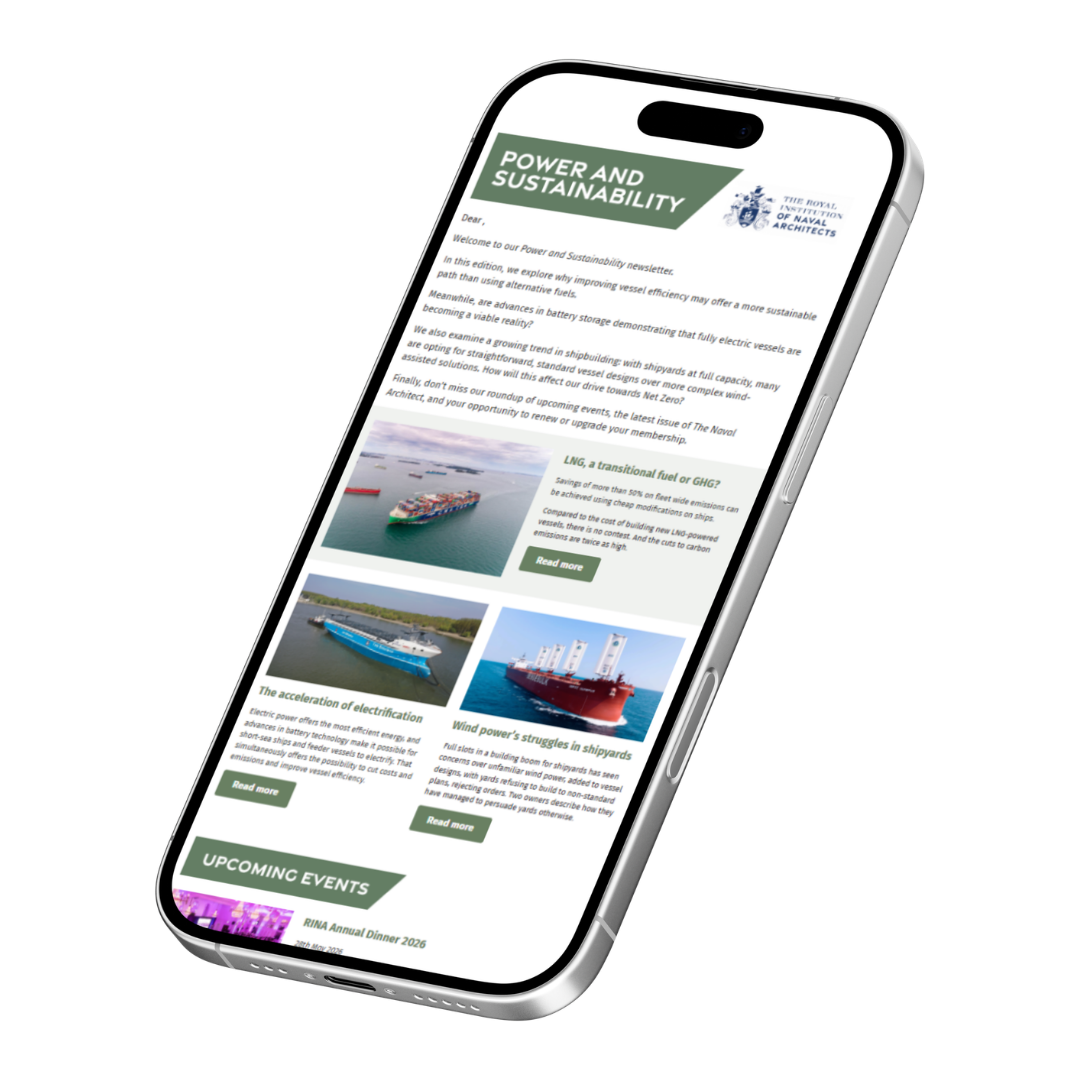
Newsletters
Stay connected with the global maritime community through RINA’s newsletters.
Whether you are a member or not, you can receive updates from The Naval Architect, alongside selected RINA news, events and industry insights. Members also gain access to a wider portfolio of exclusive newsletters on key topics in the maritime industry.