

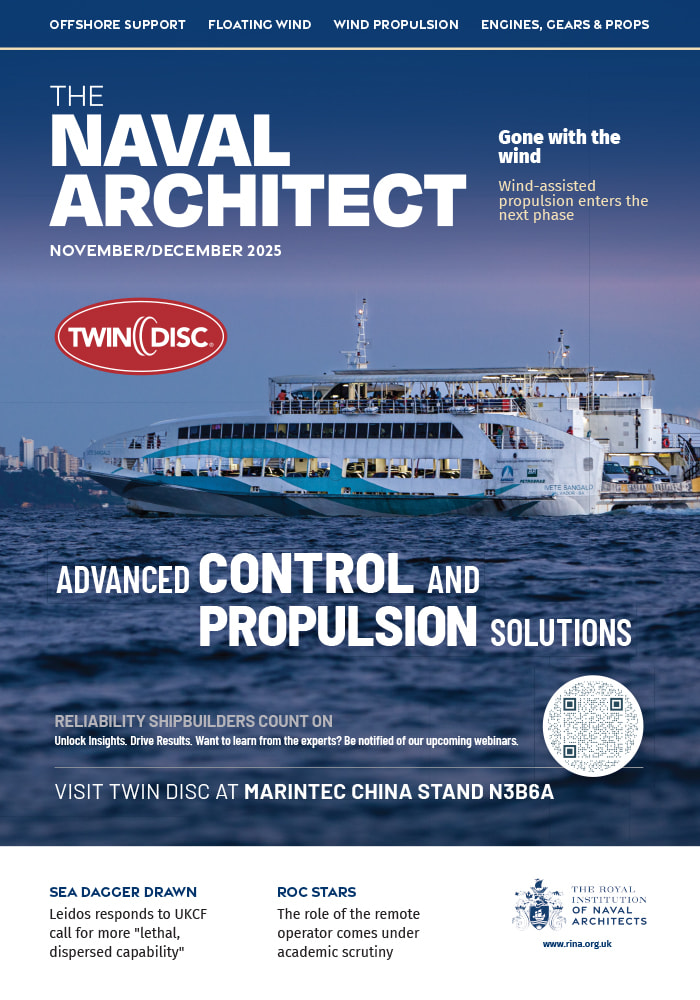
November/December 2025
The last issue of this year's Naval Architect is now available to read online and in print. Highlights from this issue:
Offshore Support
Floating Wind
Wind Propulsion
Engines, Gears & Props
Want to keep up to date with the latest news and developments in the maritime industry? Full articles and in-depth analysis are exclusively available to all RINA members & subscribers.
PORT DESIGN FOR SMALL LNG CARRIERS
Alternative Fuels
Innovative LNG transfer infrastructure is improving safety, efficiency and operational flexibility across maritime energy operations. By examining specialised manifold design, transfer interfaces and ship-to-shore integration, the work addresses key engineering challenges in fuel handling. Insights highlight opportunities to streamline LNG logistics, strengthen reliability and support evolving low-carbon maritime energy networks.
A REVIEW OF MOORING SYSTEM SOLUTIONS FOR FSRUs.
Alternative Fuels
Selecting the right mooring system is critical to the performance and economics of floating storage and regasification units. Evaluating jetty nearshore and offshore solutions researchers identified key trade-offs and developed a practical decision framework supporting owners operators and port authorities in optimising project-specific designs reducing risk improving flexibility and resilience.
A PERFORMANCE AND EMISSION INVESTIGATION OF A MARINE DIESEL FUELLED WITH B20, B50 AND B100 MICROALGAE (SCHIZOCHYTRIUM SP.) OIL WITHOUT CHEMICAL ADDITIVE
Alternative Fuels
Microalgae oil is emerging as a promising low-carbon marine fuel. Engine testing of pure and blended Schizochytrium fuel demonstrated significant reductions in NOx and carbon monoxide emissions despite efficiency and fuel-consumption trade-offs at higher loads. The findings highlight renewable biofuels’ potential to support cleaner shipping and emissions compliance efforts globally.
FUTURE FUELS FOR COMMERCIAL SHIPPING
Alternative Fuels
Meeting IMO emissions goals requires more than efficiency technologies. This analysis examines speed reductions, wind propulsion, alternative fuels, waste-derived energy sources, and renewable fuel availability. It highlights supply-chain constraints, transitional pathways, and the growing role of shipping as a major future liquid-fuel consumer, shaping decarbonisation strategies worldwide over coming decades.
LNG BUNKER VESSEL DESIGN AND OPERATION
Alternative Fuels
Liquefied natural gas bunkering is creating a new class of maritime support vessel. Drawing on extensive experience in floating LNG infrastructure and gas carrier design, engineers are developing robust bunker-vessel concepts to enable global fuel supply networks. The trend highlights LNG’s transitional role in shipping’s pathway toward lower-carbon operations worldwide.
EVALUATION OF LNG CRYOGENIC ENERGY UTILIZATION IN SEAWATER DESALINATION ON LNG FUELLED SHIPS
Alternative Fuels
Recovering LNG cryogenic energy for onboard freshwater production could significantly improve the sustainability of LNG-fuelled vessels. By integrating atmospheric water generation and distillation systems with regasification processes, researchers achieved notable efficiency gains and reduced energy consumption. The concept demonstrates a practical approach to resource recovery, operational efficiency, and maritime decarbonisation overall.
CONVERSION OF AN LNG CARRIER TO FLOATING STORAGE AND REGASIFICATION UNIT
Alternative Fuels
LNG carrier conversions are emerging as a faster, lower-cost route to expanding gas import infrastructure. By transforming existing vessels into floating storage and regasification units, operators can significantly reduce capital expenditure and deployment timelines. The approach strengthens energy security, improves market responsiveness, and supports growing global natural-gas demand efficiently today.
LNG BUNKERING VESSELS AND BARGES: A 2020 UPDATE
Alternative Fuels
Dedicated LNG bunkering vessels and barges are rapidly expanding to support growing adoption of gas-fuelled shipping. Tracking successive generations of newbuilds and conversions, the analysis highlights evolving transfer capabilities, specialised fuel-handling systems, and accelerating global infrastructure development. The trend underscores LNG’s emerging role in lower-emission maritime operations worldwide today ahead.