

November/December 2025
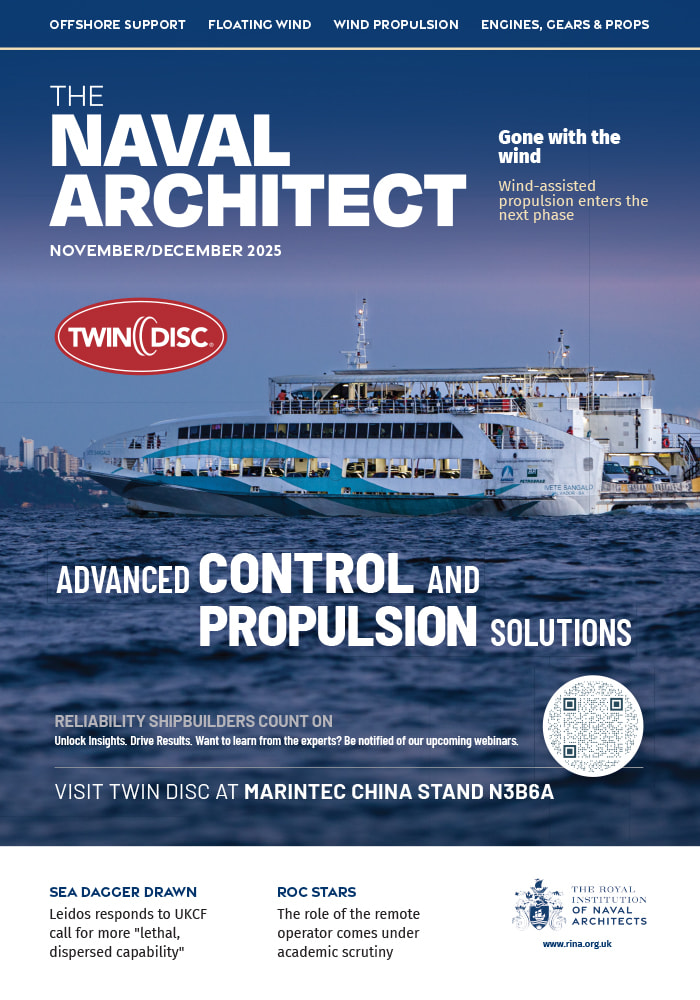
The last issue of this year's Naval Architect is now available to read online and in print. Highlights from this issue:
Offshore Support
Floating Wind
Wind Propulsion
Engines, Gears & Props
Want to keep up to date with the latest news and developments in the maritime industry? Full articles and in-depth analysis are exclusively available to all RINA members & subscribers.
CONSTRUCTION OF FLOATING OFFSHORE WIND TURBINES
Offshore Wind Summit
Floating offshore wind growth is reshaping the role of shipyards, demanding new infrastructure, capabilities and construction strategies. This analysis evaluates facility requirements for turbine assembly, substructure fabrication and deployment logistics, revealing critical engineering constraints and investment priorities. The findings offer a roadmap for scaling future offshore wind programmes globally efficiently.
COST-EFFICIENT FLOATING WIND DESIGNS (INCLUDING STRUCTURES, MOORINGS AND ANCHORING)
Offshore Wind Summit
Floating offshore wind faces a critical challenge: achieving cost efficiency at scale. Examining the often-overlooked role of anchoring and mooring systems, this perspective exposes competing priorities, technical complexities, and industry fragmentation. It also explores collaborative pathways that could accelerate innovation, strengthen viability, and unlock cleaner energy futures for generations ahead.
EVOLVING REQUIREMENT FOR FLOATING WIND INSTALLATION VESSELS
Offshore Wind Summit
Floating wind’s rapid expansion is creating unprecedented demand for specialised offshore vessels. With more than 60 GW forecast by 2035, aging fleets, oil and gas competition, and complex mooring operations are exposing critical capacity gaps. Emerging vessel concepts promise solutions, but challenging economics could reshape the industry’s next phase ahead.
MARITIME INTEGRITY OF FLOATING OFFSHORE STRUCTURES
Offshore Wind Summit
Maintaining maritime integrity is a defining challenge for floating offshore installations operating in harsh environments. From watertight integrity and stability to mooring ballast and station-keeping systems effective risk management demands integrated engineering approaches. The review highlights emerging industry practices and strategies that strengthen reliability safety and long-term operational performance today.