

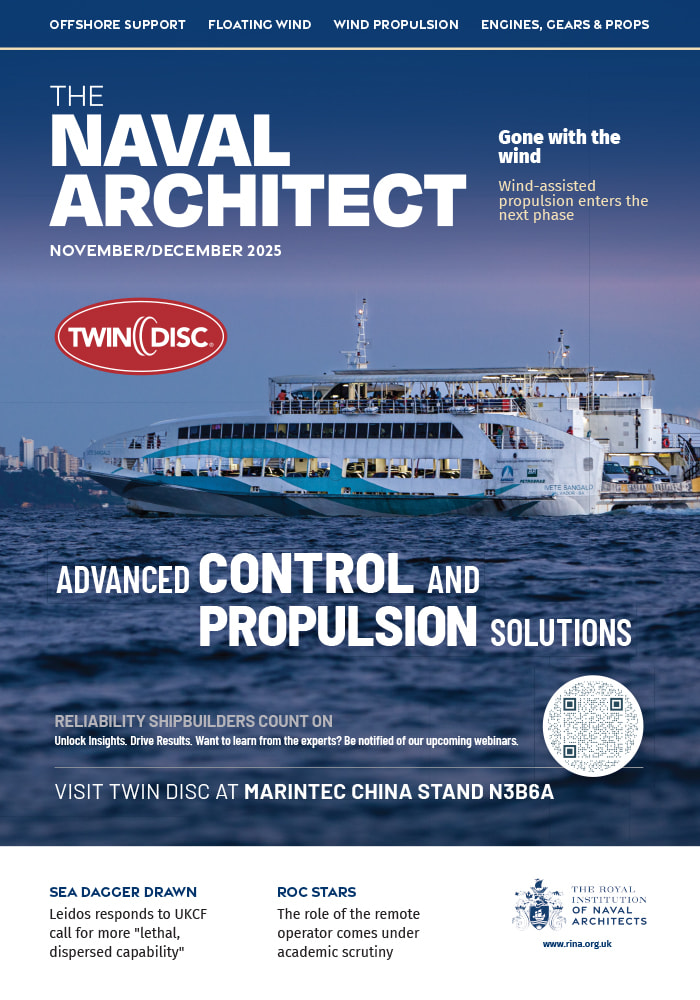
November/December 2025
The last issue of this year's Naval Architect is now available to read online and in print. Highlights from this issue:
Offshore Support
Floating Wind
Wind Propulsion
Engines, Gears & Props
Want to keep up to date with the latest news and developments in the maritime industry? Full articles and in-depth analysis are exclusively available to all RINA members & subscribers.
AN INTEGRATED REAL-TIME SHIP OPERATION OPTIMISATION SYSTEM TO REDUCE FUEL CONSUMPTION AND EMISSIONS FROM SHIPPING NAVIGATION AND PORT CALLS - Copy
ICCAS
Ship design complexity is accelerating, challenging naval architects to balance safety, sustainability, innovation and regulatory demands. A novel node-network methodology organizes multidisciplinary calculations around a 3D product model, enabling faster analysis, greater design transparency and flexible optimisation. The approach reveals new possibilities for more informed engineering decisions at scale today.
SYSTEM ARCHITECTING METHODS FOR FLOATING OFFSHORE WIND POWER SYSTEM
ICCAS
A structured methodology is improving conceptual design of complex systems where requirements, components and constraints are not yet fully defined. Combining Object-Process Methodology with System Dynamics simulation, the approach enables comparison of alternative concepts, reveals critical trade-offs and causal relationships, and supports more informed design decisions for innovative engineering challenges.
STUDY OF PIPE INSTALLATION SIMULATION BASED ON PATH PLANNING ALGORITHM
ICCAS
Digital assembly simulation is helping shipbuilders tackle one of production’s most complex challenges: piping installation. By combining collision-free path planning algorithms with automated assembly sequence generation and validation against real-world CAD models, the approach improves constructability assessment, installation planning and procurement decisions, enabling more efficient and reliable shipbuilding processes.
INTEGRATED SHIP DESIGN USING TEAMCENTER, NX AND SIMCENTER FOR ADVANCED STRUCTURAL ANALYSIS
ICCAS
Navantia is advancing digital shipbuilding through an integrated design methodology that connects CAD, structural analysis and lifecycle management within a unified digital engineering environment. By linking 3D models, finite element simulations and PLM workflows from concept through construction, the approach improves collaboration, design accuracy and traceability, enabling faster decisions and more efficient ship development.
3D APPROVAL PROCESS USING THE STANDARD OCX FORMAT OF THE NAVANTIA SHIP STRUCTURE DESIGN WORKFLOW
ICCAS
A shift toward model-based structural approval is transforming collaboration between shipbuilders and classification societies. By embedding structural scantling data directly within 3D models, this approach promises improved traceability, reduced documentation effort and faster approvals. Early proof-of-concept work highlights remaining challenges in standardising complex structural details for a fully digital future.
MODELLING AND SIMULATION OF WIND ASSISTED SHIP PROPULSION SYSTEMS ON THE 3DEXPERIENCE PLATFORM
ICCAS
Wind-Assisted Propulsion Systems are accelerating maritime decarbonisation through advanced digital engineering. By combining aerofoil optimisation, high-fidelity fluid dynamics and structural simulation within an integrated 3DEXPERIENCE® workflow, engineers can maximise propulsion efficiency, reduce emissions and shorten development cycles, demonstrating how virtual design technologies are enabling more sustainable shipping solutions.
A STUDY ON AI-BASED BEAD SHAPE ANALYSIS SYSTEM USING LASER SCANNING
ICCAS
Automated weld inspection is addressing growing workforce shortages and rising inspection costs in shipbuilding. By combining laser scanning, bead-shape analysis and AI-powered defect identification, the system enables accurate remote assessment of weld quality, reduces reliance on specialist inspectors and improves efficiency, consistency and accessibility across complex shipyard environments.
PROPOSAL FOR A SHIPBUILDING PROCESS DATA STRUCTURE AND SIMULATION SYSTEM FOR AUTOMATIC UPDATING OF PRODUCTION PLANS
ICCAS
Digital process simulation is helping shipyards overcome the challenge of constantly changing designs and fragmented production planning. By introducing a network-based data structure that automatically synchronises design updates, production workflows and departmental plans, this approach enables more efficient scheduling, stronger cross-functional coordination and greater responsiveness across complex shipbuilding programmes.
A METHOD OF VISUALIZING MASSIVE 3D CAD MODELS FOR SHIPBUILDING VR APPLICATION
ICCAS
Virtual reality is unlocking new possibilities for shipbuilding collaboration, training and design review, but handling massive 3D CAD models remains a major technical challenge. By combining GPU instancing, intelligent caching and voxel-based optimisation, this approach enables faster loading, lower memory demands and more immersive visualisation of complex ship designs.