

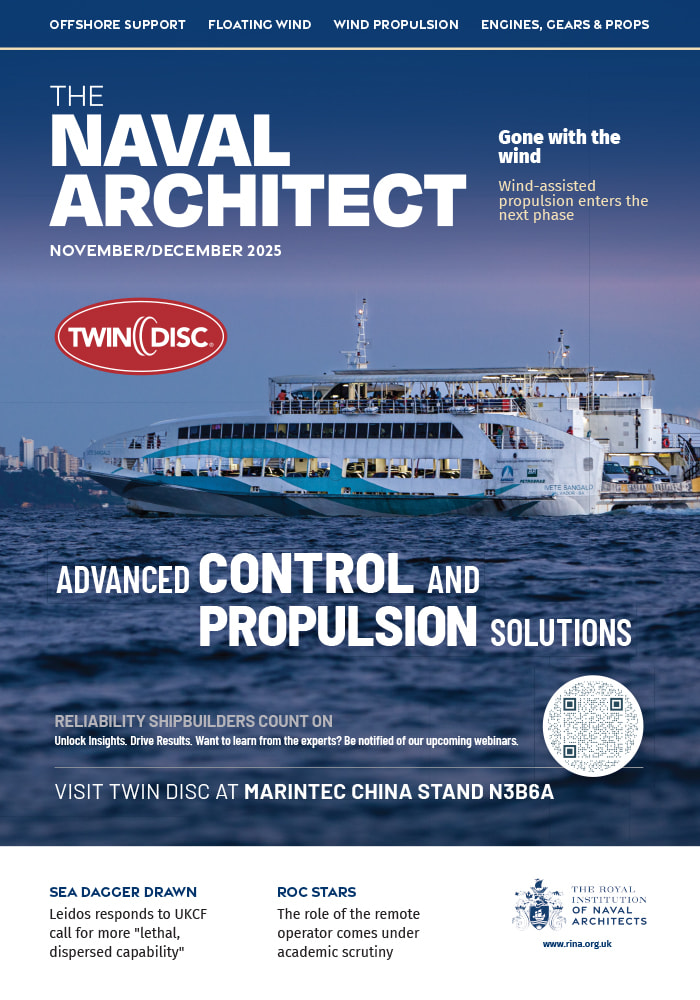
November/December 2025
The last issue of this year's Naval Architect is now available to read online and in print. Highlights from this issue:
Offshore Support
Floating Wind
Wind Propulsion
Engines, Gears & Props
Want to keep up to date with the latest news and developments in the maritime industry? Full articles and in-depth analysis are exclusively available to all RINA members & subscribers.
AUTONOMOUS SWATH VESSELS FOR WIND FARM INSPECTIONS: A COMPARATIVE STUDY ON OPERATIONAL EFFICIENCY
Autonomous Ships
Autonomous SWATH vessels could transform offshore wind farm support operations by combining hybrid fuel cell-battery propulsion with highly stable hull designs. Through numerical simulation and real-world operating scenarios, the research demonstrates superior availability and ROV deployment performance in harsh sea conditions, highlighting a promising solution for safer, more efficient and sustainable offshore maintenance.
EXPLORING THE FEASIBILITY OF AUTONOMOUS FERRIES FOR URBAN MOBILITY
Autonomous Ships
Autonomous passenger ferries could reshape urban mobility by reducing congestion and supporting more sustainable transport networks. Evaluating a proposed uncrewed ferry service in Denmark, this study examines legal, technical and commercial viability, revealing that while regulation and technology show promise, economic sustainability remains a significant challenge for large-scale deployment.
IMPLEMENTING A NEW PLATFORM INTO THE U.S. NAVY: A SYSTEMS VIEW
Autonomous Ships
Facing growing fleet-capacity challenges, the U.S. Navy is exploring a bimodal force structure that combines smaller warships with autonomous capabilities. The Lightly Manned Automated Combat Corvette offers a compelling concept, but success depends on integrating technology, doctrine and long service-life considerations across a complex system-of-systems architecture for future maritime operations.
START WITH THE WHY - THE VALUE OF MARS COMPETENCE CENTRE
Autonomous Ships
Regulating maritime autonomy demands governance that can keep pace with technological change. Examining emerging frameworks for Maritime Autonomous Surface Ships, this paper highlights the need for collaboration between industry and regulators. The proposed MARS Centre offers a novel model to bridge expertise gaps, support adaptive regulation and enable innovation safely.
DANELEC AND DANPILOT REMOTE PILOTING
Autonomous Ships
Remote piloting technologies are reshaping maritime navigation, enabling pilots to monitor vessels from shore-based control centres. By eliminating physical pilot transfers, the approach enhances safety, reduces operational costs, cuts fuel consumption and emissions, and improves efficiency. The initiative highlights how digital innovation can deliver safer, smarter and more sustainable shipping