The Naval Architect provides in-depth information on all aspects of vessel design, construction and engineering. Practical applications of latest technology and case studies are accompanied by analysis and foresights. Published every two months, the magazine covers everything from superyachts and short-hop ferries to tankers and heavy-lift vessels; from battery pack installations and sail-assisted solutions to LNG tank retrofits; and from offshore safety to warship resilience.
THE UK NAVAL AUTHORITY GLIDEPATH TO CERTIFIED IMO DEGREE 4 AUTONOMY
Warship
Achieving IMO Degree 4 autonomy is reshaping naval certification, with adaptive, goal-based frameworks enabling progression from remotely operated to fully autonomous vessels. Collaboration across UK defence regulators aligns safety and legal principles while addressing emerging architectures, technology risks, and engineering challenges. Early lessons reveal opportunities for scalable certification pathways ahead.
A RISK AGGREGATION APPROACH TO SUPPORT RISK ASSESSMENT FOR FUTURE CREWED AND UNCREWED VESSELS
Warship
Risk aggregation is becoming essential for informed decision-making across crewed and uncrewed maritime operations. By formalising methods for independent and dependent risks, new approaches provide a clearer view of overall exposure while exposing critical limitations. The findings highlight why robust policy frameworks and contextual assessment remain vital for future autonomy.
FUNCTIONAL SAFETY APPROACH TO SUPPORT MARITIME AUTONOMY
Warship
Maritime autonomy promises efficiency, safety and strategic advantage, but assuring AI-driven, safety-critical operations remains a pressing challenge. A functional safety framework combines quantitative evidence, governance measures and lifecycle assurance to support autonomous systems. Using collision avoidance as an example, the approach reveals practical pathways for trusted deployment at scale today.
ADVANCED NUMERICAL SIMULATION OF HYDRO-ELASTIC VESSEL STRUCTURAL RESPONSE TO ASSIST SUSTAINABILITY ASSESSMENTS
Warship
Novel simulation techniques are advancing naval resilience by modelling extreme sea states and complex structural responses with unprecedented fidelity. By coupling Smoothed Particle Hydrodynamics with detailed Finite Element Analysis, engineers can better assess vessel survivability, validate designs against real-world conditions, and unlock faster, more efficient sustainment strategies.
HOW IMPORTANT IS IT THAT STAKEHOLDERS SHOULD BETTER UNDERSTAND NAVAL SHIP DESIGN?
Warship
Naval ship design remains widely misunderstood, creating risks for acquisition, capability development and long-term performance. Challenging entrenched concepts such as the platform-payload divide, this perspective highlights how stronger engagement between designers, operators and decision-makers is essential to navigate sustainability, AI integration and increasingly complex naval programmes.
SUPPORT TO CONCEPT ANALYSIS AND REQUIREMENT DEVELOPMENT THROUGH WARGAMING
Warship
Manual wargaming is emerging as a powerful tool for evaluating novel maritime concepts when time, data and funding are limited. By exploring system-of-systems interactions early, it helps shape requirements, assess autonomous applications, and inform future force design decisions, offering a practical bridge to more rigorous operational analysis and capability development.
LARGE UNCREWED SURFACE VESSELS - BALANCE OF SURVIVABILITY
Warship
Large Uncrewed Surface Vessels could transform naval operations, but mission success depends on a careful balance of survivability, resilience and risk. Combining vulnerability analysis, wargaming and engagement modelling, emerging approaches examine how platform-level protection and force-level design can enhance endurance, reduce losses and strengthen operational effectiveness in contested environments.
A CAN CURRENT AND FUTURE DIGITAL TOOLS SUPPORT EFFECTIVE AND EFFICIENT EVALUATION OF SUBMARINE CREWING?
Warship
Human performance is becoming a critical design factor in advanced maritime systems. By combining digital crew-modelling tools, at-sea data collection and psychophysiological monitoring, emerging approaches enable evidence-based crewing decisions, helping predict fatigue, stress and workload while improving safety, operational effectiveness and workforce resilience across increasingly complex naval platforms.
ADAPTING COMMERCIAL HYBRID-ELECTRIC PROPULSION SOLUTIONS FOR SMALLER NAVAL VESSELS: CHALLENGES AND OPPORTUNITIES
Warship
Hybrid and electric propulsion is gaining momentum in naval shipbuilding, offering measurable gains in endurance, efficiency and sustainability. Drawing on Indian industry expertise, emerging solutions for smaller naval vessels demonstrate reduced emissions, lower lifecycle costs and greater operational flexibility, positioning advanced propulsion technologies as a strategic opportunity for future fleet modernisation.
VALIDATING OPERATIONAL SCENARIOS THROUGH SIMULATION
Warship
Integrating operational simulation into early-stage vessel design is helping naval architects link design choices directly to mission outcomes. Using naval operations modelling and USV case studies, this approach provides earlier insight into capability, effectiveness and performance, enabling more informed decisions and better alignment between vessel design and operational requirements.
MULTI-ATTRIBUTE DECISION MAKING FOR THE DESIGN OF A NAVAL SURFACE COMBATANT
Warship
Multi-attribute decision-making could help transform naval ship design by adapting proven platforms to evolving mission demands. Applying structured evaluation methods to warship development offers a faster, more cost-effective alternative to wholly new designs, balancing performance, survivability and operational flexibility while addressing the growing complexity of modern multi-role naval operations.
TECHNOLOGY INNOVATION FOR DEFENCE-PLATFORM ENERGY EFFICIENCY PROJECT (TIDE): ENERGY-EFFICIENT DESIGN APPROACHES FOR NEXT-GENERATION WARSHIPS
Warship
Energy efficiency is emerging as a strategic priority in future warship design. Combining hydrodynamic innovation, hybrid propulsion analysis and voyage-scale energy modelling, new research demonstrates pathways to reduce power demand, lower through-life costs and improve operational resilience, laying the groundwork for more sustainable and mission-effective naval platforms.
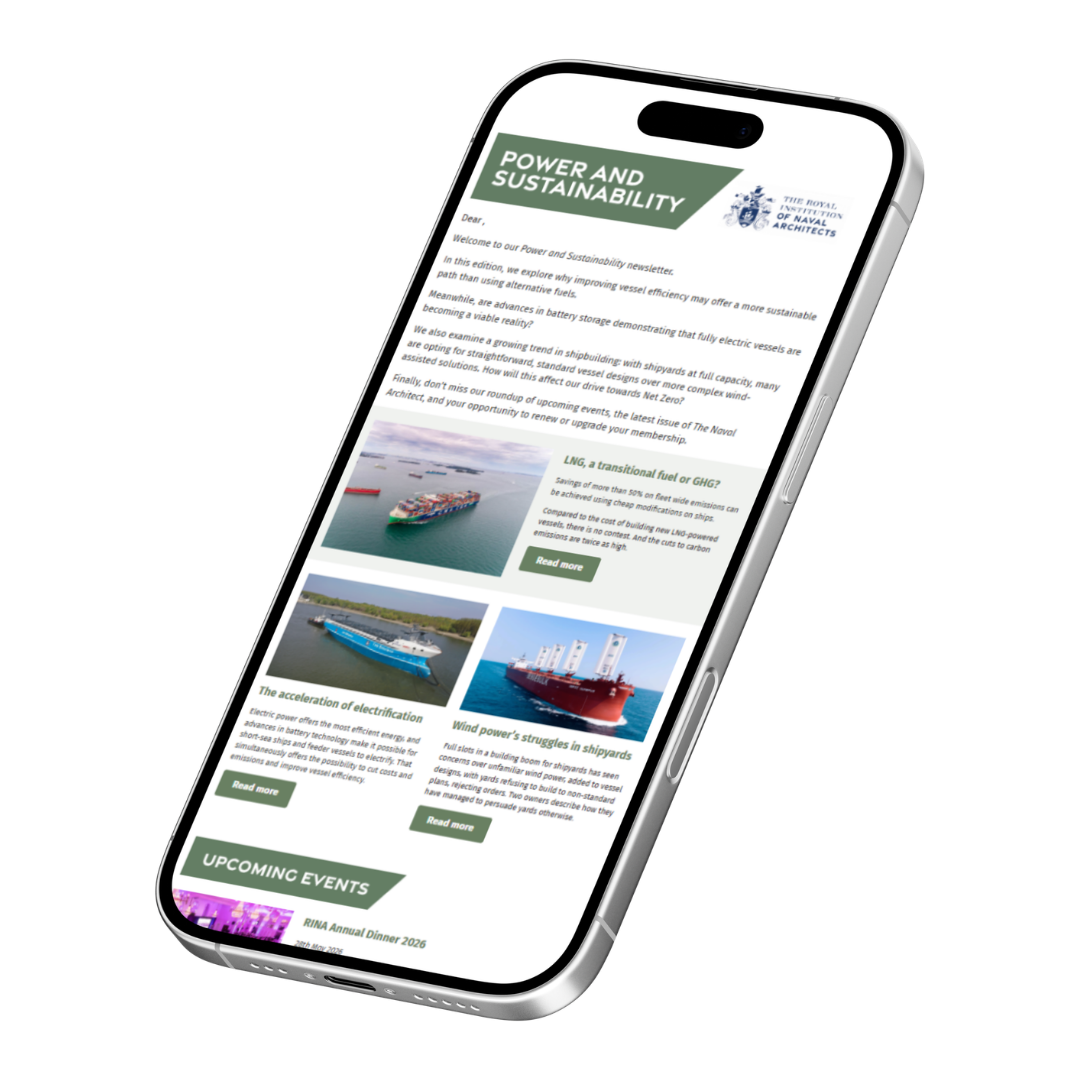
Newsletters
Stay connected with the global maritime community through RINA’s newsletters.
Whether you are a member or not, you can receive updates from The Naval Architect, alongside selected RINA news, events and industry insights. Members also gain access to a wider portfolio of exclusive newsletters on key topics in the maritime industry.