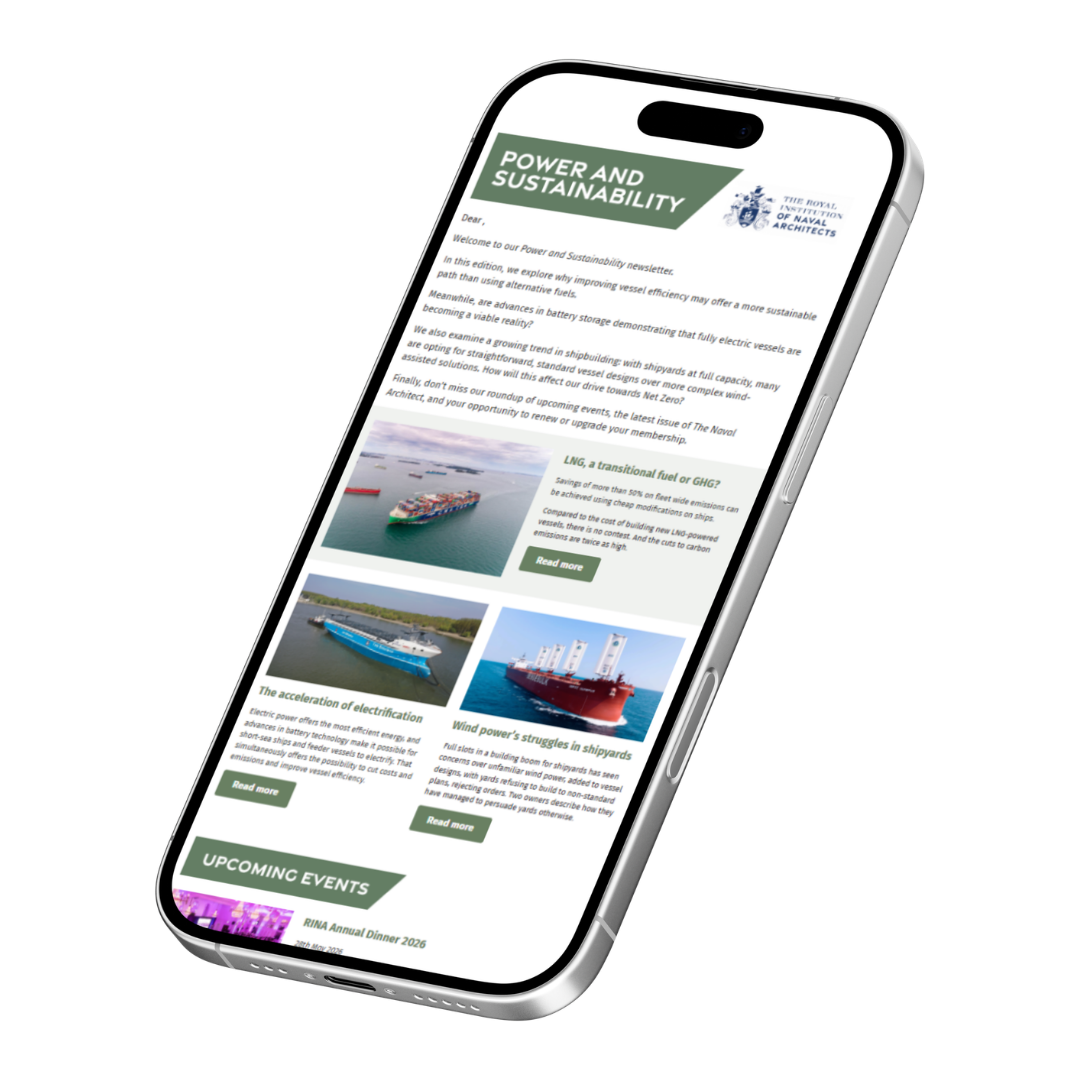
The Naval Architect provides in-depth information on all aspects of vessel design, construction and engineering. Practical applications of latest technology and case studies are accompanied by analysis and foresights. Published every two months, the magazine covers everything from superyachts and short-hop ferries to tankers and heavy-lift vessels; from battery pack installations and sail-assisted solutions to LNG tank retrofits; and from offshore safety to warship resilience.
ENVIRONMENTAL POTENTIAL OF REMOTE CONTROL TECHNOLOGIES: USE CASE REMOTE PILOTAGE
Autonomous Ships
Remote pilotage offers a practical pathway to realise the benefits of maritime remote-control technologies before full autonomous regulation is established. By combining MASS-enabled capabilities with AIS-based operational analysis, this research quantifies potential fuel and emissions savings, while exploring the operational conditions needed to safely transform pilotage services and maritime efficiency.
CONCEPT DESIGN ON A LARGE UNMANNED SURFACE VEHICLE (LUSV)
Autonomous Ships
Large Uncrewed Surface Vessels are redefining naval platform design by replacing onboard crews with advanced autonomy, remote control and intelligent system management. This concept explores safety-driven architectures, redundant systems and automated operations, revealing how future patrol-class vessels could deliver comparable capability, resilience and performance while reducing personnel requirements and operational constraints.
MUM - AN EXTRA LARGE UNMANNED UNDERWATER VEHICLE (XLUUV)
Autonomous Ships
The MUM project is advancing a new generation of highly modular extra-large uncrewed underwater vehicles, designed to adapt rapidly to diverse mission requirements. By combining autonomous surface and underwater navigation, risk-informed engineering and early regulatory engagement, the programme is addressing key design challenges while establishing foundations for future validation and operational deployment
AUTONOMOUS SWATH VESSELS FOR WIND FARM INSPECTIONS: A COMPARATIVE STUDY ON OPERATIONAL EFFICIENCY
Autonomous Ships
Autonomous SWATH vessels could transform offshore wind farm support operations by combining hybrid fuel cell-battery propulsion with highly stable hull designs. Through numerical simulation and real-world operating scenarios, the research demonstrates superior availability and ROV deployment performance in harsh sea conditions, highlighting a promising solution for safer, more efficient and sustainable offshore maintenance.
EXPLORING THE FEASIBILITY OF AUTONOMOUS FERRIES FOR URBAN MOBILITY
Autonomous Ships
Autonomous passenger ferries could reshape urban mobility by reducing congestion and supporting more sustainable transport networks. Evaluating a proposed uncrewed ferry service in Denmark, this study examines legal, technical and commercial viability, revealing that while regulation and technology show promise, economic sustainability remains a significant challenge for large-scale deployment.
IMPLEMENTING A NEW PLATFORM INTO THE U.S. NAVY: A SYSTEMS VIEW
Autonomous Ships
Facing growing fleet-capacity challenges, the U.S. Navy is exploring a bimodal force structure that combines smaller warships with autonomous capabilities. The Lightly Manned Automated Combat Corvette offers a compelling concept, but success depends on integrating technology, doctrine and long service-life considerations across a complex system-of-systems architecture for future maritime operations.
START WITH THE WHY - THE VALUE OF MARS COMPETENCE CENTRE
Autonomous Ships
Regulating maritime autonomy demands governance that can keep pace with technological change. Examining emerging frameworks for Maritime Autonomous Surface Ships, this paper highlights the need for collaboration between industry and regulators. The proposed MARS Centre offers a novel model to bridge expertise gaps, support adaptive regulation and enable innovation safely.
DANELEC AND DANPILOT REMOTE PILOTING
Autonomous Ships
Remote piloting technologies are reshaping maritime navigation, enabling pilots to monitor vessels from shore-based control centres. By eliminating physical pilot transfers, the approach enhances safety, reduces operational costs, cuts fuel consumption and emissions, and improves efficiency. The initiative highlights how digital innovation can deliver safer, smarter and more sustainable shipping
Newsletters
Stay connected with the global maritime community through RINA’s newsletters.
Whether you are a member or not, you can receive updates from The Naval Architect, alongside selected RINA news, events and industry insights. Members also gain access to a wider portfolio of exclusive newsletters on key topics in the maritime industry.