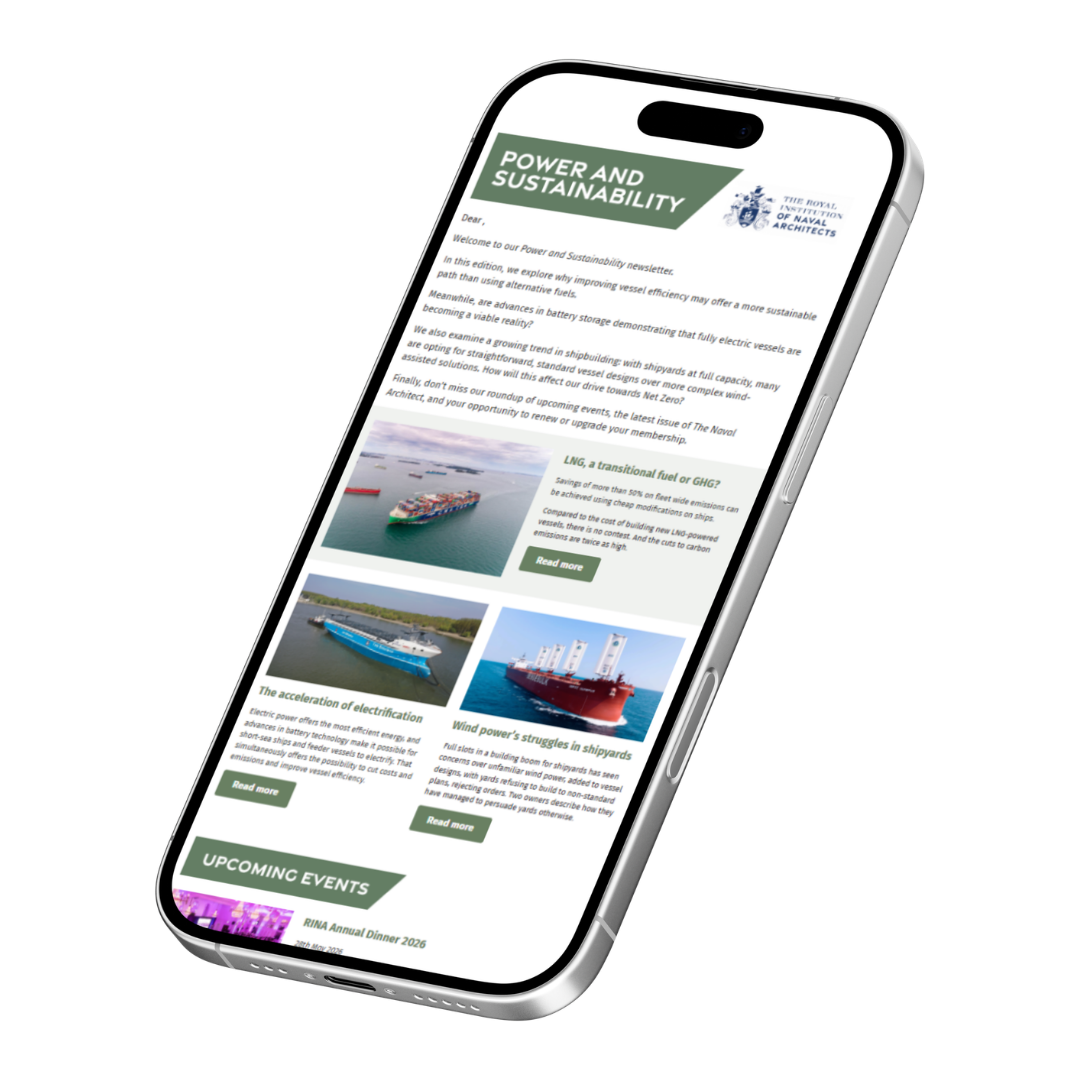
The Naval Architect provides in-depth information on all aspects of vessel design, construction and engineering. Practical applications of latest technology and case studies are accompanied by analysis and foresights. Published every two months, the magazine covers everything from superyachts and short-hop ferries to tankers and heavy-lift vessels; from battery pack installations and sail-assisted solutions to LNG tank retrofits; and from offshore safety to warship resilience.
TRANSIENT ANALYSIS OF HYDRODYNAMIC INTERACTION EFFECTS ON AN AUTONOMOUS UNDERWATER VEHICLE IN PROXIMITY OF A MOVING SUBMARINE
Transactions
As autonomous underwater operations become more advanced, managing the hidden effects of vessel-to-vessel hydrodynamic interaction is emerging as a critical challenge. High-fidelity modelling reveals how relative motion influences AUV control and manoeuvrability near submarines, highlighting important considerations for mission reliability, navigational safety, and the coordination of future autonomous systems.
CALCULATION OF THE HYDRODYNAMIC INTERACTION BETWEEN TWO ENCOUNTERING BODIES IN COUPLING MULTI-FREEDOM MOTIONS
Transactions
When vessels operate in close proximity, hydrodynamic interactions can rapidly escalate into a safety-critical concern. Advanced coupled motion and flow modelling reveals how speed, separation distance, and vessel size shape sway and yaw behaviour, offering deeper insight into collision risk and the complex dynamics that influence ship manoeuvrability in confined encounters.
A CASE STUDY ON STABILISER FIN-HULL INTERACTION USING CFD AND MODEL EXPERIMENTS
Transactions
Stabiliser fins are widely used to improve vessel comfort and seakeeping, yet their effectiveness can be significantly influenced by the surrounding hull. Combined CFD and experimental analysis reveals that fin-hull interactions can dramatically alter lift and drag performance, challenging simplified design assumptions and highlighting the importance of integrated hydrodynamic assessment.
THE CHANCES FOR REDUCTION OF VIBRATIONS IN MECHANICAL SYSTEM WITH LOW-EMISSION SHIPS COMBUSTION ENGINES
Transactions
As emissions standards drive the evolution of diesel engines, managing the resulting increase in vibration and dynamic loading is becoming a growing engineering challenge. Innovative drivetrain technologies such as pneumatic dual-mass flywheels offer a promising route to improve mechanical stability, reduce vibration, and support the reliable operation of next-generation low-emission propulsion systems.
RISK ASSESSMENT OF ARCTIC NAVIGATION BY USING IMPROVED FUZZY-AHP APPROACH
Transactions
As Arctic shipping gains strategic importance, the opportunities offered by shorter trade routes are accompanied by a uniquely complex risk landscape. Structured risk assessment is helping to quantify the navigational challenges posed by ice, weather, and remoteness, supporting more informed decision-making as commercial activity expands across increasingly accessible polar waters.
STANDARDISING THE DESIGN AND PRODUCTION OF MOORING WINCHES THROUGH MORE COHESIVE REGULATIONS: A NECESSARY STEP
Transactions
As vessel complexity increases, mooring systems remain constrained by a fragmented regulatory landscape that often adds cost without delivering equivalent safety benefits. Efforts to harmonise requirements across stakeholders could streamline equipment design, reduce manufacturing complexity, and improve consistency, highlighting standardisation as an overlooked opportunity for greater efficiency across the maritime sector.
20 YEARS DECOMMISSIONING EXPERIENCE - EVOLUTION OF INNOVATIVE SOLUTIONS
Transactions
As offshore decommissioning activity accelerates, operators are confronting rising costs, greater technical complexity, and increasing demand for specialised execution expertise. Experience-driven innovation in removal techniques, supported by advances in lifting operations, motion forecasting, and offshore access methods, is helping to redefine how ageing energy infrastructure can be safely and efficiently retired.
WORK ANALYSIS OF PLATE BENDING WORKSHOP IN SHIPBUILDING INDUSTRY
Transactions
As shipbuilders face increasing pressure to improve productivity and delivery performance, digital simulation is emerging as a powerful tool for manufacturing optimisation. Analysis of plate-bending workshop operations reveals how targeted changes to equipment, processing times, and resource allocation can reduce bottlenecks and support more efficient production across the shipyard.
Newsletters
Stay connected with the global maritime community through RINA’s newsletters.
Whether you are a member or not, you can receive updates from The Naval Architect, alongside selected RINA news, events and industry insights. Members also gain access to a wider portfolio of exclusive newsletters on key topics in the maritime industry.