The Naval Architect provides in-depth information on all aspects of vessel design, construction and engineering. Practical applications of latest technology and case studies are accompanied by analysis and foresights. Published every two months, the magazine covers everything from superyachts and short-hop ferries to tankers and heavy-lift vessels; from battery pack installations and sail-assisted solutions to LNG tank retrofits; and from offshore safety to warship resilience.
REVIEW OF LEGISLATION ON NOISE AND VIBRATION REGULATIONS IN MERCHANT SHIPS
Transactions
Maritime noise is moving from a niche compliance issue to a broader environmental and operational consideration. Evolving regulations are expanding beyond onboard comfort to address port communities and underwater radiated noise, reflecting growing expectations for quieter, more sustainable shipping and increasing pressure for noise performance to become a design priority.
ANOMALY DETECTION IN VESSEL TRACKING - A BAYESIAN NETWORKS (BNs) APPROACH
Transactions
As maritime authorities grapple with growing volumes of vessel data, the ability to distinguish normal operations from emerging risks is becoming increasingly valuable. Applying probabilistic machine-learning techniques to AIS information enables more transparent and interpretable anomaly detection, highlighting the expanding role of intelligent analytics in maritime surveillance, safety, and operational awareness.
ON THE STABILITY OF FAST FERRY IN DAMAGE SCENARIOS
Transactions
As high-speed ferries and ro-ro vessels operate in increasingly demanding conditions, damage stability is receiving renewed attention. Advanced time-domain simulation of flooding, wave effects, and trapped water dynamics is revealing how complex interactions can influence survivability, highlighting the need for more realistic assessment methods to support safer vessel design and operation.
HYDRODYNAMIC HULL FORM DESIGN SPACE EXPLORATION OF LARGE MEDIUM-SPEED CATAMARANS USING FULL-SCALE CFD
Transactions
The search for sustainable high-speed maritime transport is driving renewed interest in large medium-speed catamarans. Advanced CFD analysis is helping define the design space for fuel-efficient operation, revealing how hull slenderness, vessel size, and loading conditions interact to influence transport efficiency and shape the next generation of ferry concepts.
LOW REYNOLDS NUMBER PERFORMANCE OF A MODEL SCALE T-FOIL
Transactions
Ride control technologies are central to the performance of modern high-speed ferries, where comfort, efficiency, and seaworthiness depend on precise motion management. Detailed evaluation of a submerged T-foil highlights the real-world impact of hydrodynamic effects and control-system dynamics, reinforcing the complexity behind delivering responsive and reliable vessel stabilisation.
VERTICAL AND SLOPED BANK EFFECTS ON DIFFERENT SHIP TYPES
Transactions
Navigating close to shorelines introduces complex hydrodynamic challenges that can significantly affect vessel behaviour. High-fidelity simulation of bank effects reveals how ship size, channel geometry, and proximity to embankments influence manoeuvrability, highlighting critical interactions that can increase collision risk and shape safer navigation strategies in restricted waterways.
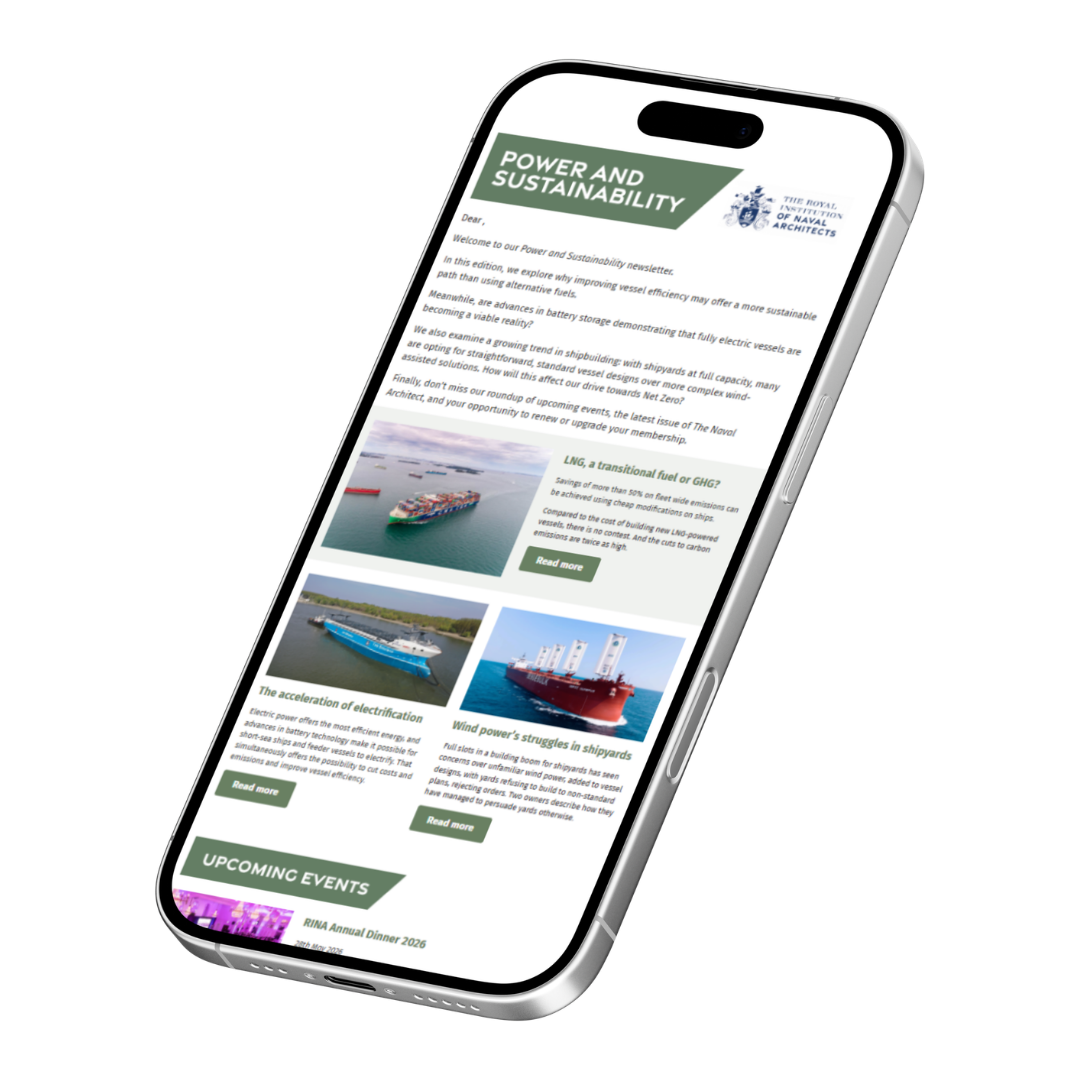
Newsletters
Stay connected with the global maritime community through RINA’s newsletters.
Whether you are a member or not, you can receive updates from The Naval Architect, alongside selected RINA news, events and industry insights. Members also gain access to a wider portfolio of exclusive newsletters on key topics in the maritime industry.