The Naval Architect provides in-depth information on all aspects of vessel design, construction and engineering. Practical applications of latest technology and case studies are accompanied by analysis and foresights. Published every two months, the magazine covers everything from superyachts and short-hop ferries to tankers and heavy-lift vessels; from battery pack installations and sail-assisted solutions to LNG tank retrofits; and from offshore safety to warship resilience.
ON THE SAFE PILOTAGE OF SHIP'S WITH PROPULSION THAT CAN AZIMUTH FOR STEERING
Transactions
As azimuth propulsion transforms vessel manoeuvrability across the maritime sector, operational practices and workforce knowledge are struggling to keep pace with technological change. Growing experience from accidents, incidents, and training initiatives highlights the need for greater standardisation, stronger competency development, and closer alignment between ship design and operational reality.
BUCKLING AND POST-BUCKLING OF ISOTROPIC AND COMPOSITE STIFFENED PANELS: A REVIEW ON ANALYSIS AND EXPERIMENT (2000-2012)
Transactions
As demand grows for lighter and stronger engineering structures, understanding buckling behaviour is becoming increasingly important to design performance and safety. Advances in the analysis of stiffened metallic and composite panels are reshaping approaches to structural optimisation, revealing new opportunities to balance weight reduction, load capacity, and long-term structural resilience.
PRESSURE DISTRIBUTION DUE TO STERN TAB DEFLECTION AT MODEL SCALE
Transactions
Trim tabs play a vital role in improving the performance and efficiency of high-speed vessels, yet the forces they generate remain more complex than conventional assumptions suggest. Combining physical testing with CFD analysis reveals important pressure-distribution effects that influence lift generation, offering fresh insight into motion control, resistance reduction, and vessel optimisation.
RANS-BASED CFD PREDICTION OF THE HYDRODYNAMIC COEFFICIENTS OF DARPA SUBOFF GEOMETRY IN STRAIGHT-LINE AND ROTATING ARM MANOEUVRES
Transactions
As CFD becomes an increasingly important tool in underwater vehicle design, confidence in simulation results depends heavily on modelling choices. Analysis of manoeuvring hydrodynamics highlights how turbulence models, mesh quality, and boundary conditions can significantly influence accuracy, reinforcing the importance of robust simulation practices in engineering decision-making.
AN OVERVIEW: ENVIRONMENTAL AND ECONOMIC STRATEGIES FOR IMPROVING QUALITY OF SHIPS EXHAUST GASES
Transactions
As pressure mounts on the maritime sector to curb emissions, shipowners face increasingly complex choices between environmental performance, regulatory compliance, and operating costs. Comparative assessment of leading emissions-reduction technologies highlights the trade-offs shaping fleet decarbonisation strategies, with fuel choice and retrofit investments emerging as critical determinants of future sustainability.
OPERATIONAL ANALYSIS IN SYSTEM DESIGN OF SUBMARINES DURING THE EARLY PHASES
Transactions
Simulation-based design is reshaping how complex naval systems are conceived, enabling operational effectiveness to influence decisions from the earliest design stages. By integrating requirements analysis, capability assessment, and stakeholder input into a unified framework, designers can explore broader solution spaces and make more informed trade-offs beyond cost and technical performance alone.
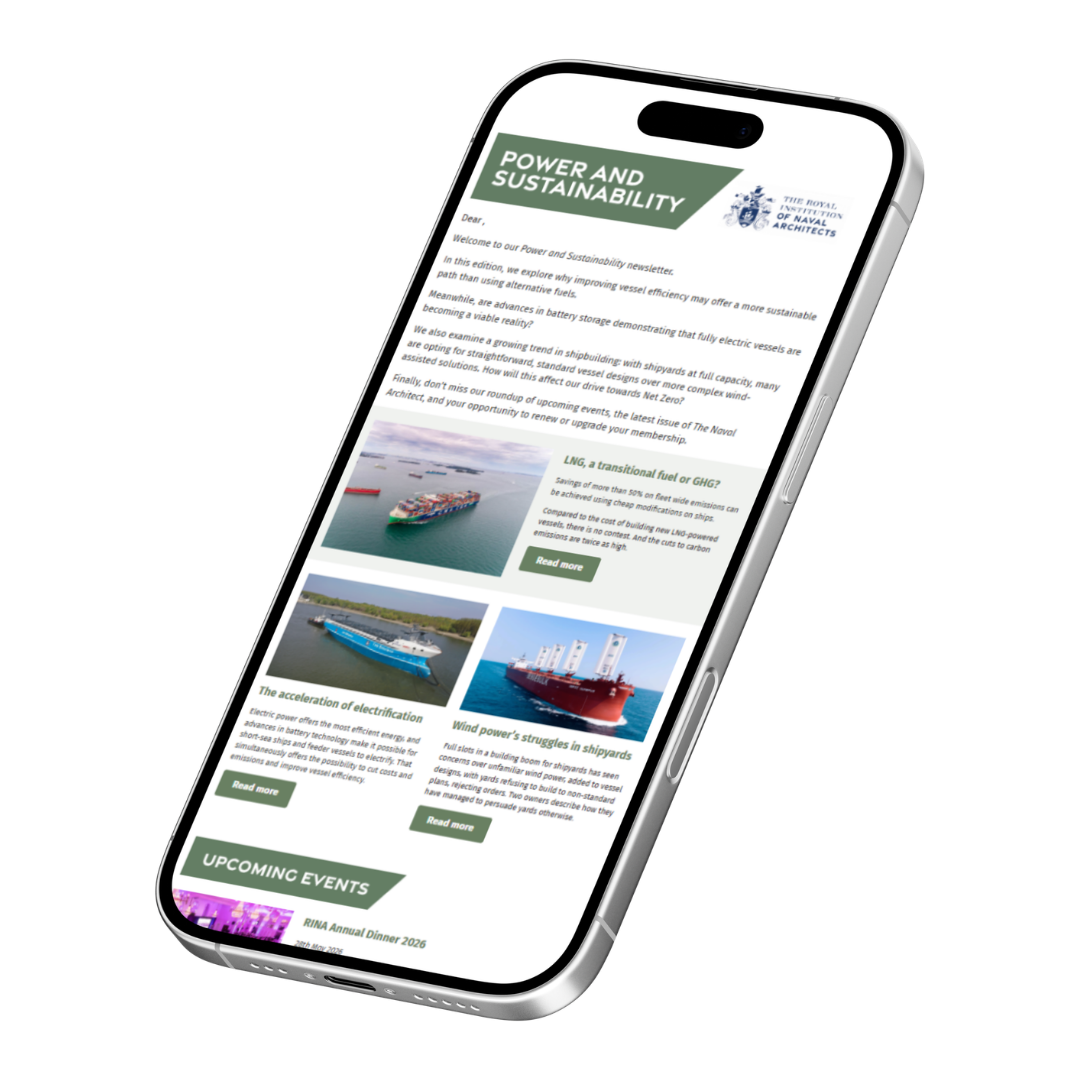
Newsletters
Stay connected with the global maritime community through RINA’s newsletters.
Whether you are a member or not, you can receive updates from The Naval Architect, alongside selected RINA news, events and industry insights. Members also gain access to a wider portfolio of exclusive newsletters on key topics in the maritime industry.