The Naval Architect provides in-depth information on all aspects of vessel design, construction and engineering. Practical applications of latest technology and case studies are accompanied by analysis and foresights. Published every two months, the magazine covers everything from superyachts and short-hop ferries to tankers and heavy-lift vessels; from battery pack installations and sail-assisted solutions to LNG tank retrofits; and from offshore safety to warship resilience.
LOW REYNOLDS NUMBER PERFORMANCE OF A MODEL SCALE T-FOIL
Transactions
Ride control technologies are central to the performance of modern high-speed ferries, where comfort, efficiency, and seaworthiness depend on precise motion management. Detailed evaluation of a submerged T-foil highlights the real-world impact of hydrodynamic effects and control-system dynamics, reinforcing the complexity behind delivering responsive and reliable vessel stabilisation.
VERTICAL AND SLOPED BANK EFFECTS ON DIFFERENT SHIP TYPES
Transactions
Navigating close to shorelines introduces complex hydrodynamic challenges that can significantly affect vessel behaviour. High-fidelity simulation of bank effects reveals how ship size, channel geometry, and proximity to embankments influence manoeuvrability, highlighting critical interactions that can increase collision risk and shape safer navigation strategies in restricted waterways.
SPECIAL CONSUMPTION TAX INCENTIVE ON MARINE BUNKERS AND CARGO SHIFTING TO SHORT SEA SHIPPING IN TURKISH CABOTAGE ROUTES
Transactions
As governments and industries seek practical pathways to lower carbon emissions, transport mode selection is gaining renewed strategic importance. Analysis of maritime fuel use and freight movement patterns highlights the environmental advantages of shipping, underscoring how modal shifts and fuel-efficiency improvements could play a significant role in broader decarbonisation efforts.
ANCHOR WINDLASSES: A DESIGN PROPOSAL TO STANDARDISE REGULATIONS
Transactions
As shipbuilders seek to balance customisation, compliance, and cost competitiveness, standardisation is emerging as a powerful lever for efficiency. Harmonising regulatory requirements and equipment design could reduce complexity, unlock economies of scale, and help manufacturers deliver more cost-effective solutions without compromising the operational needs of vessel owners.
APPLICATION OF FUZZY ANALYTIC HIERARCHY PROSES FOR ERROR DETECTION OF AUXILARY SYSTEMS OF SHIP MAIN DIESEL ENGINES
Transactions
Engine room reliability remains fundamental to safe and efficient vessel operations, where minor faults can quickly escalate into costly failures. Applying fuzzy decision-making techniques to fault diagnosis and maintenance planning helps prioritise critical systems, highlighting the growing role of data-driven decision support in improving operational resilience and engineering performance.
INVESTIGATION OF OIL TANKER ACCIDENTS BY USING GIS
Transactions
Oil tanker safety remains a critical concern at key global trade chokepoints, where navigational complexity and traffic density can amplify operational risk. By transforming historical accident records into geospatial intelligence, emerging analytical approaches are uncovering patterns in accident occurrence, offering fresh perspectives on risk concentration, route management, and maritime safety planning.
COMPARISON BETWEEN DIFFERENT SURVIVABILITY MEASURES ON A GENERIC FRIGATE
Transactions
Ship survivability is increasingly recognised as a design challenge that extends far beyond structural protection alone. Emerging approaches show that survivability outcomes depend heavily on how threats are defined and assessed, highlighting the importance of evaluating impacts across multiple ship functions and incorporating uncertainty into early-stage design decisions.
ON THE SAFE PILOTAGE OF SHIP'S WITH PROPULSION THAT CAN AZIMUTH FOR STEERING
Transactions
As azimuth propulsion transforms vessel manoeuvrability across the maritime sector, operational practices and workforce knowledge are struggling to keep pace with technological change. Growing experience from accidents, incidents, and training initiatives highlights the need for greater standardisation, stronger competency development, and closer alignment between ship design and operational reality.
BUCKLING AND POST-BUCKLING OF ISOTROPIC AND COMPOSITE STIFFENED PANELS: A REVIEW ON ANALYSIS AND EXPERIMENT (2000-2012)
Transactions
As demand grows for lighter and stronger engineering structures, understanding buckling behaviour is becoming increasingly important to design performance and safety. Advances in the analysis of stiffened metallic and composite panels are reshaping approaches to structural optimisation, revealing new opportunities to balance weight reduction, load capacity, and long-term structural resilience.
PRESSURE DISTRIBUTION DUE TO STERN TAB DEFLECTION AT MODEL SCALE
Transactions
Trim tabs play a vital role in improving the performance and efficiency of high-speed vessels, yet the forces they generate remain more complex than conventional assumptions suggest. Combining physical testing with CFD analysis reveals important pressure-distribution effects that influence lift generation, offering fresh insight into motion control, resistance reduction, and vessel optimisation.
RANS-BASED CFD PREDICTION OF THE HYDRODYNAMIC COEFFICIENTS OF DARPA SUBOFF GEOMETRY IN STRAIGHT-LINE AND ROTATING ARM MANOEUVRES
Transactions
As CFD becomes an increasingly important tool in underwater vehicle design, confidence in simulation results depends heavily on modelling choices. Analysis of manoeuvring hydrodynamics highlights how turbulence models, mesh quality, and boundary conditions can significantly influence accuracy, reinforcing the importance of robust simulation practices in engineering decision-making.
AN OVERVIEW: ENVIRONMENTAL AND ECONOMIC STRATEGIES FOR IMPROVING QUALITY OF SHIPS EXHAUST GASES
Transactions
As pressure mounts on the maritime sector to curb emissions, shipowners face increasingly complex choices between environmental performance, regulatory compliance, and operating costs. Comparative assessment of leading emissions-reduction technologies highlights the trade-offs shaping fleet decarbonisation strategies, with fuel choice and retrofit investments emerging as critical determinants of future sustainability.
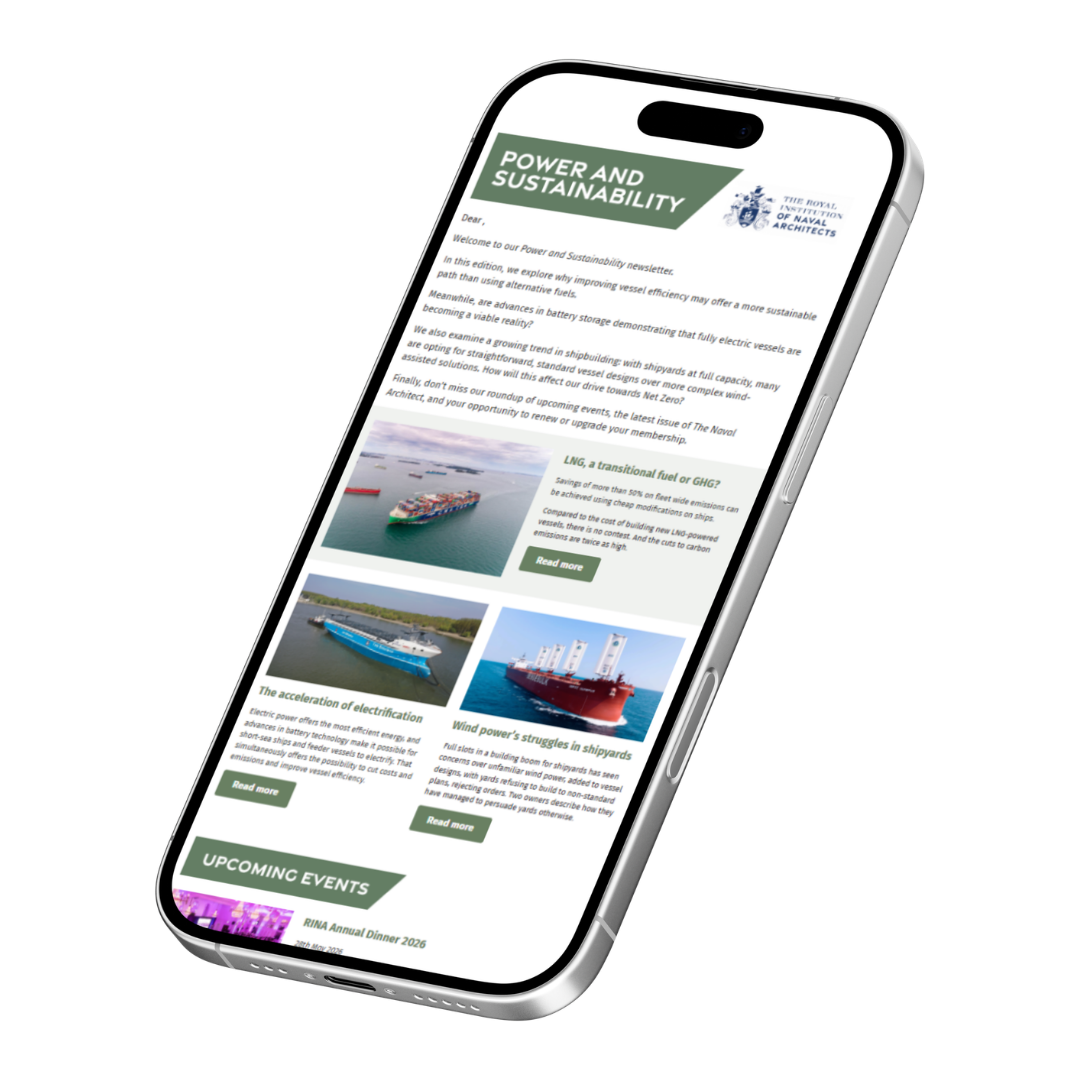
Newsletters
Stay connected with the global maritime community through RINA’s newsletters.
Whether you are a member or not, you can receive updates from The Naval Architect, alongside selected RINA news, events and industry insights. Members also gain access to a wider portfolio of exclusive newsletters on key topics in the maritime industry.