The Naval Architect provides in-depth information on all aspects of vessel design, construction and engineering. Practical applications of latest technology and case studies are accompanied by analysis and foresights. Published every two months, the magazine covers everything from superyachts and short-hop ferries to tankers and heavy-lift vessels; from battery pack installations and sail-assisted solutions to LNG tank retrofits; and from offshore safety to warship resilience.
A COMPARISON OF EXPERIMENTAL AND NUMERICAL BEHAVIOUR CHARACTERISTICS OF A SHIP ENTERING A LOCK USING BENCHMARK TEST DATA
Transactions
Managing ships in locks and confined waterways remains one of maritime engineering’s most demanding challenges. Comparative analysis of advanced numerical and experimental approaches shows steady progress in predicting complex hydrodynamic forces, while underscoring the continued value of physical testing. Together, these capabilities are shaping more reliable tools for navigation and infrastructure planning.
AN INHERENTLY SAFER LAYOUT DESIGN FOR THE LIQUEFACTION PROCESS OF AN FLNG PLANT
Transactions
As FLNG facilities grow in scale and complexity, safety is increasingly being designed into operations from the outset rather than added later. An innovative layout optimisation approach balances risk, space constraints, and economics, reducing potential domino-effect losses while providing a practical framework for safer, more resilient offshore energy infrastructure.
STRESS DISTRIBUTION IN THE HOLLOW STIFFENED HYBRID LAMINATED COMPOSITE PANELS IN SHIP STRUCTURES UNDER SINUSOIDAL LOADING
Transactions
Advanced composite materials are creating new opportunities to reduce weight, cost, and structural risk in marine construction. By combining GFRP and CFRP laminates with sophisticated stress-modelling techniques, engineers gain deeper insight into structural performance, enabling more efficient stiffened panel designs while balancing strength, durability, and economic considerations.
LOADING RESPONSE OF STERN TAB MOTION CONTROLS IN SHALLOW WATER
Transactions
Shallow-water operations may be influencing high-speed vessel performance far more than traditionally assumed. New findings reveal significant changes in active stern-tab lift behaviour as water depth decreases, with direct implications for ride control, trim optimisation, and manoeuvrability. The interaction between vessel control systems and confined-water hydrodynamics emerges as a critical design consideration.
PARAMETRIC ESTIMATION OF THE DIRECTIONAL WAVE SPECTRUM FROM SHIP MOTIONS
Transactions
Real-time awareness of sea conditions is becoming increasingly important for safe and efficient maritime operations. By transforming ship motions into a source of wave intelligence and combining parametric spectrum modelling with genetic algorithms, a new approach enables continuous sea-state estimation, advancing situational awareness for navigation, offshore operations, and autonomous systems.
ESTABLISHMENT OF NOx MEASUREMENT AND CERTIFICATION SYSTEM FOR SMALL SHIPS
Transactions
As environmental compliance requirements tighten across global shipping, the challenge of accurately measuring vessel emissions remains a significant operational hurdle. Efforts to align onboard NOx monitoring and certification with international regulations are driving the development of more practical, flexible, and cost-effective compliance frameworks for diverse commercial fleets.
TOWARDS A NEW SOLAS CONVENTION: A TRANSFORMATION OF THE SHIP SAFETY REGULATORY FRAMEWORK
Transactions
Maritime safety regulation is approaching a pivotal moment as technology, automation, and operational demands outpace frameworks developed for an earlier era. A vision for fundamentally rethinking SOLAS through goal-based safety principles could enable a more adaptive, future-ready approach, balancing innovation, risk management, and regulatory effectiveness across the shipping industry.
ASSEMBLY LINE BALANCING IMPLEMENTATION IN MINOR AND SUB ASSEMBLY WORK SHOP AT SHIPYARDS
Transactions
As competition intensifies across global shipbuilding, production speed is becoming a critical differentiator. Reimagining traditional yard layouts through assembly-line principles and simulation-driven optimisation can streamline prefabrication workflows, reduce manufacturing bottlenecks, and improve delivery performance. The shift highlights how industrial engineering techniques are reshaping efficiency and competitiveness in modern shipyards.
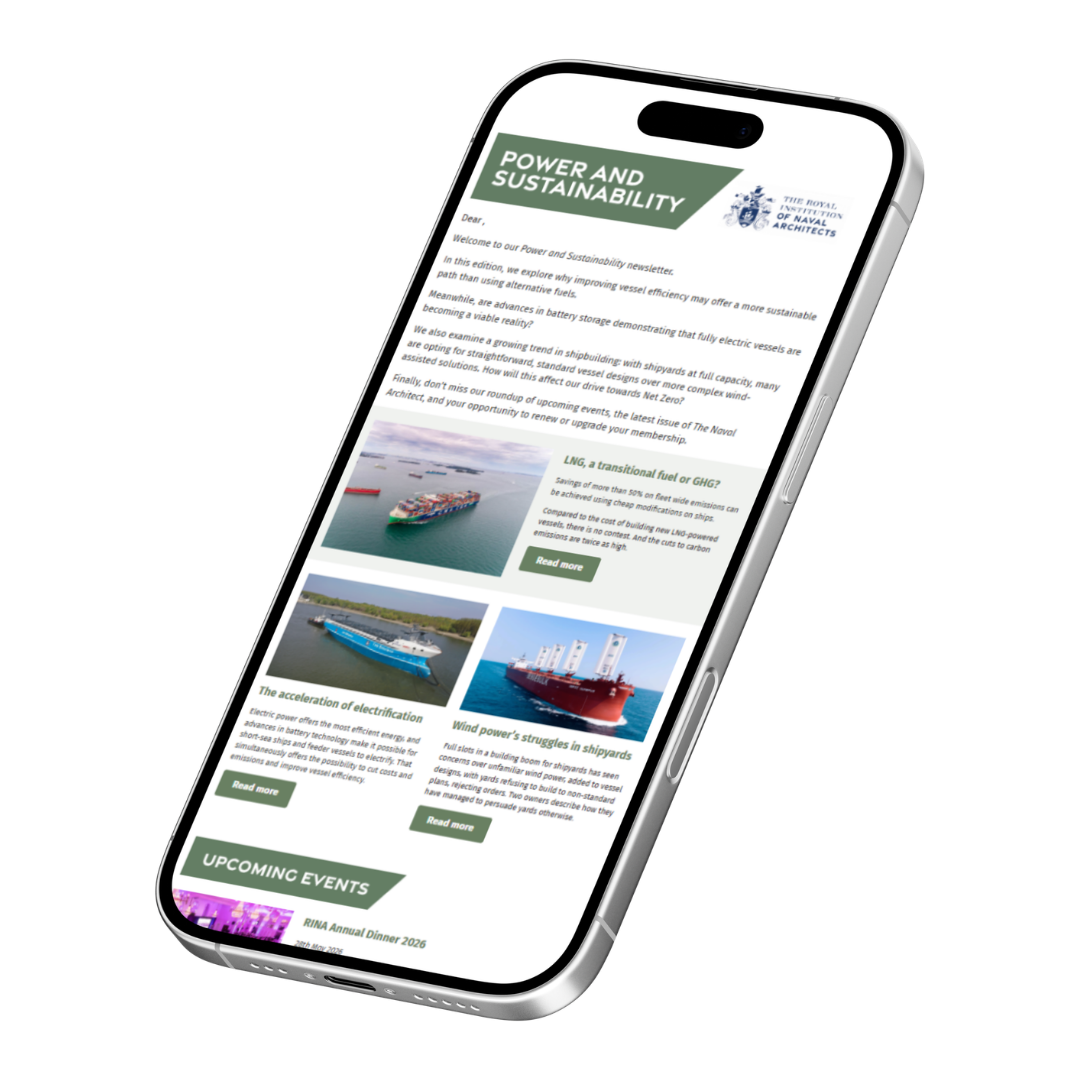
Newsletters
Stay connected with the global maritime community through RINA’s newsletters.
Whether you are a member or not, you can receive updates from The Naval Architect, alongside selected RINA news, events and industry insights. Members also gain access to a wider portfolio of exclusive newsletters on key topics in the maritime industry.