The Naval Architect provides in-depth information on all aspects of vessel design, construction and engineering. Practical applications of latest technology and case studies are accompanied by analysis and foresights. Published every two months, the magazine covers everything from superyachts and short-hop ferries to tankers and heavy-lift vessels; from battery pack installations and sail-assisted solutions to LNG tank retrofits; and from offshore safety to warship resilience.
TOWARDS A NEW SOLAS CONVENTION: A TRANSFORMATION OF THE SHIP SAFETY REGULATORY FRAMEWORK
Transactions
Maritime safety regulation is approaching a pivotal moment as technology, automation, and operational demands outpace frameworks developed for an earlier era. A vision for fundamentally rethinking SOLAS through goal-based safety principles could enable a more adaptive, future-ready approach, balancing innovation, risk management, and regulatory effectiveness across the shipping industry.
ASSEMBLY LINE BALANCING IMPLEMENTATION IN MINOR AND SUB ASSEMBLY WORK SHOP AT SHIPYARDS
Transactions
As competition intensifies across global shipbuilding, production speed is becoming a critical differentiator. Reimagining traditional yard layouts through assembly-line principles and simulation-driven optimisation can streamline prefabrication workflows, reduce manufacturing bottlenecks, and improve delivery performance. The shift highlights how industrial engineering techniques are reshaping efficiency and competitiveness in modern shipyards.
UNSTEADY CHARACTERISTICS OF LIFT GENERATED BY SMALL UNDERWATER CONTROL FIN
Transactions
High-speed oceangoing vessels face a constant trade-off between punctuality and wave-induced slamming. An innovative Resonance-Free SWATH design uses actively controlled fins to eliminate motion resonance, while advanced 3D Rankine panel modelling and experiments reveal critical unsteady lift, phase-lag, and hydrodynamic interference effects that shape future vessel performance.
HUMAN FACTORS ON OFFSHORE SUPPLY VESSELS IN THE NORWEGIAN SEA - AN EXPLANATORY SURVEY
Transactions
Safety at sea depends on more than technology alone. Findings from next-generation offshore vessels underscore the operational value of embedding human factors into design decisions, linking crew experience, maintainability, and workplace conditions with measurable outcomes. The results point to new opportunities for reducing incidents and strengthening vessel performance.
DESIGN OF LOW-DRAG AUTONOMOUS UNDERWATER VEHICLES AND FLOW CONTROL
Transactions
Autonomous underwater vehicle design is challenging long-held assumptions about the trade-off between efficiency and capability. By combining advanced body shaping with distributed boundary-layer suction, engineers achieve exceptionally low drag in compact, low-slenderness designs, unlocking new possibilities for endurance, manoeuvrability, and mission flexibility in next-generation underwater systems.
SHIP-SHIP HYDRODYNAMIC INTERACTION IN CONFINED WATERS WITH COMPLEX BOUNDARIES BY A PANELLED MOVING PATCH METHOD
Transactions
Digital tools are reshaping how navigational risks are managed in increasingly constrained waterways. A fast potential-flow modelling approach delivers real-time insight into ship-to-ship hydrodynamic interactions, even around complex seabed features. By extending accurate prediction beyond simplified environments, the capability could strengthen operational decision-making, safety, and traffic management.
DESIGN OF ADAPTIVE FUZZY FRACTIONAL ORDER PID CONTROLLER FOR AUTONOMOUS UNDERWATER VEHICLE (AUV) IN HEADING AND DEPTH ATTITUDES
Transactions
Underwater autonomy is pushing conventional control strategies to their limits. By combining adaptive fuzzy logic with fractional-order PID control, a new self-tuning approach improves stability, precision, and resilience in highly dynamic operating environments. The results highlight a promising pathway for managing uncertainty, disturbance rejection, and advanced autonomous manoeuvring.
Technical Note: EFFECT OF THE SPANWISE DISCRETISATION ON TURBULENT FLOW PAST A CIRCULAR CYLINDER
Transactions
As simulation becomes central to engineering design, balancing accuracy with computational efficiency remains a critical challenge. New insights into large-eddy simulation of turbulent cylinder flows identify practical limits for spatial resolution, offering a route to faster, more cost-effective modelling without sacrificing the complex flow physics engineers rely upon.
AN AHP MODEL FOR THE CHOICE OF SHIP FLAG: A CASE STUDY OF TAIWANESE SHIPOWNERS
Transactions
Strategic decisions around ship registration are increasingly shaped by economic competitiveness and regulatory flexibility. A structured decision-making framework reveals the factors carrying greatest influence over flag selection, highlighting how labour costs, financial incentives, and compliance considerations can reshape fleet strategy and inform policies aimed at strengthening national maritime registries.
Newsletters
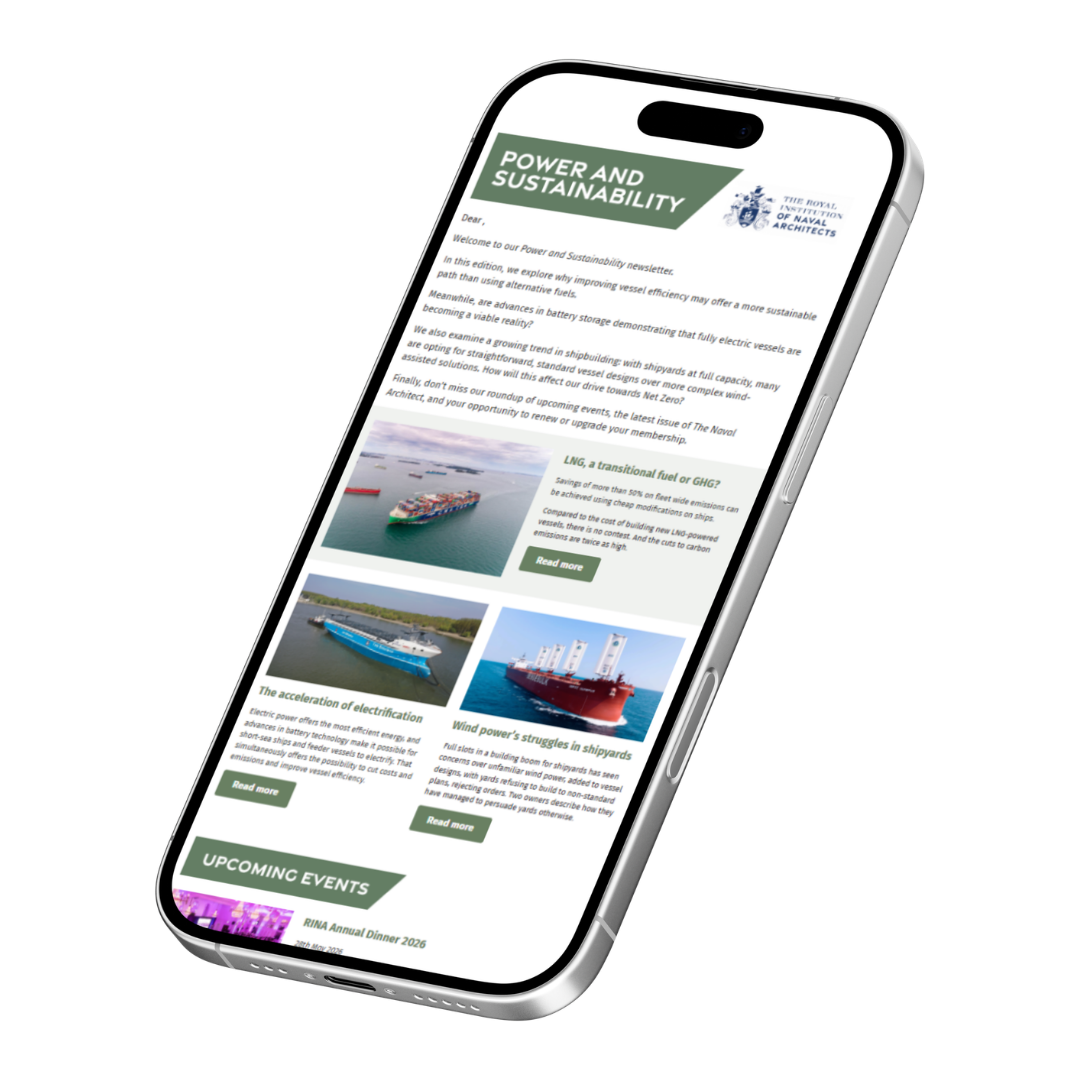
Stay connected with the global maritime community through RINA’s newsletters.
Whether you are a member or not, you can receive updates from The Naval Architect, alongside selected RINA news, events and industry insights. Members also gain access to a wider portfolio of exclusive newsletters on key topics in the maritime industry.