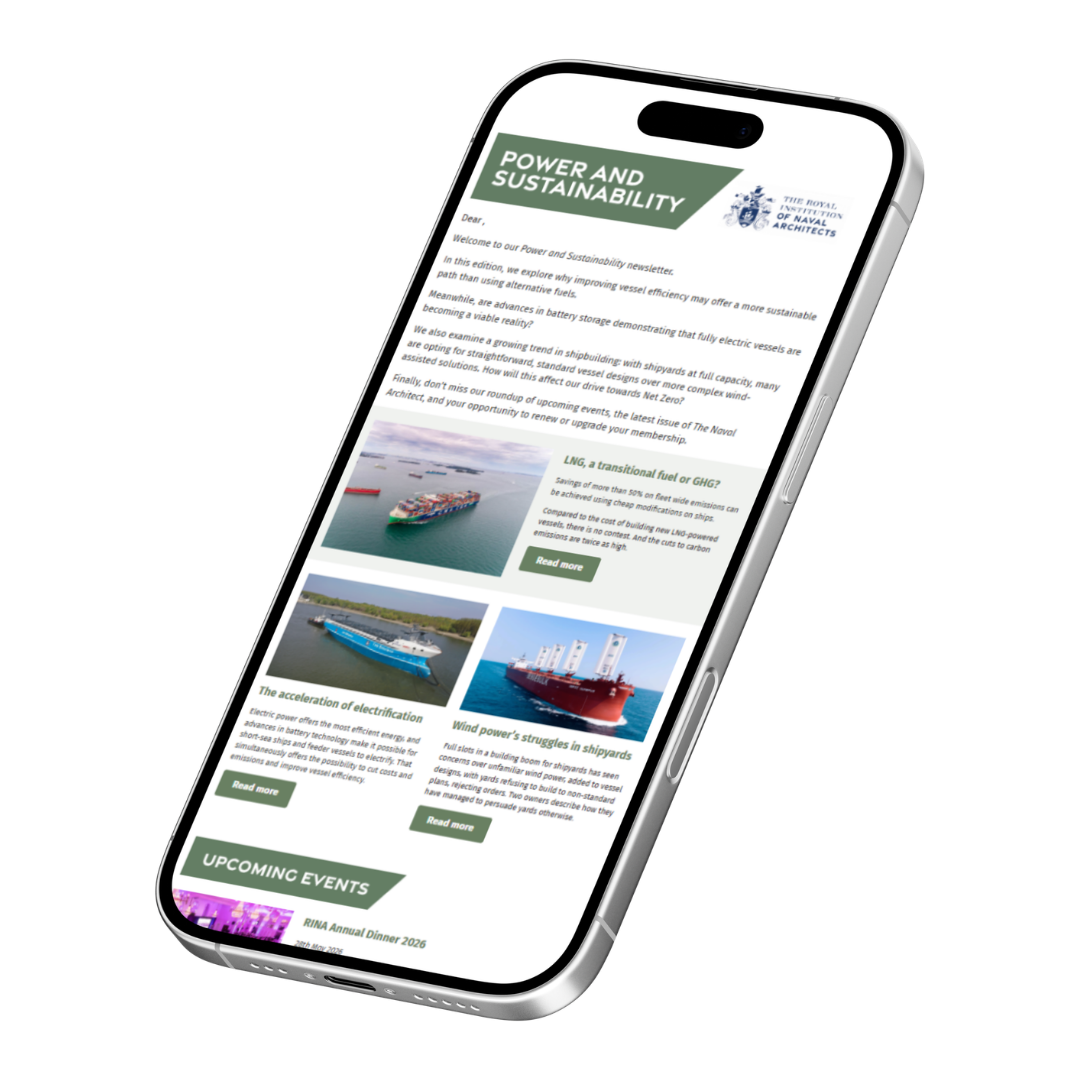
The Naval Architect provides in-depth information on all aspects of vessel design, construction and engineering. Practical applications of latest technology and case studies are accompanied by analysis and foresights. Published every two months, the magazine covers everything from superyachts and short-hop ferries to tankers and heavy-lift vessels; from battery pack installations and sail-assisted solutions to LNG tank retrofits; and from offshore safety to warship resilience.
CHOOSING THE STYLE OF A NEW DESIGN - THE KEY SHIP DESIGN DECISION
Transactions
Early-stage ship design decisions can have lasting consequences for capability, performance and adaptability. For complex naval vessels, design “style” shapes choices across systems, architectures and disciplines, making it a powerful framework for exploring alternatives, managing trade-offs and guiding more coherent, effective vessel development from the outset.
MODEL PREDICTIVE CONTROL OF AN AUV USING DE-COUPLED APPROACH
Transactions
Autonomous underwater vehicles are becoming increasingly capable through advanced control strategies designed to manage complex, nonlinear dynamics. A decoupled model predictive control approach simplifies implementation while maintaining effective guidance and stability, supporting more reliable ocean survey operations and expanding the potential of autonomous systems in demanding underwater environments.
Discussion: HULLFORM & HYDRODYNAMIC CONSIDERATIONS IN THE DESIGN OF THE UK FUTURE AIRCRAFT CARRIER (CVF)
Transactions
Future aircraft carrier design demands the careful integration of hydrodynamics, aviation requirements, propulsion, structural engineering and operational effectiveness. Balancing these interconnected considerations remains essential to delivering complex naval platforms that are affordable, resilient and operationally effective, while accommodating evolving technologies and future strategic demands.
HULLFORM & HYDRODYNAMIC CONSIDERATIONS IN THE DESIGN OF THE UK FUTURE AIRCRAFT CARRIER (CVF)
Transactions
Aircraft carrier design requires balancing a complex mix of hydrodynamic performance, aviation operations, survivability and supportability considerations. Exploring alternative Future Aircraft Carrier concepts reveals how early hullform and propulsion decisions can shape capability, efficiency and risk, offering valuable insight into the multidisciplinary trade-offs that underpin successful naval platform development.
NON-DIMENSIONALISATION OF LATERAL DISTANCES BETWEEN VESSELS OF DISSIMILAR SIZES FOR INTERACTION EFFECT STUDIES
Transactions
Safe and effective ship-assist operations depend on a clear understanding of the hydrodynamic interactions between tugs and large vessels. Improved methods for scaling and comparing interaction effects across different vessel sizes are enhancing operational planning, helping define safer tug operating distances and supporting more reliable manoeuvring in demanding port environments.
ANALYSIS OF A WWII T2-TANKER USING A VIRTUAL 3D MODEL AND CONTEMPORARY CRITERIA
Transactions
The survival of the S.S. Ohio remains one of the most remarkable stories in maritime history. Re-examining the tanker’s wartime damage through modern stability, buoyancy and structural-strength analysis provides fresh insight into the factors that enabled the vessel to reach Malta, highlighting the enduring importance of survivability and resilience in ship design.
SAFE MOORING OF LARGE CONTAINER SHIPS AT QUAY WALLS SUBJECT TO PASSING SHIP EFFECTS
Transactions
Growing vessel sizes and rising port traffic are placing increasing demands on mooring systems and harbour infrastructure. Understanding how mooring arrangements and line characteristics influence a vessel’s response to passing ships can enhance berth safety, reduce operational risk and support more effective management of large container vessels in busy port environments.
THE SAFETY OF SHIP BERTHING OPERATIONS AT PORT DOCK - A GAP ASSESSMENT MODEL BASED ON FUZZY AHP
Transactions
Safe and efficient berthing operations rely on close coordination between shipmasters, marine pilots and port authorities. Understanding differing perceptions of key safety factors can help reduce operational risk, improve decision-making and strengthen port safety performance, particularly as vessel sizes and navigational complexity continue to increase.
NUMERICAL PREDICTION OF VERTICAL SHIP MOTIONS AND ADDED RESISTANCE
Transactions
Advanced CFD techniques are expanding the ability to predict ship behaviour in waves, offering deeper insight into vertical motions and added resistance under realistic operating conditions. Improved modelling of coupled hydrodynamic responses supports more accurate performance assessment, helping designers optimise efficiency, enhance seakeeping performance and reduce uncertainty in high-speed vessel development.
REGULATORY APPROACHES LEADING TO HOLISTIC IMPLEMENTATION IN A FISHING VESSEL FLEET LESS THAN 24M IN LENGTH
Transactions
Fishing vessel safety remains a persistent challenge for maritime administrations seeking to reduce fatalities while supporting sustainable operations. Goal-based safety frameworks and risk-informed assessment approaches are creating new opportunities to improve safety management, encourage design flexibility and support more holistic governance of small fishing fleets and the communities that depend on them.
A SIMULATION-BASED METHODOLOGY FOR EVALUATING THE FACTORS ON SHIP EMERGENCY EVACUATION
Transactions
Effective emergency evacuation remains a critical aspect of passenger vessel safety, where human behaviour, vessel layout and routing strategies can significantly influence outcomes. Advanced simulation techniques are improving understanding of evacuation performance, helping operators optimise emergency procedures, enhance passenger safety and support more resilient design and operational decision-making.
RISK ANALYSIS OF OFFSHORE TRANSPORTATION ACCIDENT IN ARCTIC WATERS
Transactions
Arctic shipping presents unique safety challenges as increasing activity in ice-covered waters coincides with complex environmental and operational risks. Advanced risk-analysis frameworks that combine accident causation, consequence modelling and uncertainty assessment are strengthening decision-making, supporting safer navigation, more effective risk management and improved resilience along emerging Arctic trade routes.
Newsletters
Stay connected with the global maritime community through RINA’s newsletters.
Whether you are a member or not, you can receive updates from The Naval Architect, alongside selected RINA news, events and industry insights. Members also gain access to a wider portfolio of exclusive newsletters on key topics in the maritime industry.