The Naval Architect provides in-depth information on all aspects of vessel design, construction and engineering. Practical applications of latest technology and case studies are accompanied by analysis and foresights. Published every two months, the magazine covers everything from superyachts and short-hop ferries to tankers and heavy-lift vessels; from battery pack installations and sail-assisted solutions to LNG tank retrofits; and from offshore safety to warship resilience.
Discussion: SLIDING MODE BASED PREDICTIVE CONTROLLER OF A SPHEROIDAL UNDERWATER VEHICLE
Transactions
Advanced control systems continue to expand the capabilities of autonomous underwater vehicles operating in complex environments. The combination of predictive control and robust stabilisation techniques highlights growing opportunities to improve vehicle performance, manoeuvrability and reliability, supporting the development of more capable autonomous systems for marine, defence and research applications.
AN OPTIMIZATION MODEL FOR PRELIMINARY STABILITY AND CONFIGURATION ANALYSES OF SEMI-SUBMERSIBLES
Transactions
Early-stage design decisions play a pivotal role in the performance, efficiency and commercial viability of semi-submersible platforms. Integrating mathematical design models with global optimisation techniques enables a more balanced assessment of stability, motion behaviour and operational requirements, supporting smarter design choices and more efficient offshore structures from the outset.
EVALUATION METHODOLOGY ON TRAJECTORY OF INBOUND SINGLE SHIP USING SIMILARITY MEASUREMENT BETWEEN PLANAR CLOUDS
Transactions
Quantitative assessment is becoming increasingly important in pilotage, training and port operations, where understanding vessel manoeuvring performance can enhance safety and consistency. By combining simulator data, trajectory modelling and scoring techniques, more objective evaluation of ship handling can support improved training outcomes, operational benchmarking and better-informed navigational decision-making.
CFD STUDY OF SHIP-TO-BANK INTERACTION
Transactions
Navigating in confined and shallow waterways remains a significant challenge, where ship-to-bank interactions can affect vessel controllability, safety and operational efficiency. Advances in CFD modelling are improving understanding of these complex hydrodynamic effects, supporting more accurate prediction of bank-induced forces and helping inform safer navigation and waterway management strategies.
MANAGING INTERNATIONAL COLLABORATIVE RESEARCH BETWEEN ACADEMICS, INDUSTRIES, AND POLICY MAKERS IN UNDERSTANDING THE EFFECTS OF BIOFOULING IN SHIP HULL TURBULENT BOUNDARY LAYERS
Transactions
Biofouling is emerging as a major operational and environmental challenge, with hull roughness significantly affecting fuel consumption and emissions. International collaboration between industry, academia and classification bodies is advancing new measurement and monitoring techniques, creating opportunities for more effective hull management, improved vessel efficiency and better-informed sustainability and maintenance strategies.
EXPERIMENTAL INVESTIGATION INTO THE EFFECTS OF REDUCED VERTICAL CENTRE OF GRAVITY OF AN ARTICULATED CONCRETE MATTRESS IN CURRENT FLOW
Transactions
Stability is a critical consideration for subsea protection systems, where installation configuration can significantly influence long-term performance. Experimental analysis of articulated concrete mattresses reveals how centre-of-gravity changes affect hydrodynamic behaviour in current flows, providing valuable guidance for installation practices and supporting more reliable protection of offshore and subsea infrastructure.
AN ADVANCED PROCEDURE FOR THE QUANTITATIVE RISK ASSESSMENT OF OFFSHORE INSTALLATIONS IN EXPLOSIONS
Transactions
Managing explosion risk remains a critical challenge for offshore oil and gas facilities, where major incidents can have severe safety, environmental and financial consequences. Advanced probabilistic risk assessment is enabling a more comprehensive understanding of explosion hazards, supporting risk-informed design decisions, improved resilience and stronger protection of personnel, assets and the environment.
NUMERICAL STUDY ON NOX EMISSION REDUCTION MECHANISM OF HCCI MARINE DIESEL ENGINE FOR IMO TIER III EMISSION LIMITS
Transactions
Homogeneous charge compression ignition technology is emerging as a promising pathway to cleaner marine propulsion, combining high thermal efficiency with dramatically lower nitrogen oxide emissions. As pressure grows to meet increasingly stringent environmental regulations, advanced combustion strategies could play a significant role in supporting the next generation of low-emission marine engines.
ADVANTAGES AND OBSTACLES OF APPLYING PHYSIOLOGICAL COMPUTING IN REAL WORLD: LESSONS LEARNED FROM SIMULATOR BASED MARITIME TRAINING
Transactions
Simulator-based maritime training is evolving beyond traditional assessment methods through the integration of physiological computing and wearable technologies. Real-time monitoring of cognitive and physical responses offers new opportunities to enhance performance evaluation, adaptive training and human-centred system design, while highlighting challenges associated with implementation in operational environments.
A VIRTUAL PISTON-TYPE WAVE MAKER BASED ON OPENFOAM
Transactions
Accurate numerical wave generation is essential for reliable hydrodynamic simulation and offshore engineering analysis. Enhancements to the OpenFOAM platform are improving the modelling of finite-amplitude waves, while validation against analytical and experimental data strengthens confidence in virtual testing environments used to support marine research, design and performance evaluation.
A FUZZY NEURAL NETWORK MODEL FOR ANALYZING BALTIC DRY INDEX IN THE BULK MARITIME INDUSTRY
Transactions
Forecasting freight market movements remains a strategic priority across the dry bulk shipping sector. Advanced fuzzy neural network techniques are enhancing the prediction of Baltic Dry Index trends by capturing relationships between shipping and financial market indicators, supporting more informed investment decisions, fleet planning and risk management in a highly volatile market.
NAVAL ARCHITECTURAL CONSIDERATIONS IN THE DESIGN OF FLOATING DOCK
Transactions
Floating docks play a vital role in ship repair and maintenance, placing unique demands on stability, structural strength and operational flexibility. Effective design strategies that balance lifting capacity, structural efficiency and docking requirements can enhance safety, optimise material use and support more reliable performance throughout the dock’s operational lifecycle.
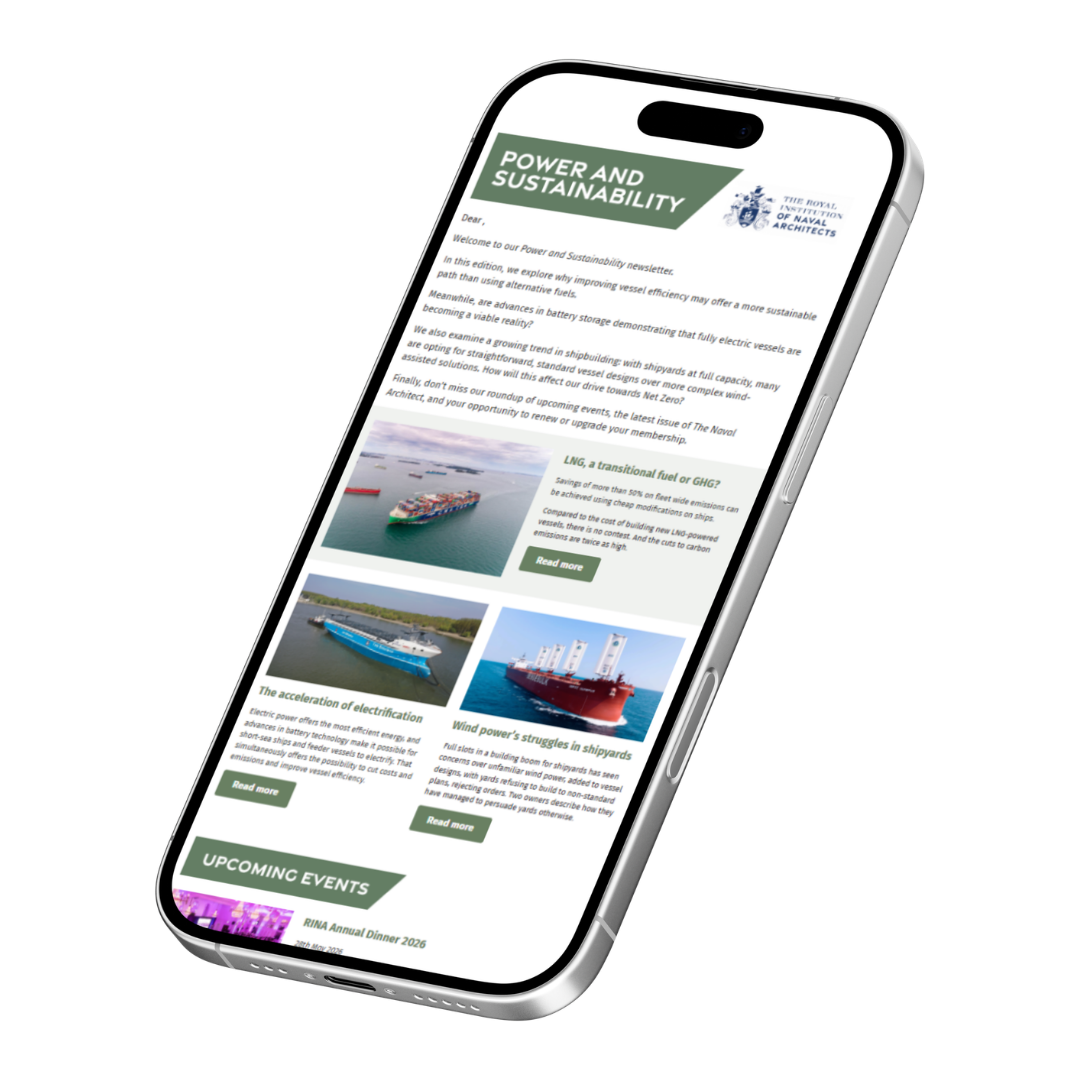
Newsletters
Stay connected with the global maritime community through RINA’s newsletters.
Whether you are a member or not, you can receive updates from The Naval Architect, alongside selected RINA news, events and industry insights. Members also gain access to a wider portfolio of exclusive newsletters on key topics in the maritime industry.