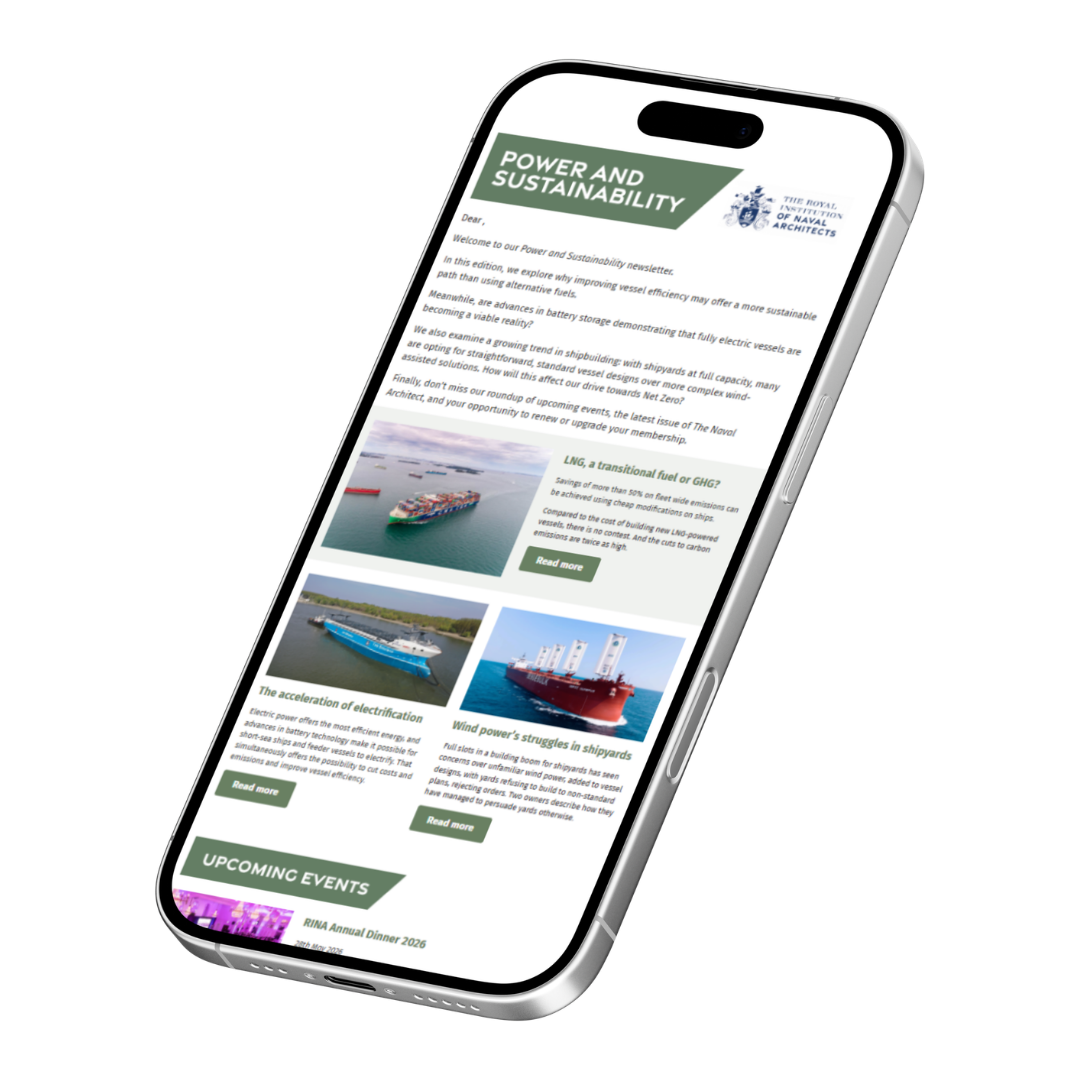
The Naval Architect provides in-depth information on all aspects of vessel design, construction and engineering. Practical applications of latest technology and case studies are accompanied by analysis and foresights. Published every two months, the magazine covers everything from superyachts and short-hop ferries to tankers and heavy-lift vessels; from battery pack installations and sail-assisted solutions to LNG tank retrofits; and from offshore safety to warship resilience.
AN ADVANCED PROCEDURE FOR THE QUANTITATIVE RISK ASSESSMENT OF OFFSHORE INSTALLATIONS IN EXPLOSIONS
Transactions
Managing explosion risk remains a critical challenge for offshore oil and gas facilities, where major incidents can have severe safety, environmental and financial consequences. Advanced probabilistic risk assessment is enabling a more comprehensive understanding of explosion hazards, supporting risk-informed design decisions, improved resilience and stronger protection of personnel, assets and the environment.
NUMERICAL STUDY ON NOX EMISSION REDUCTION MECHANISM OF HCCI MARINE DIESEL ENGINE FOR IMO TIER III EMISSION LIMITS
Transactions
Homogeneous charge compression ignition technology is emerging as a promising pathway to cleaner marine propulsion, combining high thermal efficiency with dramatically lower nitrogen oxide emissions. As pressure grows to meet increasingly stringent environmental regulations, advanced combustion strategies could play a significant role in supporting the next generation of low-emission marine engines.
ADVANTAGES AND OBSTACLES OF APPLYING PHYSIOLOGICAL COMPUTING IN REAL WORLD: LESSONS LEARNED FROM SIMULATOR BASED MARITIME TRAINING
Transactions
Simulator-based maritime training is evolving beyond traditional assessment methods through the integration of physiological computing and wearable technologies. Real-time monitoring of cognitive and physical responses offers new opportunities to enhance performance evaluation, adaptive training and human-centred system design, while highlighting challenges associated with implementation in operational environments.
A VIRTUAL PISTON-TYPE WAVE MAKER BASED ON OPENFOAM
Transactions
Accurate numerical wave generation is essential for reliable hydrodynamic simulation and offshore engineering analysis. Enhancements to the OpenFOAM platform are improving the modelling of finite-amplitude waves, while validation against analytical and experimental data strengthens confidence in virtual testing environments used to support marine research, design and performance evaluation.
A FUZZY NEURAL NETWORK MODEL FOR ANALYZING BALTIC DRY INDEX IN THE BULK MARITIME INDUSTRY
Transactions
Forecasting freight market movements remains a strategic priority across the dry bulk shipping sector. Advanced fuzzy neural network techniques are enhancing the prediction of Baltic Dry Index trends by capturing relationships between shipping and financial market indicators, supporting more informed investment decisions, fleet planning and risk management in a highly volatile market.
NAVAL ARCHITECTURAL CONSIDERATIONS IN THE DESIGN OF FLOATING DOCK
Transactions
Floating docks play a vital role in ship repair and maintenance, placing unique demands on stability, structural strength and operational flexibility. Effective design strategies that balance lifting capacity, structural efficiency and docking requirements can enhance safety, optimise material use and support more reliable performance throughout the dock’s operational lifecycle.
SLIDING MODE BASED PREDICTIVE CONTROLLER OF A SPHEROIDAL UNDERWATER VEHICLE
Transactions
Autonomous underwater vehicles are expanding their role in inspection, security and surveillance missions, creating demand for control systems capable of managing highly unstable underwater dynamics. Combining sliding-mode and model predictive control techniques enhances vehicle stability and manoeuvring performance, supporting more reliable operation of next-generation underwater robotics in challenging marine environments.
MODEL- AND FULL-SCALE RANS SIMULATIONS FOR A DRIFT TANKER
Transactions
Understanding scale effects remains essential for accurate prediction of ship manoeuvring and hydrodynamic performance. Advanced full-scale and model-scale CFD simulations are providing deeper insight into viscous flow behaviour, helping improve the reliability of performance assessments while strengthening confidence in the methods used to support ship design and operational analysis.
BACKSTEPPING CONTROL OF NONLINEAR ROLL MOTION FOR A TRAWLER WITH FIN STABILIZER
Transactions
Roll stabilisation remains essential for improving safety, comfort and operational effectiveness in fishing vessels operating in challenging sea conditions. Combining advanced CFD-based hydrodynamic analysis with nonlinear control techniques enables more effective fin stabiliser performance, supporting reduced roll motion, enhanced vessel stability and improved seakeeping capabilities.
Newsletters
Stay connected with the global maritime community through RINA’s newsletters.
Whether you are a member or not, you can receive updates from The Naval Architect, alongside selected RINA news, events and industry insights. Members also gain access to a wider portfolio of exclusive newsletters on key topics in the maritime industry.