

Deep-vee without the penalty? The Petestep hull
It’s an adage so old that nobody knows to whom it should be attributed anymore; that good design is always about making the right compromises.
When it comes to planing monohulls, one of the biggest compromises is deadrise, the sharpness of the V angle of the hull when viewed forward from the transom. A shallow deadrise creates a shallow-vee hull, which, all other things being equal means the boat will plane earlier, achieve more speed in flat water for a given horsepower, but ride more harshly in chop than the same hull with a steeper deadrise, or deep vee.
The Petestep hull began development as the brainchild of Swedish powerboat racer and innovator Peter Bjersten in the 1990s. Bjersten had become fascinated in how the spray behaved leaving the hull of a deep-vee monohull powerboat with traditional spray rails.
Traditional spray rails
Spray rails are the usually parallel to the keel line, longitudinal strakes that run along the planing surfaces of many powerboats, particularly those designed for use offshore.
Various data over the years has confirmed that for planing hulls, spray rails confer a slight advantage in efficiency over a plain version of the same hull, somewhere between 1% and 5%, depending on which study you look at.
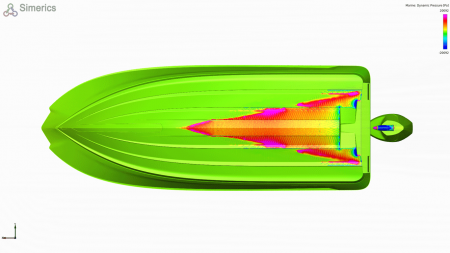 |
|---|
Because the rails are roughly horizontal underneath, they provide high lift areas reducing the effective deadrise of the hull, creating more lift so the hull runs higher and drier for a given speed.
They also interrupt the tendency of the water to sheen up the hull. The idea is the water sheens upwards from the stagnation line only as far as the next spray rail then peels away from the hull. This further reduces effective wetted area and provides a drier ride to boot.
Deflector strakes
But while Bjersten understood the benefits of spray rails, he also noted that they forced a great deal of spray outward from the hull almost perpendicular to the hull’s direction of travel.
When a hull slams down from a wave this outward redirection of water from the hull is even more pronounced.
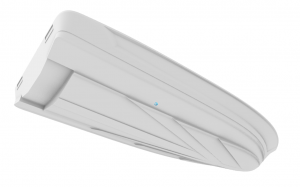
The Petestep hull that Bjersten developed is a bit of a misnomer as it isn’t any kind of hull step (although it can and has worked in combination with transversal steps). It consists of a series of parallel deflector strakes running diagonally from the forward keel area to the outer edges of the planing surfaces.
These deflectors run parallel to the stagnation line at a range of different speeds. These deflect spray that would otherwise be propelled outwards or upwards, into a downwards and backwards direction. According to the company, this increases fuel efficiency by up to 35%, with similar reductions in vertical accelerations (wave slamming), and a cleaner wake and a drier ride.
Further testing suggested that the idea could have a commercial value, with the company, ‘Petestep’ which owns the IP for the system, being established in 2015. CEO, Jonas Danielsson says that there are now ‘over 500’ hulls with this system in existence. Questioning Danielsson, it soon becomes clear that the easiest way to understand how the technology delivers is through our existing understanding of deadrise.
“If we imagine a Petestep-equipped hull with a deadrise of 20 degrees, it can have the early planing and fuel efficiency benefits of a 17-degree deadrise hull, while simultaneously delivering the rough water ride characteristics of a 23-degree deadrise hull.”
Ride comfort
Bjernsten’s original motives did not place ride comfort front and centre. He is, after all, a powerboat racer. Danielsson has also identified a mechanism here, apart from the hull efficiency gains that softens hull slamming in rough conditions. This is an important consideration for more than human ride comfort. Autonomous high-speed craft often carry fragile equipment aboard that can be damaged by sudden vertical accelerations and there is no human on board to throttle back.
Danielsson adds that this aspect, as well as the benefits of long endurance due to hull efficiency and a low wake signature has prompted some interest in the hull from the marine autonomy industry. The TacOps Toms-19, a 19ft autonomous surface platform engineered for defence, security and high-risk maritime operations was recently launched featuring a Petestep hull, for example.
 |
|---|
Scalable tech
The technology seems to scale well too with, at the other end of the size scale, the 115ft aluminium motoryacht Vanquish 115 Veloce, with almost 8,000hp (3 x 2,650hp to be exact) and 45knot capability.
One recent and particularly interesting Petestep hull design at the smaller end of the scale is the Vexus Boats DVX 23s. This is a leisure fishing boat built for the North American freshwater lakes, where they take going fast as seriously as catching fish.
Capable of nearly 80mph, the glass-fibre hulled DVX runs a single petrol outboard from 400 to 500hp mounted on an optional hydraulic jack plate.
Vexus discovered Petestep at the IBEX trade show in Tampa, Florida in 2024. The North American inland lake fishing boat market is a competitive space, with high-speed boats and the high technology equipment used often conferring a sales advantage. Danielsson added that Petestep were not particularly targeting this market at IBEX, expecting the US centre console boat market to adopt it first.
| Article Tags | |
| Article Tags | |
| General | |
| Preview Text | It’s an adage so old that nobody knows to whom it should be attributed anymore; that good design is always about making the right compromises. When it comes to planing monohulls, one of the biggest compromises is deadrise, the sharpness of the V angle of the hull when viewed forward from the transom. A shallow deadrise creates a shallow-vee hull, which, all other things being equal means the boat will plane earlier, achieve more speed in flat water for a given horsepower, but ride more harshly in chop than the same hull with a steeper deadrise, or deep vee. The Petestep hull began development as the brainchild of Swedish powerboat racer and innovator Peter Bjersten in the 1990s. Bjersten had |
| Naval Architect Edition | |
| Naval Architect Edition | |