

Shaping design around battery integration
From early pilot projects to gigawatt-scale ambition, battery technology is rapidly redefining the boundaries of ferry and fast craft design.
For long-time collaborators Corvus Energy and Fjellstrand Shipyard, advances in energy density, system integration and vessel architecture are not only enabling larger, fully electric vessels, but also accelerating a fundamental shift toward battery-centric design, where performance, efficiency and future scalability are engineered from the outset rather than retrofitted later.
The partnership is known for its pioneering work on the world’s first fully electric battery car ferry, the MF Ampere, which has now been in operation on the Norwegian fjords for 15 years.
Compared to a traditional fossil-fueled ferry, the operational cost per crossing has been reduced by an impressive 85% to 90%, generating total savings of nearly US$15 million.
But even since Ampere took to the water, battery power has come a long way. To illustrate, the MF Ampere has 1MWh of Corvus’s first-generation batteries installed, but the company’s largest system to date will have almost 42MWh of lightweight Dolphin batteries onboard.
And it’s this increase in power, coupled with the fact that batteries are now far more lightweight, which is where real progress has been made.
Why weight isn’t an issue
For battery-powered vessels, especially fast craft, there was traditionally always a penalty to pay in terms of weight.
Large-scale battery integration reshapes weight distribution and stability design in high-capacity ferries and fast craft, but this isn’t a problem if the route length and the availability of charging is properly taken into account.
Weight aside, battery systems are far more flexible in terms of placement when it comes to vessel design, says Edmund Tolo, R&D and sales manager at Fjellstrand Shipyard.
“Since batteries are more flexible to where they are placed, the distribution is in many ways easier than with engines and diesel tanks.”
“Batteries can be placed where they fit the stability criteria and high-speed craft does not have the width of the engine as a minimum criterion for hull width. Batteries are also stable in weight.”
He explains that the requirements for machinery space and structural arrangements for battery rooms are different for ferries and fast craft though.
Ferries traditionally have heavy equipment installed so are already equipped for extra weight, but for fast craft, the collision forces must be considered. So, this means that high towers of batteries need to be secured against the G-forces set in the rules, making the foundations more advanced with securing against bulkheads or above decks.
Future-proofing vessels
Much of a design team’s work surrounds the structural and operational planning required to future-proof vessels for increased battery capacity over their service life.
Finn Arne Rognstad SVP sales, passenger segment, Corvus Energy, points out that the vessel size is central here.
For large vessels there might be space and carrying capacity for installing future battery capacity, However, for small fast craft, the space and weight capacity is limited and the possibility for future reserves are smaller.
“Future-proofing a vessel starts with giving it enough space, weight allowance and system capacity to grow over time,” he says.
“Even if only a small battery is installed at first, the ship is built with stronger decks, larger foundations and clear access routes so more battery modules or newer technology can be added later without major rebuilding.”
He points out that extra room can be set aside for future racks, cooling equipment and cable runs and the electrical system is sized with enough headroom to handle higher power demands down the line.
At the same time, the design must consider how routes, charging infrastructure and regulations are likely to evolve.
This approach turns the battery system into something entirely upgradable rather than something fixed at launch.
 |
|---|
Next-generation design
Corvus’s vessel electrification projects are helping inform the next generation of high-capacity, low-emission ferry and fast craft designs.
Projects that were considered unrealistic only a few years ago are now being built and the supporting infrastructure, especially high-capacity shore charging, is evolving just as quickly.
This rapid progress is enabling larger battery installations, longer routes and a much higher degree of electrification across all vessel segments, says Rognstad.
The industry is shifting from “diesel first with a battery add on” to genuinely battery-centric vessels, where diesel acts only as a flexible range extender.
The lessons learned from these flagship projects – battery placement, thermal management, fire safety, grid integration and shoreside interface, are directly informing the next generation of high-capacity vessels.
Batteries deliver lower emissions, reduced noise and better passenger experience. Just as importantly, they are proving that large energy storage systems can be integrated safely and reliably at scale.
When operators see that 1,500-passenger, 160-car ferries can run hybrid or fully electric where infrastructure allows, it sets a new benchmark for the entire industry.
Scaled-up demand
“In the cruise and ferry markets especially, battery systems are scaling at an unprecedented rate, we are now involved in projects reaching into the hundreds of megawatt hours, something unimaginable only a short time ago,” says Rognstad.
One of the clearest examples, he says, is Incat’s new vessel, the world’s largest lightweight fast ferry, which will also carry the world’s largest marine battery installation.
Designed to carry 2,000 passengers between Argentina and Uruguay, it can operate fully electric for around 1.5 hours.
The original design was based around LNG, but switching to batteries actually reduced the vessel’s weight by 130tonnes, a demonstration of how far battery technology has come in terms of both energy density and system integration.
 |
|---|
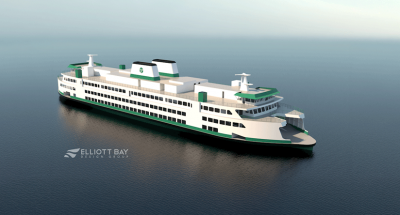
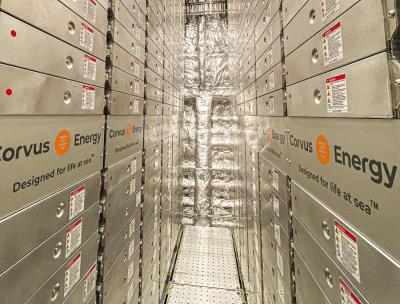
More recently, Corvus Energy was selected by ABB’s Marine & Ports division to supply its Dolphin NxtGen energy storage systems (ESS) for two new hybrid-electric ferries being built for Washington State Ferries, a leading ferry operator in the US.
This project is anticipated to be the largest investment in maritime electrification and the largest ferry electrification project in the US to date.
The company also has its eye firmly set on the future of marine battery technology.
It recently signed a Strategic Cooperation Agreement (SCA) with BYD Energy Storage, a global leader in the energy storage sector, marking a major milestone in the companies’ collaboration.
The new agreement builds on a Memorandum of Understanding (MoU) signed in December 2025, which created a long‑term framework for cooperation on next‑generation marine battery technologies.
Together, Corvus says that these projects show that electric ships are not only increasing in number, they are scaling in size, capability and ambition. Electrification is no longer a niche solution; it is rapidly becoming the new baseline for modern vessel design.
“This is what good naval architecture looks like in practice, where the entire vessel, the full energy system and the real operational profile are considered as one integrated whole,” concludes Rognstad.
| Article Tags | |
| Article Tags | |
| General | |
| Preview Text | From early pilot projects to gigawatt-scale ambition, battery technology is rapidly redefining the boundaries of ferry and fast craft design. For long-time collaborators Corvus Energy and Fjellstrand Shipyard, advances in energy density, system integration and vessel architecture are not only enabling larger, fully electric vessels, but also accelerating a fundamental shift toward battery-centric design, where performance, efficiency and future scalability are engineered from the outset rather than |
| Naval Architect Edition | |
| Naval Architect Edition | |