

The ferry designed to reshape Australia's waterways
Australia’s first 100% electrically driven passenger ferry – a collaboration between Aus Ships and Volvo Penta, intends to go beyond just deploying new technology – it aims to further validate scalable electric marine propulsion.
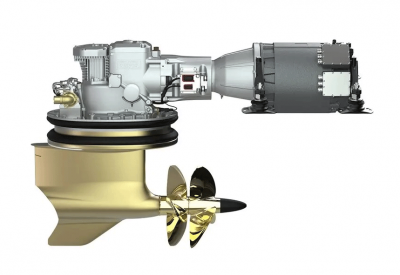
Supported with an AUD2 million (US$1.4 million) grant from the Australia-Singapore Low Emissions Technologies (ASLET) initiative, the ferry will be the first vessel globally to enter the market with a twin installation of the Volvo Penta IPS450E electric propulsion system, delivering 250kW per driveline.
The Volvo Penta Electric Inboard Performance System (IPS) system will leverage forward-facing propulsion and advanced Electronic Vessel Control (EVC) to optimise energy use and extend range, with the help of a Volvo Penta D4 variable-speed genset.
It will also combine a large onboard battery pack of 460kWh with solar panels, creating a flexible and efficient energy ecosystem designed for real-world commercial use.
Aus Ships Group (ASG), a long-established Australian shipbuilder with a strong track record in constructing high-speed catamarans including the CityCats for Brisbane, brings deep local expertise to the project.
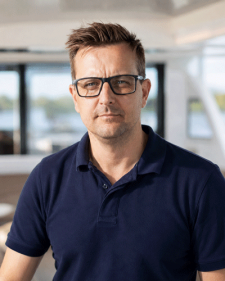
Tommy Ericson, director, ASG, says that integrating this level of propulsion and control capability into a commercial passenger vessel opens new possibilities for both efficiency and passenger experience.
 |
|---|
Hull design
Ericson explains that work to integrate the twin IPS450E electric drivetrains have influenced hull form development, weight distribution and overall resistance optimisation of the new ferry.
“The hull form has been entirely developed from the keel up specifically for the IPS450E drivetrain and the onboard electrification systems,” he says.
“We have had to give very careful consideration to longitudinal weight consideration to ensure optimal trim through all loading conditions.”
He says that to achieve a low extreme/overall draught, the aft sections of the hulls are “beamier” than for conventional drivelines due to the depth of the IPS unit and its Longitudinal Center of Gravity (LCG).
A key characteristic of the design is a deep forefoot which extends below the propeller tip of the IPS unit, with the intention to provide a significant likelihood reduction of damage if operating in very shallow waters.
The hull form designs evolved over multiple iterations which included a number of CFD simulations internally by ASG’s naval architects and Volvo’s technical team in Sweden.
Jacob Vierø, senior global sales project manager for Volvo Penta, says that the keywords in any project are “early engagement”.
“The naval architects and marine engineers at Volvo Penta strive to be part of the design process early on, to be able to not only judge the compatibility of systems, but also to give input to hull and engine room optimisation.”
“Volvo Penta offers theoretical input as well as experience from a vast database of vessel designs. The collaboration is now extended to include the producers of batteries and power management systems, which is particularly important since incompatible systems can have excessive energy losses.”
Energy management
The vessel’s energy management system has been carefully architected to balance redundancy, peak load management and operational predictability, particularly in the context of passenger service reliability requirements and emergency power scenarios.
System architecture developed for this project is intended to validate and demonstrate two distinct systems – fully electric and serial hybrid.
Significant levels of redundancy in the system are provided through an independent propulsion battery system, independent house and safety battery systems (low voltage DC) and independent Programmable Logic Controller (PLC) control systems with a variable speed generator.
Vierø says that the genset offers controlled fuel consumption due to its variable speed and load making it a logical choice for the vessel.
“More so, the permanent magnet generators with the yard mounted inverter fit seamlessly into the DC-grid ultimately powering the IPS legs.”
There are key engineering challenges in integrating DC systems, power electronics and propulsion control onboard a passenger-carrying vessel under evolving regulatory frameworks.
“There are many challenges from an engineering perspective, the most significant being space and separation/segregation,” says Ericson.
“Integrating the large number of control, interconnect and junction boxes into a relatively small platform, whilst maintaining practicality from a passenger and operational perspective is especially challenging.”
 |
 |
|---|
Vessel control
Volvo Penta’s integration of Electronic Vessel Control (EVC), Dynamic Positioning System (DPS) and joystick manoeuvring, alter the traditional naval architecture approach to bridge design, particularly in low-speed urban ferry operations where precision is critical.
“The integration of a high level of control and interface provides the designer and shipbuilder with a higher degree of confidence in the efficient performance of the vessel achieved through improved manoeuvrability, which leads to lower energy use and ultimately increased endurance from a given energy system,” says Ericson.
Vierø adds that possibly the biggest advantage offered by IPS in any installation is the very high efficiency of the pulling counterrotating propellers lowering the power/energy consumption significantly.
“This bears additional importance to electric vessels as this has a direct bearing on the battery size onboard; saving vessel displacement which again logically saves energy in a benign spiral.”
Future scalability
From a naval architecture perspective, there are multiple elements of this ferry platform which are considered critical for scalability across future ferry designs – particularly in terms of modular propulsion integration, battery lifecycle management and shore charging infrastructure.
Ericson says that the most critical systems for scalability are the propulsion units and the DC grid infrastructure, along with the integration and installation requirements.
“The IPS units provide good bandwidth/range on thrust and can therefore be specifically matched to a particular platform and then scaled for required performance,” he says.
“The battery energy storage system can be easily scaled to suit the requirements of a particular operation, as can the addition of the variable speed generation for applications where increased endurance, short range higher performance, or additional redundancy are required.”
He says that charging infrastructure remains a critical element. In many cases around the world, this has proven to be the most challenging part of an electrification project, more so than the design and construction of the vessel itself.
“To this end, our vessel is seeking to validate (for particular lower energy operations) that any infrastructure over and above conventional three-phase shore power is not required.”
To this end, ASG is integrating modest charging infrastructure onboard the vessel so that it can operate from any port with conventional shore power.
Future aspirations
ASG is currently under contract for national fleet replacement programmes through 2029, positioning it as a critical partner in scaling future electric vessel deployments.
Together, the partners in this project aim to stimulate interest in electrification and accelerate the shift toward zero-emission transport solutions in Australia.
The new ferry will be used as a demonstrator before it goes into operation. It is currently under construction, with commissioning due to be complete in the last quarter of 2026.
Long-term ambitions for the partnership include the development of a fleet of similar ferries serving key routes along the east coast of Australia, including Brisbane and Sydney.
| Naval Architect Edition | |
| Naval Architect Edition | |
| Article Tags | |
| Article Tags | |
| General | |
| Preview Text | Australia’s first 100% electrically driven passenger ferry – a collaboration between Aus Ships and Volvo Penta, intends to go beyond just deploying new technology – it aims to further validate scalable electric marine propulsion. Supported with an AUD2 million (US$1.4 million) grant from the Australia-Singapore Low Emissions Technologies (ASLET) initiative, the ferry will be the first vessel globally to enter the market with a twin installation of the Volvo Penta IPS450E electric propulsion system, delivering 250kW per driveline. The Volvo Penta Electric Inboard Performance System (IPS) system will leverage |