The Naval Architect provides in-depth information on all aspects of vessel design, construction and engineering. Practical applications of latest technology and case studies are accompanied by analysis and foresights. Published every two months, the magazine covers everything from superyachts and short-hop ferries to tankers and heavy-lift vessels; from battery pack installations and sail-assisted solutions to LNG tank retrofits; and from offshore safety to warship resilience.
EFFECTS OF MARINE CONDITION ON THE SPEED AND FUEL CONSUMPTION OF A FULLY - LOADED VLCC
Transactions
Fuel consumption remains a critical focus for ship operators seeking greater efficiency in varying sea conditions. Analysis of operational voyage data reveals how wind, waves and vessel heading influence speed loss and performance, providing a practical foundation for improved fuel-use forecasting, voyage planning and more cost-effective fleet management.
RISK ASSESSMENT MODEL OF COASTAL SEA POLLUTION BY BLACK (SEWAGE) WATERS FROM VESSELS
Transactions
Environmental protection in coastal waters requires risk assessments that capture the complexity of vessel operations and local sensitivities. Pollution threats from ship discharges are shaped by vessel characteristics, treatment capabilities and location-specific factors, making robust risk evaluation increasingly important for safeguarding marine ecosystems, public health and coastal economic activities.
PERFORMANCE PREDICTION OF A 112M WAVE-PIERCING CATAMARAN
Transactions
Accurately predicting the power requirements of high-speed catamarans remains a critical challenge for designers seeking performance, efficiency and operational certainty. Strong correlation between model-scale testing and full-scale vessel performance reinforces the strategic value of proven extrapolation methods, supporting more reliable design decisions and greater confidence in powering assessments for advanced fast-ferry concepts.
DRY-DOCKING TIME AND LABOUR
Transactions
Dry-docking efficiency remains a critical commercial consideration for both shipowners and shipyards. Better understanding of how vessel size, age and type influence maintenance time and labour requirements can support more accurate planning, reduce operational costs and improve resource utilisation, helping organisations maximise availability while minimising time spent out of service.
AN APPLICATION OF MACHINE LEARNING TO SHIPPING EMISSION INVENTORY
Transactions
Maritime decarbonisation and air-quality management increasingly depend on accurate emission measurement and forecasting. Machine learning is emerging as a powerful tool for enhancing shipping emission inventories, improving the estimation of vessel-generated pollutants across different operating conditions and supporting more informed environmental reporting, regulatory compliance and emissions-reduction strategies.
FULL-SCALE MEASUREMENTS OF WELDING-INDUCED INITIAL DEFLECTIONS AND RESIDUAL STRESSES IN STEEL-STIFFENED PLATE STRUCTURES
Transactions
Structural integrity in ships and offshore assets is heavily influenced by welding-induced distortions and residual stresses that can affect long-term strength and stability. Expanding full-scale measurement data and validation capabilities is becoming increasingly important for improving predictive models, reducing design uncertainty and supporting more reliable assessment of welded marine structures.
AN OPTIMIZED ENERGY-EFFICIENT PATH FOLLOWING ALGORITHM FOR UNDERACTUATED MARINE SURFACE SHIP MODEL
Transactions
Energy-efficient navigation is becoming an increasingly important objective as ship operators seek to reduce fuel consumption without compromising performance. Combining advanced guidance algorithms, predictive vessel modelling and optimisation techniques enables more efficient path-following behaviour, supporting lower energy use, improved operational efficiency and smarter decision-making for future autonomous and conventionally operated vessels.
EVALUATING KEY RISK FACTORS AFFECTING CARGO DAMAGES ON EXPORT OPERATIONS FOR CONTAINER CARRIERS IN TAIWAN
Transactions
Reducing cargo damage remains a key priority for container shipping operators seeking to improve reliability and customer confidence. Risks associated with cargo declaration, packaging, securing arrangements and documentation continue to influence export operations, highlighting the importance of robust risk management practices and stronger coordination across the maritime logistics chain.
Newsletters
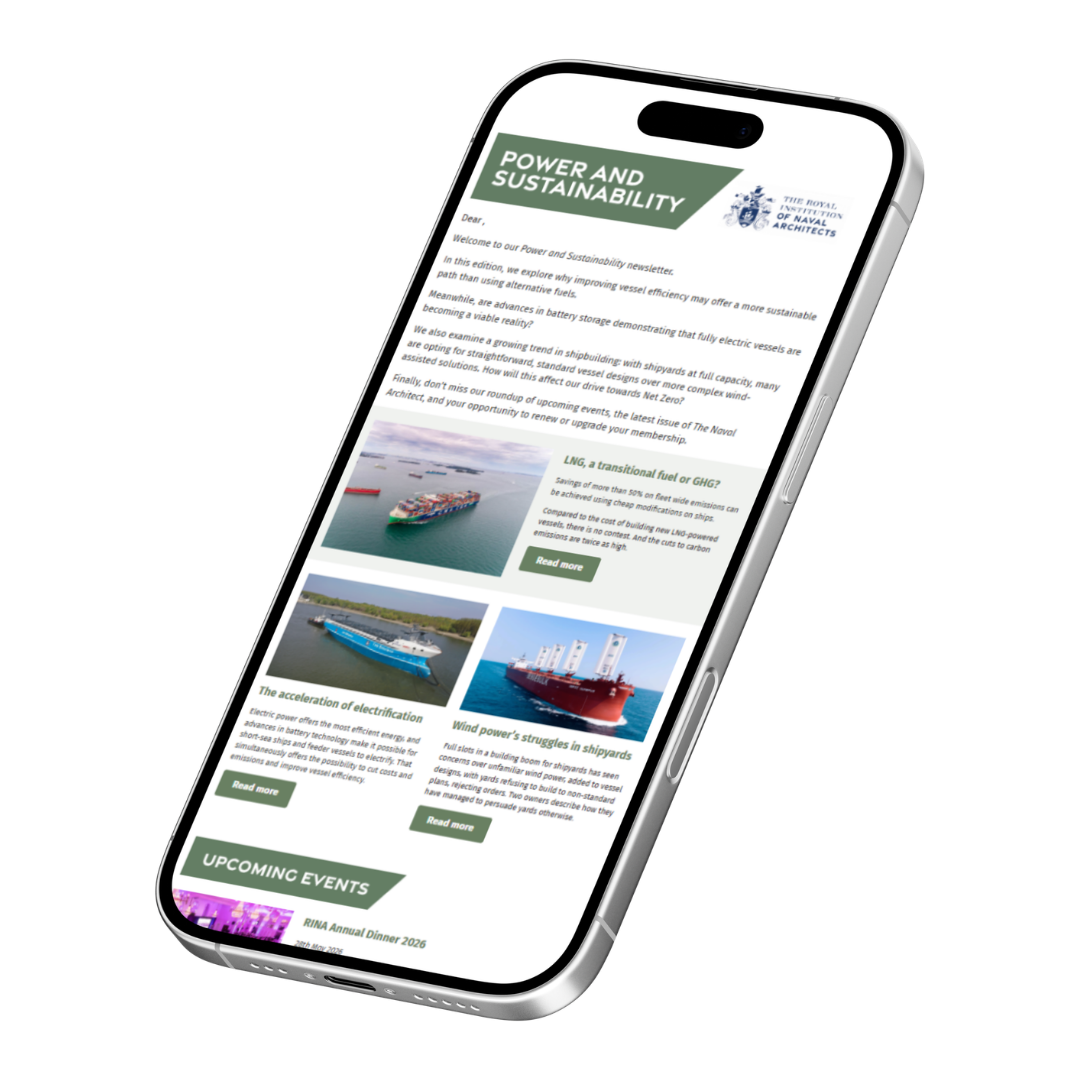
Stay connected with the global maritime community through RINA’s newsletters.
Whether you are a member or not, you can receive updates from The Naval Architect, alongside selected RINA news, events and industry insights. Members also gain access to a wider portfolio of exclusive newsletters on key topics in the maritime industry.