

Oil markets still restraining offshore wind
As the cost of offshore wind dives below the level of fossil-fuelled production the drive for electrification is ramping up in Europe and other regions, but the vessels developing the windfarms remain conventionally powered.
The offshore wind segment is entering a decisive decade. In the UK, the levelised cost of energy (LCOE) for offshore wind had already well surpassed gas-fired power plants, at £44/MWh vs £114/MWh, respectively.
Reports from the Middle East suggest that the potential damage to oil infrastructure points to a prolonged period of repair, around three years, to return to full production. As a result, greater reliance on other countries such as the US means analysts expect that crude will remain in the region of US$90 per barrel for some time to come.
Unfortunately, many of the Commissioning, Service and Operation Vessels (CSOVs) required to administer those windfarms, once built, are powered by conventional marine diesel oil (MDO), whose price more than doubled in Rotterdam recently, from around US$700 per tonne in February, to highs of US$1,600 in April.
Embarrassingly, then, this means that oil & gas industry still retains at least a portion of windfarm revenues and therefore leverage over whether windfarms get to make a profit.
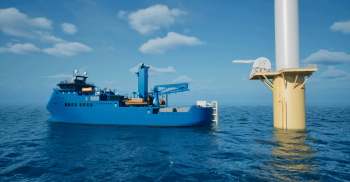
Recognising the strategic liability this represents, Europe is keen to alter this state of affairs. In April, Stillstrom, a Mærsk offshoot, unveiled the power hub and power tower, two in-situ charging systems for CSOVs and crew transfer vessels (CTVs).
 |
|---|
The power hub is a monopile structure designed to be added to existing windfarms, while the power tower is sized and shaped like a conventional wind turbine foundation, allowing it to be installed by the same vessels.
Each features a cable reel and a small crane boom, allowing the cable to be lowered onto the deck of a vessel moored close to the structure, and helping to negate the risk of the plug being submerged in the water.
In conjunction with a battery, in-situ charging would enable SOVs to be powered almost entirely by electrical energy. Since this energy is used before it is transmitted to the grid, it could be supplied at cost, conferring a massive advantage for such vessels.
Vard Seaonics is working on its own offshore charging system, Ocean Charger, which is mounted on a wind turbine. Like the Mærsk system, it comprises a cable on a reel, though it relies on the vessel’s own crane to retrieve and hoist it aboard.
Thanks to improvements in the design of deck equipment, power can be put to effective use on the vessel, too. Newer CSOVs eschew hydraulic cranes and gangways in favour of electrically driven units, articulated with a system of cables, winches and pulleys.
This equipment can be made to benefit from energy recovery in the same way electric cars do, meaning that a large fraction of electrical energy involved in, for example, raising a gangway, can be recovered when it is lowered again. This allows a vessel with even a relatively small battery capacity to use a fraction of its fuel for on-site work.
But a strength for CSOVs is a weakness for wind turbine installation vessels (WTIVs). Requiring vast power, these vessels likewise benefit from batteries. But there is scant prospect of recharging from turbines that are still under construction. Even if there were, weight is critical for this type of vessel, a key barrier to larger battery installations.
Illustrating this compromise, Cadeler switched out several 54-tonne medium-speed engines for Everllence high-speed models in its P-Class designs, weighing 9tonnes each.
The high-speed engines favour the sudden burst of power needed for jacking, raising the vessels above the level of the water, a different kind of power from the continuous supply favoured by medium-speed engines.
“This is significant… the less weight the WTIV itself has, the more wind farm components it can transport in a single trip,” said Henning Bullwinkel, Everllence global manager, Wind Offshore.
If Europe does not make a concerted investment in WTIV technology and development now, it could serve as a brutal constraint on wind capacity, both in number and cost, for decades to come.
| Naval Architect Edition | |
| Naval Architect Edition | |
| Article Tags | |
| Article Tags | |
| General | |
| Preview Text | As the cost of offshore wind dives below the level of fossil-fuelled production the drive for electrification is ramping up in Europe and other regions, but the vessels developing the windfarms remain conventionally powered. The offshore wind segment is entering a decisive decade. In the UK, the levelised cost of energy (LCOE) for offshore wind had already well surpassed |