

MIT research shows how to cut ship drag by up to 7.5%
Researchers at MIT have demonstrated that small wedge-shaped vortex generators fitted to a ship’s hull can reduce drag by up to 7.5%, offering a practical and potentially low-cost route to cutting fuel consumption and emissions.
The findings were presented at the Society of Naval Architects and Marine Engineers’ Maritime Convention in Norfolk, Virginia. The research team, drawn from MIT Sea Grant, the Department of Mechanical Engineering, and the Center for Bits and Atoms, used a combination of computational fluid dynamics, AI-assisted optimisation and physical scale model testing to identify the most effective vortex generator geometry.
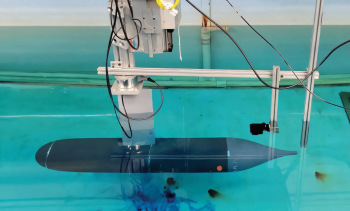
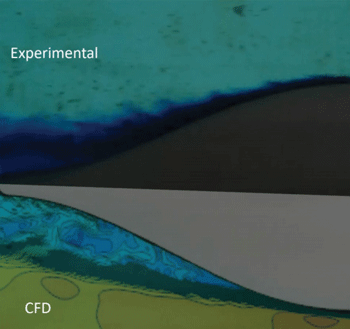
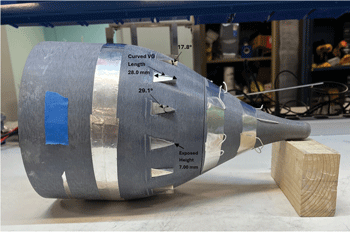
The process began with extensive parametric analysis through computational fluid dynamics to establish design trends, before multiple hull variants were produced through rapid prototyping and tested experimentally to validate the computational results.
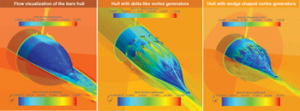
Three configurations were evaluated: a bare hull tail, a tail fitted with delta-wing vortex generators, and a tail fitted with wedge vortex generators. The wedge design emerged as the strongest performer, achieving attached flow along the hull with a lower skin friction coefficient than the delta variant.
 |
|---|
By delaying turbulent flow separation, the devices help water travel more smoothly along the hull, significantly reducing the size of the vessel’s wake. The resulting uniformity of flow also allows the propeller and rudder to operate more efficiently, compounding the overall performance benefit.
Lead researcher Michael Triantafyllou, professor of mechanical engineering and director of MIT Sea Grant, noted it was the first time a fuel reduction from vortex generators had been demonstrated experimentally on a ship hull. While vortex generators have been used for decades in aircraft wing design to maintain lift and delay stalling, their application to commercial shipping had not previously been validated at this level.
The team estimated that retrofitting the devices to a 300m Newcastlemax bulk carrier operating at 14.5knots on a trans-Pacific route would yield fuel savings of approximately US$750,000 per year, alongside a meaningful reduction in emissions. The modular nature of the wedge generators means they could be applied across a broad range of hull forms, including tankers and bulk carriers, and are compatible with existing drag-reduction technologies such as pre-swirl stators, which they could complement or, in some cases, replace.
The practical appeal of the technology lies in its retrofit potential. Rather than requiring newbuild designs, the vortex generators could be integrated into existing vessels, offering shipowners a relatively straightforward path to improved efficiency at a time when the IMO’s target of reducing carbon intensity by at least 40% against 2008 levels by 2030 is placing the industry under growing pressure to act.
The research was supported by the CBA Consortium in collaboration with Oldendorff Carriers, which operates around 700 bulk carriers worldwide, with further work backed by the MIT Maritime Consortium, established in 2025 to drive interdisciplinary research into the modernisation of the commercial fleet.
This article appeared in Features, TNA Mar/Apr 2026
|
|
 |
|
|---|---|---|
| Article Tags | |
| Article Tags | |
| Naval Architect Edition | |
| Naval Architect Edition | |
| General | |
| Article Preview Text | Researchers at MIT have demonstrated that small wedge-shaped vortex generators fitted to a ship’s hull can reduce drag by up to 7.5%, offering a practical and potentially low-cost route to cutting fuel consumption and emissions.
The findings were presented at the Society of Naval Architects and Marine Engineers’ Maritime Convention in Norfolk, Virginia. The research team, drawn from MIT Sea Grant, the Department of Mechanical Engineering, and the Center for Bits and Atoms, used a combination of computational fluid dynamics, AI-assisted optimisation and physical scale model testing to |