

Professional profile - Edwin Pang
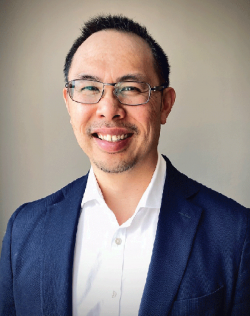
Edwin Pang describes himself as a ‘regulatory repairman’ on his LinkedIn page. Perhaps not surprising for someone who chairs RINA’s IMO Committee, and has been the Institution’s representative to the IMO since 2018. Like all those who serve on RINA’s committees, Edwin is a volunteer. His day job is running a niche consultancy business, Arcsilea, which he founded in 2018 and which focuses on greenhouse gas (GHG) reductions, decarbonisation, alternative fuels and energy efficiency, with a particular specialism in regulatory impact analysis.
“I came to RINA somewhat late in my career, having spent the first decade or so in a rather peripatetic existence,” says Edwin. “But I’d always been involved in regulatory policy development, so it was a natural progression. It has been a real honour and a privilege to have been elected by my peers to serve as chair, and to be the Institution’s representative to the IMO.”
After university, Edwin held naval architect roles with Three Quays Marine Services, Knud E. Hansen and Herbert Engineering Europe. Much of this early work concentrated on passenger ship design, covering ferries and cruise ships, with a focus on safety issues, especially stability. In time that experience widened to cover a broader range of vessel types, and other segments such as ballast water and offshore wind.
|
FOUNDER |
Arcsilea |
|---|---|
|
CHAIR |
RINA IMO Committee |
|
|
EMPLOYMENT AND EDUCATION |
|
2018-present |
Founder at Arcsilea Ltd |
|
2016-2018 |
Herbert Engineering Europe (UK) |
|
2012 |
UCL APMP |
|
2005-2015 |
Senior naval architect at Knud E. Hansen, Copenhagen and London |
|
2000-2005 |
Project naval architect at Three Quays Marine Services, London |
|
1997-2000 |
University of Strathclyde, B.Eng 1st Class Honours, Naval Architecture and Offshore Engineering |
One of the highlights of Edwin’s early career was as on-site project coordinator on a nine-month lengthening project for a 220m-long ro-ro passenger ship at Lloyd Werft Bremerhaven. “The floating calculations for the fore and aft sections of the vessel lengthening project were especially significant,” he says. “Effectively, this was a detailed estimate of weights and centres of gravity, with a limited amount of documentation, after the ship had been cut in two, which showed we needed to weld a barge to the aft part of the ship, to enable it to have a reasonable trim to minimise draught.”
Edwin also singles out his important work with the Lloyd’s Register Foundation-funded FerrySafe team, looking at improving domestic passenger ship safety in developing countries. The team tried to understand what the Philippines had done to improve its overall safety record so that these measures could be replicated elsewhere.
“Regulations can be somewhat theoretical,” he says, “especially if the issue is complex, and you need real-world maritime industry feedback to make them usable. That is what I have ended up doing – taking practical examples of what happens in reality and then assessing how to develop regulations properly based on that experience.”
In the past eight years, Edwin has undertaken a series of projects in energy efficiency and GHG reduction. This has included an analysis of the Energy Efficiency Design Index (EEDI) for new and existing ro-ro cargo and passenger ships for Interferry, leading to a revision of EEDI reference lines for both ship types at MEPC 72. He also helped develop and finalise Energy Efficiency Existing Ship Index and carbon intensity indicator regulations at IMO, working for the European Commission as well as industry, carrying out impact assessments on ships based on analysis of fuel consumption data and acting as joint coordinator of the IMO Correspondence group developing those measures.
As chair of the RINA IMO Committee, Edwin is responsible for the Institution’s submissions to the organisation, determining positions to take on key issues, discussing regulatory developments with member states and other NGOs, and much more.
“RINA plays a key, and perhaps unique, role at the IMO as one of the few organisations whose membership comes from right across the maritime industry value chain,” he says. “In many ways, RINA is in an ideal position to be the ‘honest broker’, presenting technical advice in a balanced way. Other parties appreciate our input, which is not constrained by political or commercial considerations. We are not a lobby group, and don’t stand to gain one way or another. We are there simply to represent what we think is right or technically justified.”
Over the past decade, Edwin says RINA has achieved a lot with IMO. “There is a fair amount of regulatory drafting that has our fingerprints on it, as we have made the case for sensible regulatory changes. Also, we have been adept at finding technical compromises to get different parties onboard and regulatory initiatives over the line.”
Currently the RINA IMO Technical Committee is involved in a number of areas, with a heavy focus on work relating to the revision of SOLAS Chapter III, which governs life-saving appliances, biofouling, the safety of new fuels and energy efficiency, among others. Edwin says: “Over the past few years we have submitted 10-20 papers a year to IMO. This is quite exceptional for any organisation, let alone one run by volunteers.”
RINA’s contribution to the IMO was recognised by the IMO secretary-general, Arsenio Dominguez, at the 2024 Annual Dinner. In his speech, he said that he had asked his team to summarise RINA’s work, and they sent him pages and pages of information, which he flipped through on stage. He reiterated to his team that he just wanted a summary, to which the reply was: “That is the summary!”
 |
|---|
In the alternative fuels space, RINA, heavily supported by the Maersk Mc-Kinney Møller Center for Zero Carbon Shipping, is helping to develop a global maritime fuel certification system through the IMO to provide assurance on the GHG credentials of alternative fuels supplied as bunker fuels. Edwin says: “We took on the responsibility for coordinating the drafting of a certification framework even though it isn’t core naval architectural competence, simply because it needed to be done. When we first flagged it, there were very few who recognised the importance of such a framework and were willing to engage.”
Draft guidelines will be presented to the IMO’s MEPC Committee in April, now with widespread input from many member states and NGOs, and hopefully will enable certification schemes to be audited and recognised by IMO in due course. “This broadly sums up the approach that RINA has taken at the IMO – identifying needs and proposing solutions,” Edwin says.
The emergence of alternative fuels as part of the industry’s drive to net zero is a significant challenge. “The technical and safety issues are solvable,” says Edwin, “but there is such a rush to embrace new fuels and associated technology that perhaps the rules and regulations as well as crew training have some way to catch up. The pressure to achieve rapid change is in itself a risk.”
Some of the key things that Edwin says he has learned in his career include the importance of connecting practice with theory, the necessity of compromise in design and the need to see the wider picture. “Naval architects often think of safety in terms of design and hardware, but the role of the human element is equally, if not more, important. Issues such as crew training are certainly something we need to remember when we are regulating in an era of new fuels.”
Looking back on his 25 years of experience in ship design, what advice would he give to anyone starting out in naval architecture? He says: “There are so many aspects to naval architecture, so be curious and gain experience in as many of them as you can. Just because you have specialised in something for 10 years doesn’t mean you might not do something else later. It is important to get a range of experiences and to achieve a balance between generalist and specialist.”
This article appeared in Professional Profile, TNA Mar/Apr 2026
| General | |
| Article Preview Text | Edwin Pang describes himself as a ‘regulatory repairman’ on his LinkedIn page. Perhaps not surprising for someone who chairs RINA’s IMO Committee, and has been the Institution’s representative to the IMO since 2018. Like all those who serve on RINA’s committees, Edwin is a volunteer. His day job is running a niche consultancy business, Arcsilea, which he founded in 2018 and which focuses on greenhouse gas (GHG) reductions, decarbonisation, alternative fuels and energy efficiency, with a particular specialism in regulatory impact analysis.
“I came to RINA somewhat late in my career, having spent the first decade or so |
| Article Tags | |
| Article Tags | Professional profile |
| Naval Architect Edition | |
| Naval Architect Edition | |