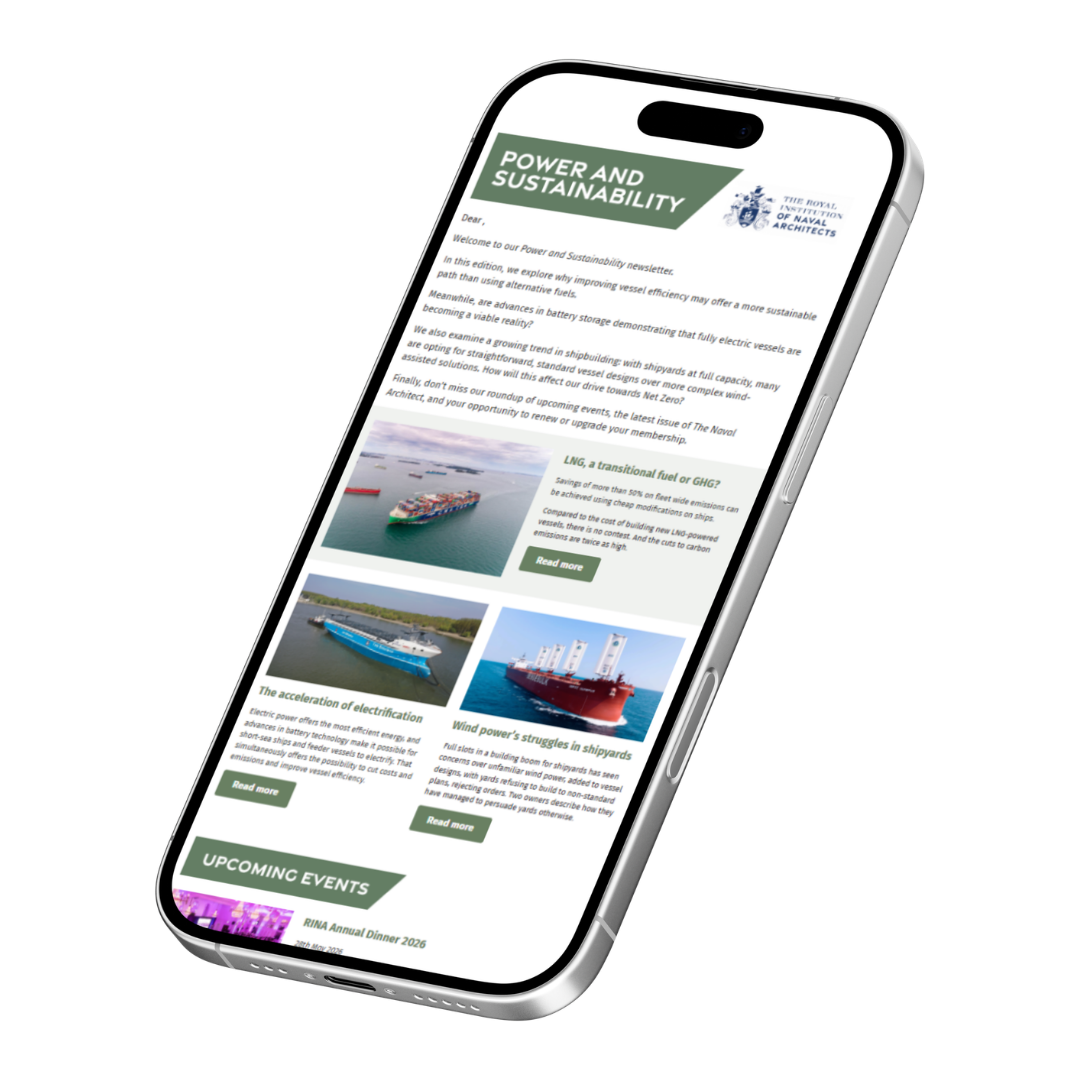
The Naval Architect provides in-depth information on all aspects of vessel design, construction and engineering. Practical applications of latest technology and case studies are accompanied by analysis and foresights. Published every two months, the magazine covers everything from superyachts and short-hop ferries to tankers and heavy-lift vessels; from battery pack installations and sail-assisted solutions to LNG tank retrofits; and from offshore safety to warship resilience.
ROUTE OPTIMISATION FOR ADVANCED WATERJET SELECTION
Waterjet
Vessel efficiency extends far beyond maximum speed. By combining detailed route analysis with tailored waterjet selection and design, engineers can optimise performance across an asset’s entire operating profile. The approach reveals new methods for balancing competing demands, unlocking fuel savings, operational efficiency and smarter propulsion decisions in practice today onwards.
AN INVESTIGATION ABOUT ADDED POWER IN HEAVY WEATHER FOR PASSENGER SHIPS WITH FOCUS ON WIND EFFECT
Full Scale Ship Performance
Real-world performance data is reshaping understanding of passenger ship efficiency in heavy weather. By analysing full-scale operational measurements, researchers quantify the combined impact of wind and waves through an added-power methodology. New insights into aerodynamic drag on large topside structures could improve voyage planning, energy efficiency and design decisions globally.
INSTALLATION INNOVATION FOR FLOATING OFFSHORE WIND
Maritime Innovation and Emerging Technologies
Floating offshore wind is moving from demonstration to deployment, creating new demands for naval architecture, marine operations and port infrastructure. This review examines construction, towing and installation challenges, alongside stability, certification and maintenance considerations. The insights highlight practical strategies to reduce project risk, costs and lifecycle uncertainty at scale globally.
REMOTE INSPECTION OF A FPSO UNIT CRUDE OIL TANK WHILST STILL PRODUCING
Full Scale Ship Performance
Remote drone-based inspection is transforming offshore asset assurance by enabling detailed survey work without confined-space entry. Lessons from a successful FPSO crude oil tank inspection highlight the importance of planning, stakeholder coordination, class-approved procedures and tank preparation, demonstrating how UAV technology can reduce risk, cost and inspection time significantly today.
IMPROVING ENVIRONMENTAL IMPACT AND REFINING FLEET RELIABILITY THROUGH THE USE A RELIABILITY CENTRED MAINTENANCE PROCESS TO IMPROVE MAINTENANCE OF THE VESSEL FLEET OF THE MALDIVES TRANSPORT AND CONTRACTING COMPANY PLC
Ship' Life Cycle
Reliability-Centred Maintenance is proving vital to maximising fleet availability and operational performance in challenging economic conditions. Using real-world experience from the Maldives’ essential ferry network, this work demonstrates how data-driven maintenance optimisation can reduce downtime, improve reliability and lower costs, offering valuable lessons for diverse maritime fleets worldwide at scale.
SMALL CRAFT DESIGN FOR DROP TEST: CASE STUDY
Surveillance Search & Rescue Craft
Advanced modelling is improving confidence in the structural design of high-speed craft. By combining computational fluid dynamics, finite element analysis and drop-test validation, researchers compared impact loads with conventional design rules, uncovering critical differences and optimisation opportunities. The findings provide practical reinforcement guidance for achieving robust, compliant performance today onwards.
PORT DESIGN FOR SMALL LNG CARRIERS
Alternative Fuels
Innovative LNG transfer infrastructure is improving safety, efficiency and operational flexibility across maritime energy operations. By examining specialised manifold design, transfer interfaces and ship-to-shore integration, the work addresses key engineering challenges in fuel handling. Insights highlight opportunities to streamline LNG logistics, strengthen reliability and support evolving low-carbon maritime energy networks.
STABILITY CONSIDERATIONS FOR OFFSHORE TRANSPORTATION VESSELS
Damaged Ships
Offshore transportation of large energy infrastructure demands rigorous stability assurance throughout loadout, transit and installation. Examining heavy transport vessels and cargo barges, this research explores advanced ballast management, damage stability analysis and enhancement measures such as sponsons and pontoons, offering critical lessons for safer, more resilient marine operations worldwide.
MPROVING EFFICIENCY OF HIGH SPEED CRAFT USING MACHINE LEARNING AND BIG DATA
High Speed Vessels
Big data and machine learning are transforming high-speed craft operations by turning real-world performance data into actionable fuel-efficiency insights. Advanced predictive models tackle the challenges of dynamic operating conditions while delivering real-time optimisation guidance to crews. The approach promises lower fuel consumption, reduced emissions and smarter vessel performance management today.
THE ROYAL LOUIS (1668), A SAILING MASTERPIECE
Historic Ships
Exploring the rise of French naval power under Colbert, this article examines how shipyard modernisation transformed warship design, blending engineering innovation with striking aesthetics. Through the story of the Royal Louis, it reveals how naval architecture, craftsmanship and state ambition combined to project influence, prestige and power globally at sea.
THAT UNRELENTING 80 %
Human Factors
The widely cited claim that 80% of failures stem from human error is challenged through a fresh examination of safety and automation. By testing the concept against realistic scenarios, this analysis reveals why mature systems naturally attract higher human-error attribution and identifies more meaningful measures of operational risk today onward.
FEM ANALYSIS OF AN ICE CLASS SHIP'S BULBOUS BOW
Ice Class Vessels
Finite Element Modelling is enhancing the design of ice-class vessels by enabling detailed analysis of bow structures exposed to extreme ice and hydrostatic loads. Applied to the conversion of a tanker into a research vessel, this approach demonstrates how structural optimisation can improve strength, reduce weight and support reliable performance in demanding polar environments.
Newsletters
Stay connected with the global maritime community through RINA’s newsletters.
Whether you are a member or not, you can receive updates from The Naval Architect, alongside selected RINA news, events and industry insights. Members also gain access to a wider portfolio of exclusive newsletters on key topics in the maritime industry.