

Hydrogen hits the big time with projects on the rise
While there are more commercially appealing alternative marine fuels available, hydrogen (H2), a highly flammable and odourless gas that in its super-cooled liquid form will propel man’s return to the moon, is possibly the ‘greenest’ to have made significant maritime inroads over the past 12 months.
Landmark vessel announcements, a regulatory breakthrough at the 11th session of the IMO Sub-Committee on Carriage of Cargoes and Containers in London last September, and the first serious infrastructure commitments have combined to give hydrogen the credibility it lacked just two years ago.
Indeed, there are now more than 20 hydrogen ships in operation, with twice that under construction, representing a number of ship-type ‘firsts’. As far as hydrogen is concerned, 2026 is seeing a real surge in ship design and construction.
The clearest sign that the industry is taking H2 more seriously was in April 2025, when Fincantieri and Viking announced the building of a pair of 54,300gt hydrogen-fuelled cruiseships – the world’s first designed with hydrogen to be stored onboard. Viking Libra, set to join the Viking fleet later this year, features a hybrid 6MW propulsion system based around Isotta Fraschini Motori’s proton exchange membrane (PEM) fuel cell technology. The decision to store the fuel onboard as cryogenic liquid hydrogen (LH2) in a bespoke container loaded on to the vessel during port calls is a pragmatic workaround to the absence of any fixed LH2 bunkering infrastructure to speak of.
The shortage of H2 bunkering ports is the main impediment to larger deep-sea vessels getting off the drawing board. But things are changing fast.
In May last year, for instance, the Port of Rotterdam and Oslo-based EDGE Navigation signed a Letter of Intent to develop a large-scale hydrogen network across Europe’s largest port complex. The Norwegian maritime technology company is developing a series of commercial LH2-powered cargo ships, as well as an LH2 tanker that can be used for ship-to-ship bunkering. Rotterdam aims to prepare the port for the arrival of these ships from 2028.
 |
|---|
Come 2050, it is widely anticipated that global demand for hydrogen will hit 60 million tonnes, fuelling 19% of the world fleet. To this end, Kawasaki Heavy Industries (KHI) and Japan Suiso Energy (JSE) announced at the beginning of this year plans to build a 40,000m3 liquefied hydrogen carrier, the world’s largest, under the New Energy and Industrial Technology Development Organization (NEDO) Green Innovation Fund Project. JSE plans to use the new LHC to demonstrate the ship-to-base loading/unloading under ocean-going conditions by 2023.
The vessel, slated for a building slot at KHI’s Sakaide Works, will join KHI’s 2021-built 1,250m3 capacity Suiso Frontier in taking LH2 cargoes at the Hy touch Kobe LH2 demonstration terminal.
Interestingly, the new vessel’s cargo tanks will use a high-performance insulation system designed to reduce the generation of boil-off gas (BOG) caused by natural heat ingress from the outside, enabling the much larger volume of cryogenic liquid hydrogen to be transported. A heat exchanger will also be installed to allow the BOG to be used for propulsive power. Together with the vessel’s hull form and draught, combined with the low density of liquefied hydrogen, the vessel will have a higher propulsion efficiency for less power, resulting in zero emissions. KHI believes the new vessel will provide the foundation for the future hydrogen supply chain.
Other large commercial ship hydrogen newbuild developments include a pair of 85m bulk carriers for Norwegian shipowner GMI Rederi. Each of these 4,000dwt bulkers will adopt seven PowerCell Marine System 225 units to deliver 3MW of zero-emissions power. When launched in early 2027, the vessels could be the world’s first hydrogen-powered bulk carriers.
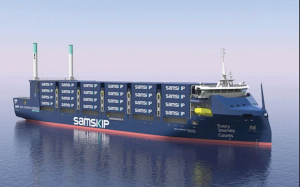
Meanwhile, Samskip’s SeaShuttle project represents one of the most ambitious leaps in the maritime industry’s hydrogen surge. Two 135m container ships, currently under construction at Cochin Shipyard in India, are being designed to establish a “green corridor” between Rotterdam and Oslo.
 |
 |
|---|---|
Each vessel is equipped with a massive 3.2MW hydrogen fuel cell system, a significant scale-up from earlier pilot projects, with liquid hydrogen supplied by Norwegian Hydrogen’s Rjukan plant. These ships have a hatch coverless design, which speeds up port operations, and “autonomous-ready” technology, aiming for remote-controlled efficiency. The first of these vessels is expected to be delivered late in 2026, with full commercial operations beginning in Q2 2027.
While these are some of the larger H2 AMF projects under development, existing smaller-scale projects are providing more immediate operational evidence for the fuel’s wider maritime potential.
One example is the operational data from the 75-passenger hydrogen-fuelled ferry Sea Change, which entered service in San Francisco Bay in July 2024. A study, published in 2025 in the International Journal of Hydrogen Energy, found that its 360kW PEM fuel cells and 246kg of hydrogen (stored at 250 bar) delivered stable and reliable power under real-world duty cycles, achieving an average electrical efficiency of approximately 45-46%.
However, the paper also noted that delivered hydrogen costs averaged approximately US$30/kg during operations, roughly 10 times the cost of diesel, although this increase represents only a 20% hike in total annual operating costs given hydrogen’s higher efficiency. You get more combustion bang for your buck.
 |
|---|
 |
Norway’s 3,400gt, 82m-long Hydra, the world’s first LH2-powered car and passenger ferry (in service since 2023), is also providing the shipping world with evidence that liquid hydrogen will play an important role in the green maritime transition. Although not as informative as the Sea Change study, 2024 reports from Ballard Power Systems – the fuel cell manufacturer – noted that Hydra has made more than 20,000 crossings, establishing efficient bunkering turnarounds.
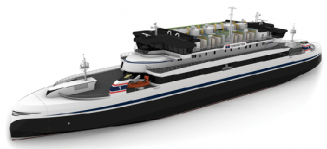
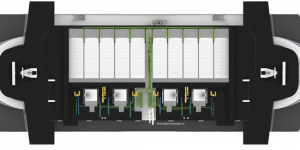
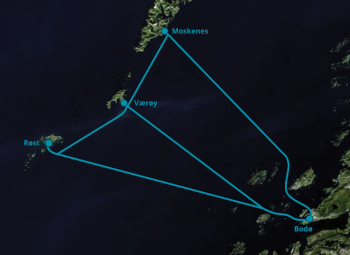
However, Hydra has since been eclipsed in scale by Torghatten Nord’s two new 117m hydrogen ferries, Røst and Moskenes, ordered for the Bodø–Lofoten route. These LR-classed double-enders, scheduled for delivery from Myklebust Verft later this year, bring hydrogen fuel cell technology firmly into the size range of conventional long-distance ro-pax tonnage, reducing annual CO₂ emissions on the Vestfjord route by some 26,500tonnes.
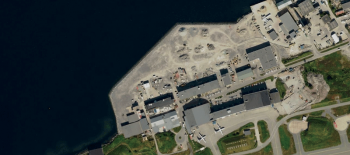
Hydrogen for the route will be supplied by GreenH, which is building a bunkering facility at Langstranda, near Bodø, with an eventual output of up to 10tonnes of hydrogen per day. The facility, the first of its kind in Northern Europe, will be the first functioning value chain for hydrogen as a maritime fuel in Norway. And once the first phase is complete later this year, compressed green hydrogen will be delivered directly from the production plant to the vessels via a dedicated pipeline, eliminating the high costs and logistical complexities of road transport. The system utilises a “cascade bunkering” method involving pressure transfer, achieving a minimum transfer speed of 1,700kg/h, allowing full daily refuelling in about three hours.
Sea change partners develop H2 ferry for NYC
Australian shipbuilder Incat Crowther and Switch Maritime in the US have announced a project to design and build a hydrogen-fuelled fast ferry for New York City.
The Big Apple’s first ever hydrogen-fuelled ferry, the 28.5m vessel has capacity to ferry 150 passengers at cruising speeds of 25knots. Featuring four H2 tanks capable of storing 720kg of compressed hydrogen, the vessel’s 16 98kW fuel cells will provide power to four Danfoss EM-PMI540-T3000 electric motors, which will in turn drive the catamaran’s twin propellers and other consumers.
Incat Crowther and Switch previously partnered on the design, delivery and regulatory approval for Sea Change – the world’s first zero-emissions hydrogen fuel cell-powered electric passenger ferry. Incat Crowther’s technical manager, Dan Mace, said the design showcases a feasible solution for mass transit operators looking to begin the fleet decarbonisation process, while maintaining existing operational profiles.
“The vessel’s ability to drop in to existing fleets is a real positive step to reduce emissions and ensures the vessel can be deployed quickly without the need for constructing additional shoreside infrastructure,” he said.
The project team plans to launch a ZEF-150 demonstration vessel at the Brooklyn Navy Yard.
These articles appeared in In depth, TNA Mar/Apr 2026
| Article Tags | |
| Article Tags | Alternative fuels |
| Naval Architect Edition | |
| Naval Architect Edition | 2026 |
| General | |
| Article Preview Text | While there are more commercially appealing alternative marine fuels available, hydrogen (H2), a highly flammable and odourless gas that in its super-cooled liquid form will propel man’s return to the moon, is possibly the ‘greenest’ to have made significant maritime inroads over the past 12 months.
Landmark vessel announcements, a regulatory breakthrough at the 11th session of the IMO Sub-Committee on Carriage of Cargoes and Containers in London last September, and the first serious infrastructure commitments have combined to give hydrogen the credibility it lacked just two years ago.
Indeed, there are now more than 20 hydrogen ships in operation, with twice that under construction, representing |