

Safety first for new fuels
Safety is not theoretical in maritime operations. The high seas remain an unforgiving environment where systems are routinely pushed to their limits. Heavy fuel oil is well understood, with decades of operational experience behind its safety protocols – yet incidents still occur.
Of the alternative fuels, LNG has matured into a proven marine fuel and one that is firmly back in favour after the IMO paused elements of its Net Zero Framework in October 2025. The regulatory hesitancy was quickly reflected in orderbooks, with LNG re-emerging as a favoured and well-understood bridge towards a lower-carbon future.
The other alternative fuels, however, introduce unfamiliar hazards. Hydrogen’s extremely low ignition energy, ammonia’s acute toxicity and methanol’s combination of flammability and toxicity all demand new layers of engineering scrutiny.
For Dr Thomas Beard, clean shipping service lead and principal marine engineer at BMT, the challenge is both technical and urgent. His doctorate in hydrogen safety, completed years before the current fuel debate intensified, has become newly relevant as shipowners seek to find ways to stay profitable, compliant and safe against a backdrop of regulatory uncertainty.
Designing for an uncertain fuel future
With no single alternative poised to displace heavy fuel oil in the near term, and limited fuel availability weighing on shipowner decisions, designers are increasingly adopting flexible, future-proofed layouts.
“In a design perspective, it’ll be like a space grab,” Beard says. “You allocate space for certain equipment and piping that can be retrofitted once the fuels become more available. Then we don’t have the weight penalty of piping we don’t need.”
 |
|---|
Space pressures are already acute because all leading alternative fuels have lower volumetric energy density than diesel:
• Methanol: ~15MJ/litre
• LNG (methane): ~13MJ/litre
• Ammonia: ~11.5MJ/litre
• Hydrogen: roughly 3-8MJ/litre depending on storage method.
Lower energy density means larger tanks, which in turn affects vessel layout, cargo capacity and stability calculations.
Storage conditions further complicate matters. Methanol is liquid at ambient conditions and can be stored similarly to diesel. LNG requires cryogenic storage at approximately –162°C, hydrogen at around –253°C or at considerable pressure, and ammonia at roughly –35°C under refrigerated conditions. Each demands dedicated tank systems and safety envelopes.
Reclaiming space through smart design
Some of the lost volume can be clawed back through careful naval architecture. Beard notes that cofferdam (air gap) distances for certain fuels can be reduced from traditional 600mm to around 30mm in specific configurations and with suitable technology.
Methanol offers particular flexibility. Because it is water-soluble, tanks do not always require double-hull separation from the ship’s side shell below the waterline.
“It means we can leverage bits of the design to start maximising the space for the additional storage requirements,” Beard explains.
All of these fuels fall under the IMO’s International Code of Safety for Ship Using Gases or Other Low-flashpoint Fuels (IGF Code). That brings extensive mandatory safeguards and existing knowhow to bear for new problems.
Layers of protection
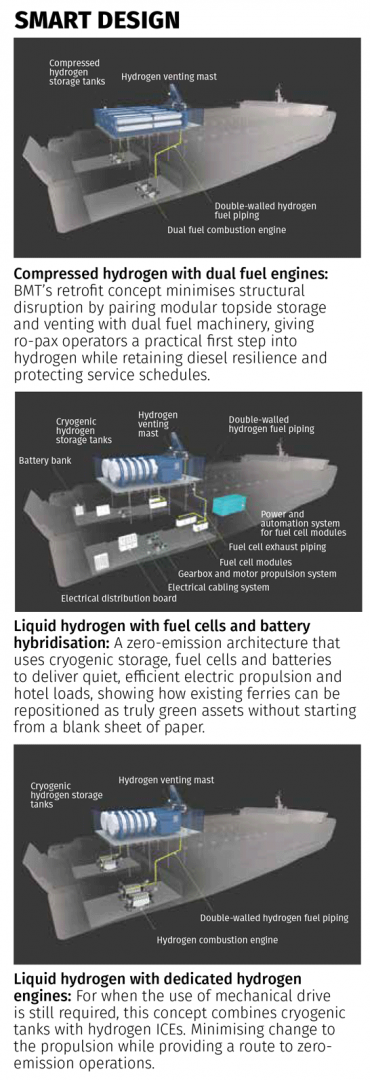
Modern low-flashpoint fuel systems rely on multiple defensive layers, including:
• Double-walled piping
• Nitrogen inerting systems
• Gas detection and alarm networks
• Airlocks and hazardous zoning
• Dedicated mechanical ventilation
• Redundant power supplies.
Redundancy is particularly critical. Safety and firefighting systems must remain operational even during major failures.
“The fuels are either highly toxic, highly flammable, or a mixture,” Beard says. “You have to design accordingly.”
Ammonia: the toxic threat
Ammonia’s primary hazard is toxicity rather than flammability. It is highly hydrophilic, which means it aggressively attacks moist tissue such as eyes, nose and throat. Exposure risks are severe. Concentrations above 0.25% can be fatal within 30 minutes and, unlike with exposure to some other chemicals, there is no cure.
Under normal operating conditions, the risks are manageable. But maritime operations rarely remain normal.
“At sea, normal conditions can quickly flip into a dark and stormy night scenario,” Beard warns. “That’s where redundancy becomes vital.”
Engineers must ensure sufficient backup power to allow crew in hazmat suits to isolate leaks, purge systems with nitrogen and restore safe conditions.
These realities may limit ammonia’s suitability for passenger vessels.
“It might be feasible on a crew transfer vessel where everyone is trained and buckled into their seats,” Beard says. “On a ferry or cruiseship, passengers are untrained and mobile, and that’s a very big challenge.”
Methanol: the double hazard
Methanol presents both flammability and toxicity risks. It can harm through ingestion, skin absorption or inhalation.
Treatment exists – most commonly fomepizole – but Beard notes an unusual secondary remedy: high-strength ethanol, such as vodka or whisky, which competes metabolically with methanol in the body.
Firefighting presents another complication. Methanol flames can be nearly invisible in daylight, requiring alcohol-resistant foam systems and enhanced detection procedures.
Hydrogen: ultra-flammable but with inbuilt safety features
Hydrogen’s minimum ignition energy is about 0.02MJ – low enough that static electricity from clothing can ignite it. Although this is at ~38% concentration, at 10% concentration the ignition energy is similar to methane (LNG). Yet the fuel also has intrinsic safety advantages.
“What I do like about hydrogen is that it has its own inbuilt safety mechanisms,” Beard says. “It’s the most buoyant and diffusive gas on Earth. It wants to rise and spread out.”
Open-deck storage can, therefore, be advantageous. Below-deck storage, however, introduces major ventilation and explosion-proofing requirements.
Blast-proof ducting, hazardous-zone equipment ratings and dense sensor networks become essential. Detection systems typically trigger at around 50% of the lower flammability limit – well before ignition is possible.
LNG: A familiar contender
Compared with the newer fuels, LNG benefits from a more mature safety framework. Engineers are “quietly confident” in handling it and it now has a proven track record as a marine fuel, even if its well-to-wake emissions are less compelling than some of the potential cleaner alternatives.
 |
|
|---|---|
|
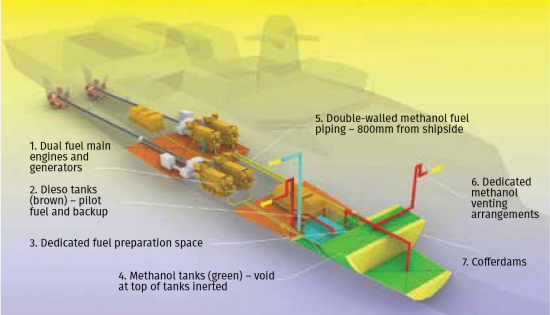
BMT Venator dual fuel frigate (methanol & F-76) BMT shows how warships can transition to low-carbon methanol without trading combat resilience, using dedicated fuel prep spaces, double-walled pipework, optimised cofferdams and segregated venting to stack multiple layers of protection around a flexible machinery arrangement. Allows cleaner operations in peace time but offers full operational capability in times of conflict. |
|
The human factor
While engineering controls are advancing rapidly, Beard believes crew competence may be the industry’s greatest challenge.
“These fuels are so different that there’s a strong argument for specialism,” he says.
Yet excessive specialisation could restrict seafarer mobility between vessel types – something crews and operators alike are keen to avoid. The uncertainty over which fuels will dominate further complicates planning. Training investment must be balanced against an unclear long-term fuel mix.
A whole-system challenge
Decarbonisation isn’t just about ships. Beard emphasises that vessel design cannot be separated from shoreside infrastructure.
“It’s no good just designing a ship,” he says. “You also need to work out how to fuel it, wherever it goes. It’s a whole ecosystem. Nobody wants stranded assets.”
It’s clear that decarbonisation will test maritime engineering in ways not seen for generations, and safety will remain the ultimate measure of success.
This article appeared in Features, TNA Mar/Apr 2026
| Article Tags | |
| Article Tags | Alternative fuelsSafety |
| General | |
| Article Preview Text | Safety is not theoretical in maritime operations. The high seas remain an unforgiving environment where systems are routinely pushed to their limits. Heavy fuel oil is well understood, with decades of operational experience behind its safety protocols – yet incidents still occur.
Of the alternative fuels, LNG has matured into a proven marine fuel and one that is firmly back in favour after the IMO paused elements of its Net Zero Framework in October 2025. The regulatory hesitancy was quickly reflected in orderbooks, with LNG re-emerging as a favoured and |
| Naval Architect Edition | |
| Naval Architect Edition | |