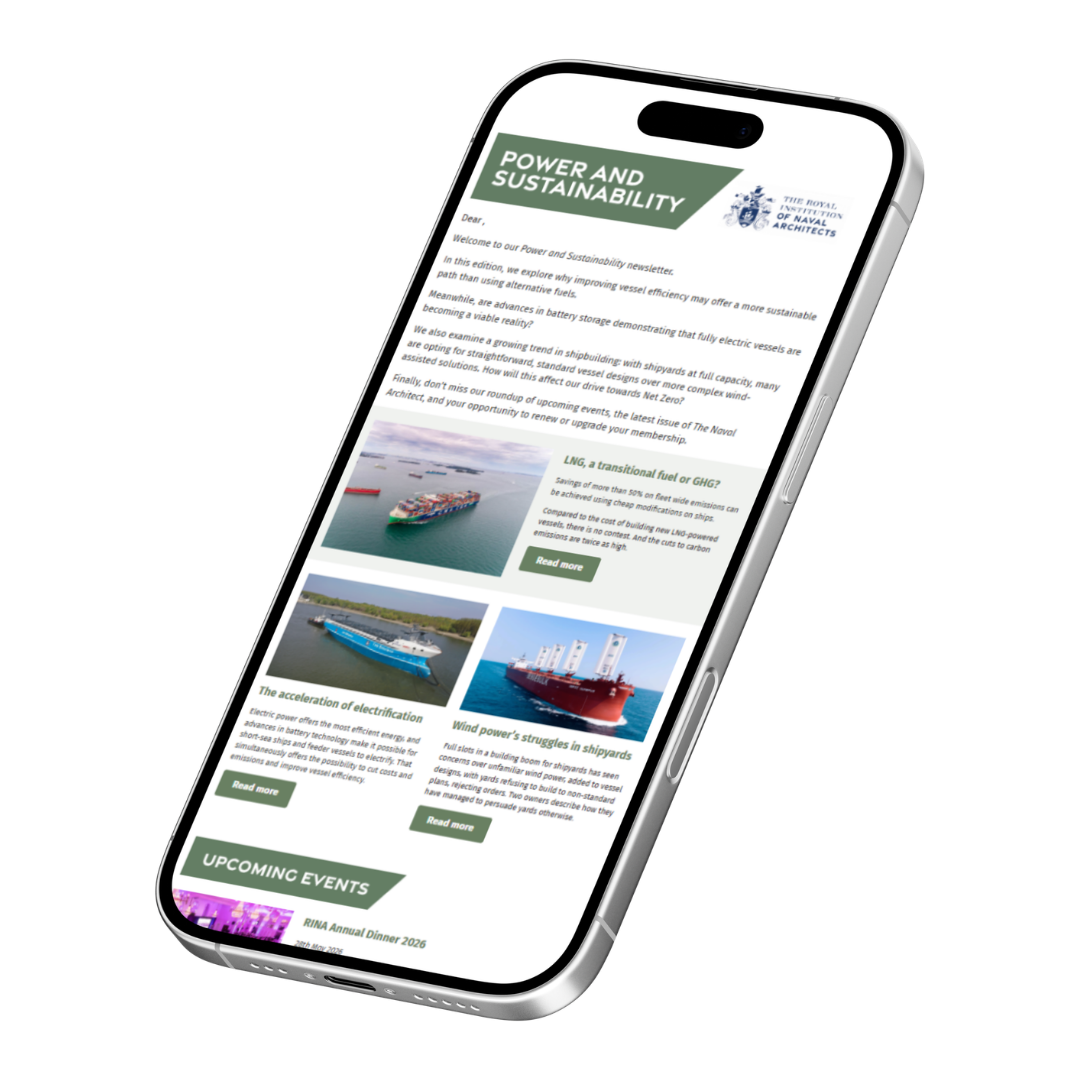
The Naval Architect provides in-depth information on all aspects of vessel design, construction and engineering. Practical applications of latest technology and case studies are accompanied by analysis and foresights. Published every two months, the magazine covers everything from superyachts and short-hop ferries to tankers and heavy-lift vessels; from battery pack installations and sail-assisted solutions to LNG tank retrofits; and from offshore safety to warship resilience.
AN INVESTIGATION ABOUT ADDED POWER IN HEAVY WEATHER FOR PASSENGER SHIPS WITH FOCUS ON WIND EFFECT
Full Scale Ship Performance
Real-world performance data is reshaping understanding of passenger ship efficiency in heavy weather. By analysing full-scale operational measurements, researchers quantify the combined impact of wind and waves through an added-power methodology. New insights into aerodynamic drag on large topside structures could improve voyage planning, energy efficiency and design decisions globally.
INSTALLATION INNOVATION FOR FLOATING OFFSHORE WIND
Maritime Innovation and Emerging Technologies
Floating offshore wind is moving from demonstration to deployment, creating new demands for naval architecture, marine operations and port infrastructure. This review examines construction, towing and installation challenges, alongside stability, certification and maintenance considerations. The insights highlight practical strategies to reduce project risk, costs and lifecycle uncertainty at scale globally.
REMOTE INSPECTION OF A FPSO UNIT CRUDE OIL TANK WHILST STILL PRODUCING
Remote drone-based inspection is transforming offshore asset assurance by enabling detailed survey work without confined-space entry. Lessons from a successful FPSO crude oil tank inspection highlight the importance of planning, stakeholder coordination, class-approved procedures and tank preparation, demonstrating how UAV technology can reduce risk, cost and inspection time significantly today.
IMPROVING ENVIRONMENTAL IMPACT AND REFINING FLEET RELIABILITY THROUGH THE USE A RELIABILITY CENTRED MAINTENANCE PROCESS TO IMPROVE MAINTENANCE OF THE VESSEL FLEET OF THE MALDIVES TRANSPORT AND CONTRACTING COMPANY PLC
Ship' Life Cycle
Reliability-Centred Maintenance is proving vital to maximising fleet availability and operational performance in challenging economic conditions. Using real-world experience from the Maldives’ essential ferry network, this work demonstrates how data-driven maintenance optimisation can reduce downtime, improve reliability and lower costs, offering valuable lessons for diverse maritime fleets worldwide at scale.
HYDRODYNAMIC LOADS AND FLOW STRUCTURE ANALYSIS FOR A SURFACED SUBMARINE USING CAPTIVE MODEL EXPERIMENTS
Warship
Understanding surfaced submarine performance is vital for safe and efficient operations. Experimental towing-tank trials on a generic submarine generated hydrodynamic load and flow-field data, revealing the effects of wave-making resistance, bow-wave forces, and pitching moments. The findings support improved seakeeping prediction, powering assessments, and validation of advanced numerical models today.
SURV 2021 Conference Proceedings
SURV
This is the Whole Conference Proceedings for: Surveillance, Search and Rescue Craft Conference 10, 13th - 14th January 2021, London, United Kingdom
DEVELOPMENT OF RESISTANCE CRITERIA METHOD FOR SHIP PERFORMANCE EVALUATION BY ONBOARD MONITORING DATA
Full Scale Ship Performance
New methods for evaluating ship performance in calm seas are improving the reliability of operational efficiency assessments. Using onboard monitoring data, resistance-based filtering, and slip-ratio correction techniques, the OCTARVIA approach isolates environmental influences and ageing effects. The validated methodology offers more accurate performance benchmarking and supports smarter fleet management decisions.
OPERATIONAL AND ENERGY USE PROFILE CHARACTERISATION OF LNG CARRIERS WITH DFDE PROPULSION PLANTS
Full Scale Ship Performance
High-frequency operational data from modern LNG carriers is providing a clearer picture of real-world energy performance. Analysing DFDE propulsion systems across an active fleet, researchers identified operational patterns with unprecedented accuracy, reducing reliance on assumptions. The findings strengthen efficiency benchmarking, support optimisation strategies, and inform future vessel design decisions globally.
JOINT SEA TRIAL OF SHIPS WITH GATE RUDDER® AND CONVENTINAL RUDDER
Full Scale Ship Performance
Full-scale trials of the Gate Rudder® reveal striking efficiency gains beyond conventional steering systems. Comparing sister ships and supported by CFD analysis, researchers identified fuel savings of up to 33% alongside manoeuvring benefits. The findings highlight how innovative rudder technology can significantly enhance vessel performance, sustainability, and operational competitiveness today.
EFFECT OF OCCUPATIONAL, NON OCCUPATIONAL, AND SOCIODEMOGRAPHICS CHARACTERISTICS FACTORS TO THE FATIGUE RISK OF SHIP STEEL SMELTING PRODUCTION WORKERS
Workplace fatigue remains a significant operational and safety challenge. Analysis of occupational health and demographic factors identified sleep quality, age and tenure as key influences on fatigue levels. The findings highlight opportunities for targeted interventions, workforce wellbeing programmes and smarter job design to enhance performance, safety and productivity overall sustainably.
MONITORING AND FAULT DETECTION OF MAIN ENGINE COOLING WATER BASED ON MODBUS COMMUNICATION AND INTERFACE
An intelligent engine monitoring system is strengthening maritime safety by detecting cooling-system faults before they escalate into failure. Built on RS485 Modbus communications, PLC processing, and real-time interfaces, the solution delivers clear alarms, regulatory compliance, and operational visibility. The platform provides a foundation for more advanced predictive maintenance capabilities ahead.
REAL TIME NOTIFICATION FOR AUTOPILOT SHIP DATA COMMUNICATION BASED ON LORA AND MQTT
An autonomous boat-control platform combines GPS guidance, microcontroller-based autopilot, and long-range LoRa communications to navigate programmed routes while transmitting real-time position data. By integrating MQTT-enabled monitoring, database connectivity, and web-based oversight, the system enhances situational awareness, remote vessel management, and scalable unmanned maritime operations with efficiency and operational resilience globally.
Newsletters
Stay connected with the global maritime community through RINA’s newsletters.
Whether you are a member or not, you can receive updates from The Naval Architect, alongside selected RINA news, events and industry insights. Members also gain access to a wider portfolio of exclusive newsletters on key topics in the maritime industry.