Wind power's struggles to get airborne

Full shipyards do not like complications. As slots are filled into 2029, yards are becoming increasingly reluctant to build vessels that do not meet a standard design.

Vessel operators at RINA’s fifth Wind Propulsion Conference, held in London in February, told how they had worked to convince yards to add wind power to vessels, whether it was newbuildings or retrofits.

Wind installations on ships should be the most straight forward of retrofits, particularly on liquid or dry bulk ships which have open decks with cargo stored underneath.

Bulk ship operators typically operate at lower speeds and not always on the same routes, and are less inclined to shift to alternative fuels, which can be difficult to source, costly to buy, and will require extensive modernisation of ships or new vessels altogether.

One company, which operates a fleet of chemical tankers, has developed a methodology that will allow the company to meet net zero emissions up to 2040 with its existing 70 vessels of varying ages.

Erik Hjortland, vice-president of technology at Odfjell Ship Management, said the company had cut the emissions from its fleet simply by utilising existing technologies to improve efficiency without converting to low-carbon fuels.

By using simple and comparatively low-cost operational and technological changes to its fleet the Norwegian company’s fuel costs have been cut by an independently corroborated 53%.

With more than a decade in the planning Odfjell’s fleet optimisation programme has culminated in the testing of Bound4Blue suction sails on its tanker Bow Olympus, but the company has said it intends to add wind propulsion to its fleet.

“We have done that [reduced emissions] without putting any stress on the renewable electricity infrastructure in the world, which we would have to do if we had gone through alternative fuels route,” explained Hjortland, who referenced last year’s Clarkson study that revealed some 63% of the world’s fleet has not installed any energy saving devices.

Jan Opedal, project manager at Odjfell Tankers, told the Wind Propulsion conference: “For medium-sized ship owners, it's much cheaper to retrofit sails on a five-year dry docking than try to get them on a new building contract.”

Asian yards, who build 80-90% of all new ships are not keen on fitting sail technology.

“If you want three vessels in a standard series, the price is just crazy because of the equipment price, plus they price in risk because they're afraid of delays,” he said. “It’s very costly if you're not controlling the design or have a really long series of vessels.”

Speaking on the same panel, Jesse Bryce, Union Maritime’s commercial performance manager said, initially the company found the cost of newbuildings with sail “quite high”.

“They were the first time the shipyards were installing wind, and there was a lot of uncertainty there, but with the manufacturers helping to explain that actually it's not a terrifying process, it's all quite predictable, quite routine,” that made each new project easier.

Union Maritime operates a fleet of 56 tankers, 11 bulkers and three offshore vessels, with a further 34 ships on order and has been adapting its fleet to wind power.

Bryce, told the conference the company had approached yards to build a series of seven vessels, taking a standard design and asking each yard how they could improve on it.

“It's been a mixed response,” said Bryce, “Some shipyards are very open to considering all sorts of things, and some we get what we're given, and that’s the end of it.”

According to Bryce, by building a series of seven ships it allows the operator to get all the steel work and installation completed and you can operate from day one with the fuel-saving sails.

Union Maritime used Blue Wasp Maritime consultancy which specialises in modelling the effects of wind propulsion on commercial ships, to develop the seven newbuildings, of 18,000dwt each, six have been delivered with another one to come.

These ships are fitted with Norsepower rotor sails, on what Bryce said were small vessels, and the Norsepower sails were compact, winning out in simulations, “The cost benefit worked out for us.”

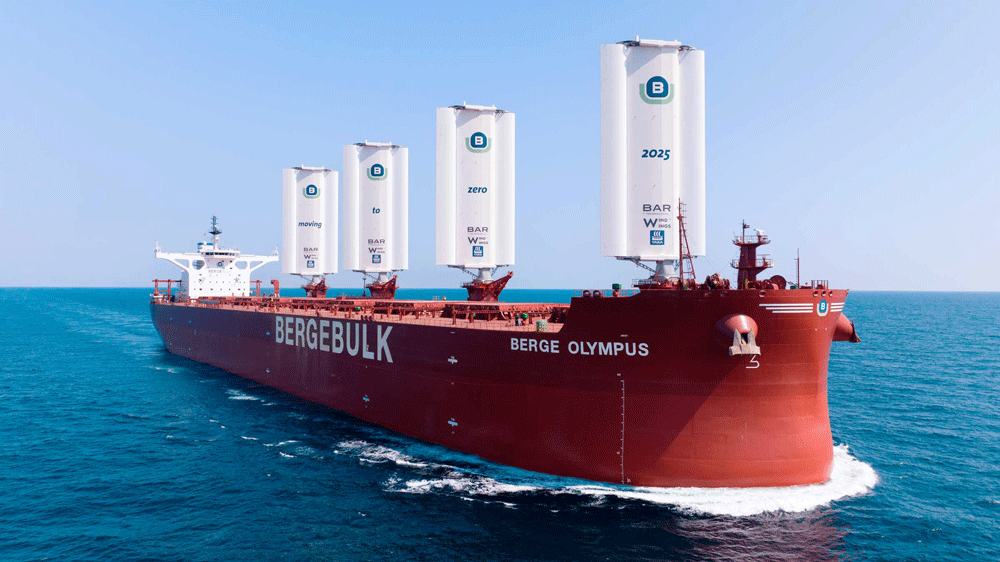
The next batch of seven aframax newbuilds will be fitted with BAR Technologies WindWings, rigid sails.

“They are very large, very powerful devices, and we can fit a lot of power onto the LR2s,” said Bryce.

He added that things are always changing with technologies improving, new designs, materials and lower prices.

Regulators approving a global form of carbon pricing would also improve the savings, and payback time.

Related Articles

Comments

No posts found, be the first!

Logon

 Create New Account 
 Forgotten Password?