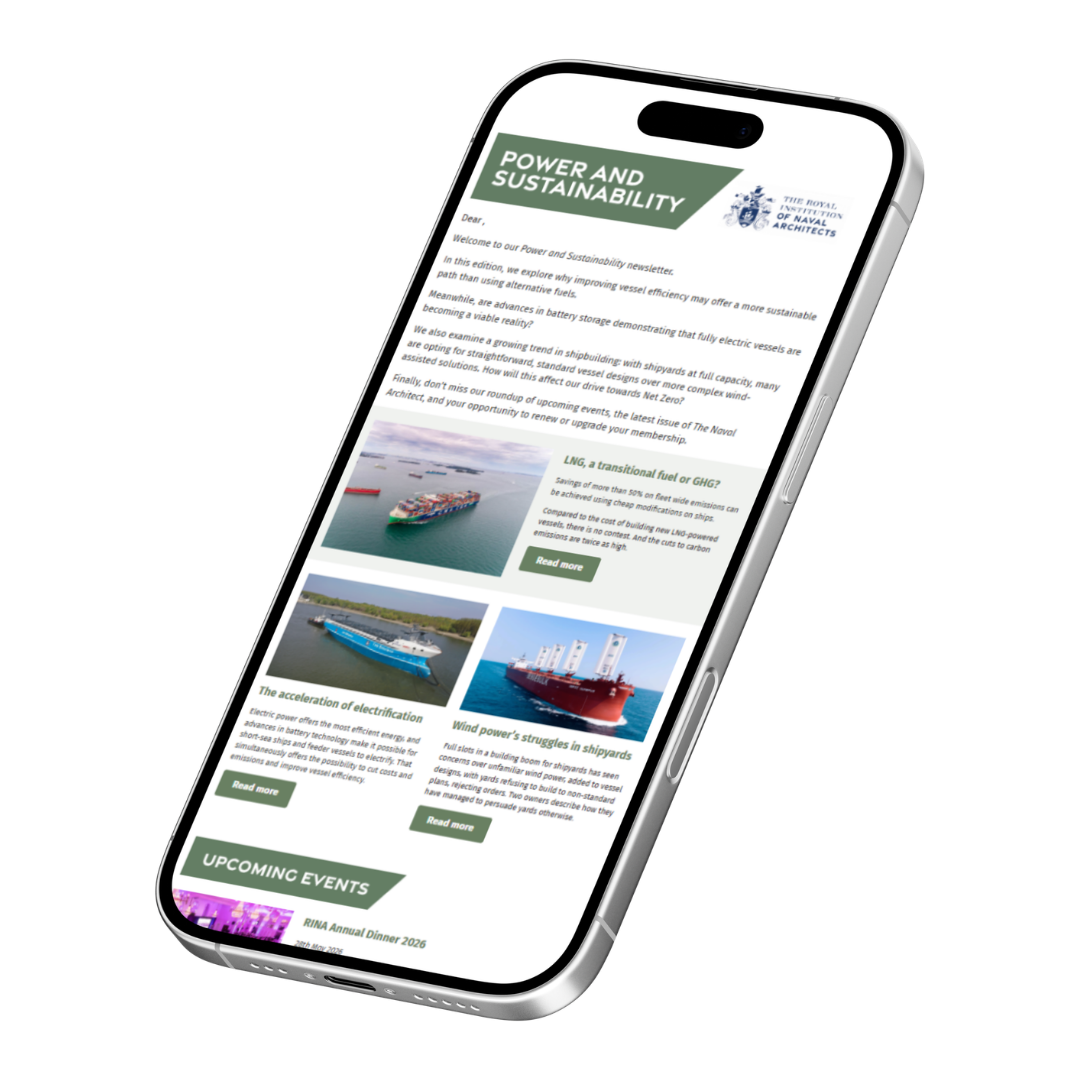
The Naval Architect provides in-depth information on all aspects of vessel design, construction and engineering. Practical applications of latest technology and case studies are accompanied by analysis and foresights. Published every two months, the magazine covers everything from superyachts and short-hop ferries to tankers and heavy-lift vessels; from battery pack installations and sail-assisted solutions to LNG tank retrofits; and from offshore safety to warship resilience.
ANALYTICAL AND EXPERIMENTAL INVESTIGATION ON THE FREE VIBRATION OF SUBMERGED STIFFENED STEEL PLATE
Transactions
Understanding how submerged structures respond to fluid interaction is essential for reliable marine and offshore design. By combining experimental testing, analytical modelling and numerical simulation, improved prediction of vibration characteristics and added-mass effects is helping engineers enhance structural performance, validate design assumptions and increase confidence in complex underwater applications.
Discussion: VISCOSITY IN SEAKEEPING
Transactions
Achieving accurate seakeeping predictions requires careful consideration of the balance between physical realism and computational complexity. Ongoing debate around viscosity, turbulence modelling and hydrodynamic damping reflects broader challenges in naval hydrodynamics, with implications for CFD practice, ship motion prediction and the future development of efficient analysis methods.
A RESEARCH ON TECHNIQUES, MODELS AND METHODS PROPOSED FOR SHIP COLLISION AVOIDANCE PATH PLANNING PROBLEM
Transactions
Improving ship collision avoidance remains a key priority as maritime operations become increasingly complex and autonomous. Artificial intelligence, fuzzy logic and heuristic optimisation techniques are playing an expanding role in path planning, enabling safer navigation and greater fuel efficiency while shaping the next generation of intelligent decision-support and autonomous vessel technologies.
VISCOSITY IN SEAKEEPING
Transactions
Accurate prediction of ship motions in waves depends on reliable estimation of hydrodynamic coefficients and the physical assumptions that underpin them. Questions around the role of viscosity, turbulence modelling and computational efficiency continue to influence seakeeping analysis, with implications for simulation accuracy, software application and the development of practical engineering methodologies.
PERSPECTIVES FOR A WIND ASSISTED SHIP PROPULSION
Transactions
Wind-assisted propulsion is emerging as a viable pathway to reducing fuel consumption and emissions in commercial shipping. Technologies such as kites, Flettner rotors and Dynarig sails can deliver greater benefits when paired with route optimisation, creating new opportunities to balance operational efficiency, voyage planning and evolving environmental requirements.
AN ICOR APPROACH TOWARDS SHIP MAINTENANCE SOFTWARE DEVELOPMENT
Transactions
Effective maintenance remains fundamental to safe, reliable and efficient ship operations. Opportunities to improve workload balancing, scheduling and onboard safety are driving the evolution of planned maintenance systems, while smarter software-enabled processes are helping operators enhance equipment reliability, streamline maintenance activities and support more effective fleet management.
A METHODOLOGY TO SUPPORT EARLY STAGE OFF-THE-SHELF NAVAL VESSEL ACQUISITIONS
Transactions
Model-Based Systems Engineering is helping bring greater rigour and traceability to naval vessel acquisition. By combining set-based design, requirements exploration and multi-criteria decision-making, the approach supports more informed evaluation of off-the-shelf solutions, reducing acquisition risk while improving alignment between capability needs, procurement decisions and long-term operational objectives.
URANS PREDICTION OF THE SLAMMING COEFFICIENTS FOR PERFORATED PLATES DURING WATER ENTRY
Transactions
Understanding slamming loads remains critical for the design of offshore and marine structures exposed to harsh operating conditions. Advanced URANS simulations reveal how perforation geometry and trapped-air behaviour influence impact forces, providing valuable insight into load management and supporting safer, more robust structural designs in demanding marine environments.
THE INFLUENCE OF CENTRE BOW LENGTH ON SLAMMING LOADS AND MOTIONS OF LARGE WAVE-PIERCING CATAMARANS
Transactions
Wave-piercing catamaran performance is closely linked to centre bow design, with bow geometry playing a significant role in wave-induced slamming loads and structural response. Increased water confinement beneath the bow can amplify impact loads and accelerations, highlighting important design trade-offs between ride performance, structural demands and operational reliability in demanding sea conditions.
CHOOSING THE STYLE OF A NEW DESIGN - THE KEY SHIP DESIGN DECISION
Transactions
Early-stage ship design decisions can have lasting consequences for capability, performance and adaptability. For complex naval vessels, design “style” shapes choices across systems, architectures and disciplines, making it a powerful framework for exploring alternatives, managing trade-offs and guiding more coherent, effective vessel development from the outset.
MODEL PREDICTIVE CONTROL OF AN AUV USING DE-COUPLED APPROACH
Transactions
Autonomous underwater vehicles are becoming increasingly capable through advanced control strategies designed to manage complex, nonlinear dynamics. A decoupled model predictive control approach simplifies implementation while maintaining effective guidance and stability, supporting more reliable ocean survey operations and expanding the potential of autonomous systems in demanding underwater environments.
Newsletters
Stay connected with the global maritime community through RINA’s newsletters.
Whether you are a member or not, you can receive updates from The Naval Architect, alongside selected RINA news, events and industry insights. Members also gain access to a wider portfolio of exclusive newsletters on key topics in the maritime industry.