The Naval Architect provides in-depth information on all aspects of vessel design, construction and engineering. Practical applications of latest technology and case studies are accompanied by analysis and foresights. Published every two months, the magazine covers everything from superyachts and short-hop ferries to tankers and heavy-lift vessels; from battery pack installations and sail-assisted solutions to LNG tank retrofits; and from offshore safety to warship resilience.
THE NEXT VERSION OF CII - WHAT MIGHT IT LOOK LIKE?
CII
The Carbon Intensity Indicator is entering a critical phase of review as industry experience reveals anomalies that may affect fairness, effectiveness and operational decision-making. With regulatory refinements under active consideration, emerging proposals could reshape how maritime emissions performance is measured, creating important implications for compliance, fleet efficiency and decarbonisation strategies.
BEYOND CARBON INTENSITY: ENHANCING GHG REDUCTIONS THROUGH EFFECTIVE ENERGY EFFICIECNY METRIC AND REGULATORY ALIGNMENT
CII
The effectiveness of maritime emissions regulation is increasingly under scrutiny. Analysis of Carbon Intensity Indicator performance reveals opportunities for energy-based alternatives, including propulsion-focused efficiency metrics and clearer emissions accounting. The findings highlight potential regulatory overlap, offering strategic insights into how future frameworks could better accelerate greenhouse gas reductions ahead globally.
THE BLUE VISBY SOLUTION: A SYSTEMIC, HOLISTIC AND UNIFIED APPROACH TO MITIGATING THE GHG EMISSIONS' IMPACT OF SAIL FAST THEN WAIT
CII
The Blue Visby Solution targets one of shipping’s largest hidden inefficiencies: vessels sailing fast only to wait at port. Combining advanced algorithms, data sharing and innovative operational frameworks, it enables coordinated arrival optimisation at scale, reducing emissions and fuel consumption while improving efficiency without disrupting port operations or logistics.
MONITORING AND ANALYZING TO ENHANCE THE EFFICIENCY AND SUSTAINABILITY ONBOARD A RO-PAX VESSEL
CII
GNV Polaris provides a real-world test of how advanced vessel design performs beyond the shipyard. By combining continuous monitoring, performance analytics and operational data, researchers are assessing propulsion efficiency during its maiden voyage to optimise engine settings, enhance sustainability and reveal the gap between predicted and actual performance outcomes today.
THE FUTURE OF CII IN THE WELL-TO-WAKE FUEL CHAIN
CII
As maritime decarbonisation accelerates, questions are emerging over whether today’s Carbon Intensity Indicator can align with future well-to-wake emissions frameworks. Drawing on operational performance experience, this analysis explores regulatory redesign options, lifecycle assessment implications and the strategic trade-offs that could reshape compliance, fuel selection and efficiency in the years ahead.
MARINE ENVIRONMENTAL METRICS: ARE WE MEASURING THE RIGHT THING?
CII
Current carbon intensity measures can conflict with real-world operational needs, sometimes incentivising higher emissions rather than genuine reductions. By examining the gap between engineering assumptions and vessel operations, this analysis highlights critical flaws in existing metrics and makes the case for more holistic performance frameworks that better support decarbonisation goals.
WING SAILS FOR CII COMPLIANCE: A TRAMP SHIPPING UNCERTAINTY STUDY
CII
Wind propulsion is emerging as a practical pathway to maritime decarbonisation, even for vessels operating on unpredictable routes. Analysis of wing sail performance shows fuel-saving estimates remain remarkably reliable over time, reducing uncertainty for shipowners and strengthening the business case for wider adoption of wind-assisted propulsion technologies.
OPERATIONAL TECHNIQUES FOR CII VOYAGE SCORE ENHANCEMENT IN WASP FITTED SHIPS
CII
Wind-Assisted Ship Propulsion can improve carbon intensity performance, but achieving predicted savings requires more than favourable wind conditions. Using holistic simulation and LNG carrier case studies, this research reveals how voyage planning, propulsion integration and wind management interact, providing practical strategies to optimise CII performance and maximise operational efficiency.
THE IMPORTANCE OF DATA SCOPE AND DATA RELIABILITY FOR THE ROBUSTNESS AND CREDIBILITY OF THE SHIP CARBON INTENSITY INDICATOR (CII)
CII
A credible carbon intensity framework depends as much on data quality as emissions performance. Survey and verifier insights expose weaknesses in voyage definitions, reporting transparency and validation processes, while highlighting support for alternative efficiency metrics. The findings point toward more trusted, actionable carbon measures that better incentivise operational change globally.
INTEGRATING HARDWARE AND SOFTWARE SOLUTIONS FOR ENHANCED CII PERFORMANCE: A CASE STUDY FROM KOWA MARINE AND NAPA
CII
Kowa Marine’s collaboration with NAPA demonstrates how integrated digital and operational technologies can improve Carbon Intensity Indicator performance. Combining voyage optimisation, trim analytics and performance monitoring with Blue Visby arrival coordination, the approach delivers measurable fuel and emissions reductions while highlighting the strategic value of data-driven maritime decarbonisation initiatives today.
eSAILS®: USING WIND TO IMPROVE REAL VESSEL CII AND ENVIRONMENTAL PERFORMANCE
CII
bound4blue’s eSAIL® technology demonstrates how wind-assisted propulsion can deliver measurable decarbonisation gains in existing fleets. Through advanced modelling of vessel dynamics and aerodynamic performance, the retrofit shows substantial fuel and CO₂ reductions, improved Carbon Intensity Indicator ratings and a practical pathway for meeting increasingly stringent environmental requirements.
EVALUATION ON ENERGY SAVINGS EFFECT OF CORRECTIVE ACTIONS USING MONITORING OPERATIONAL DATA FOR FERRIES
CII
Accurately measuring ship energy efficiency remains a major challenge as fuel consumption data often varies significantly between voyages. A new Energy Efficiency Navigational Index, combined with stochastic modelling and operational analytics, offers a more reliable evaluation framework, demonstrating measurable gains from weather routing and providing deeper insight into performance improvement opportunities.
Newsletters
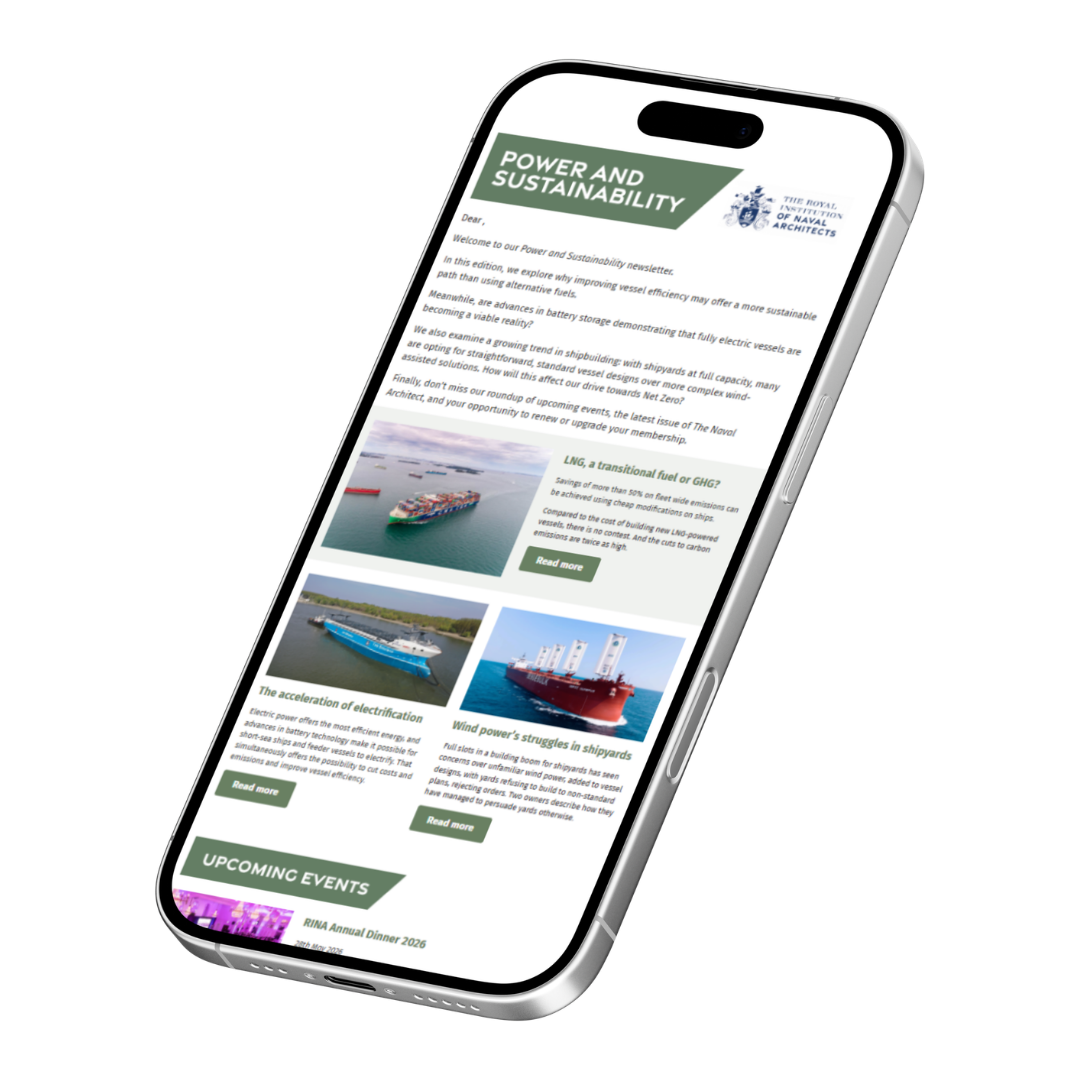
Stay connected with the global maritime community through RINA’s newsletters.
Whether you are a member or not, you can receive updates from The Naval Architect, alongside selected RINA news, events and industry insights. Members also gain access to a wider portfolio of exclusive newsletters on key topics in the maritime industry.