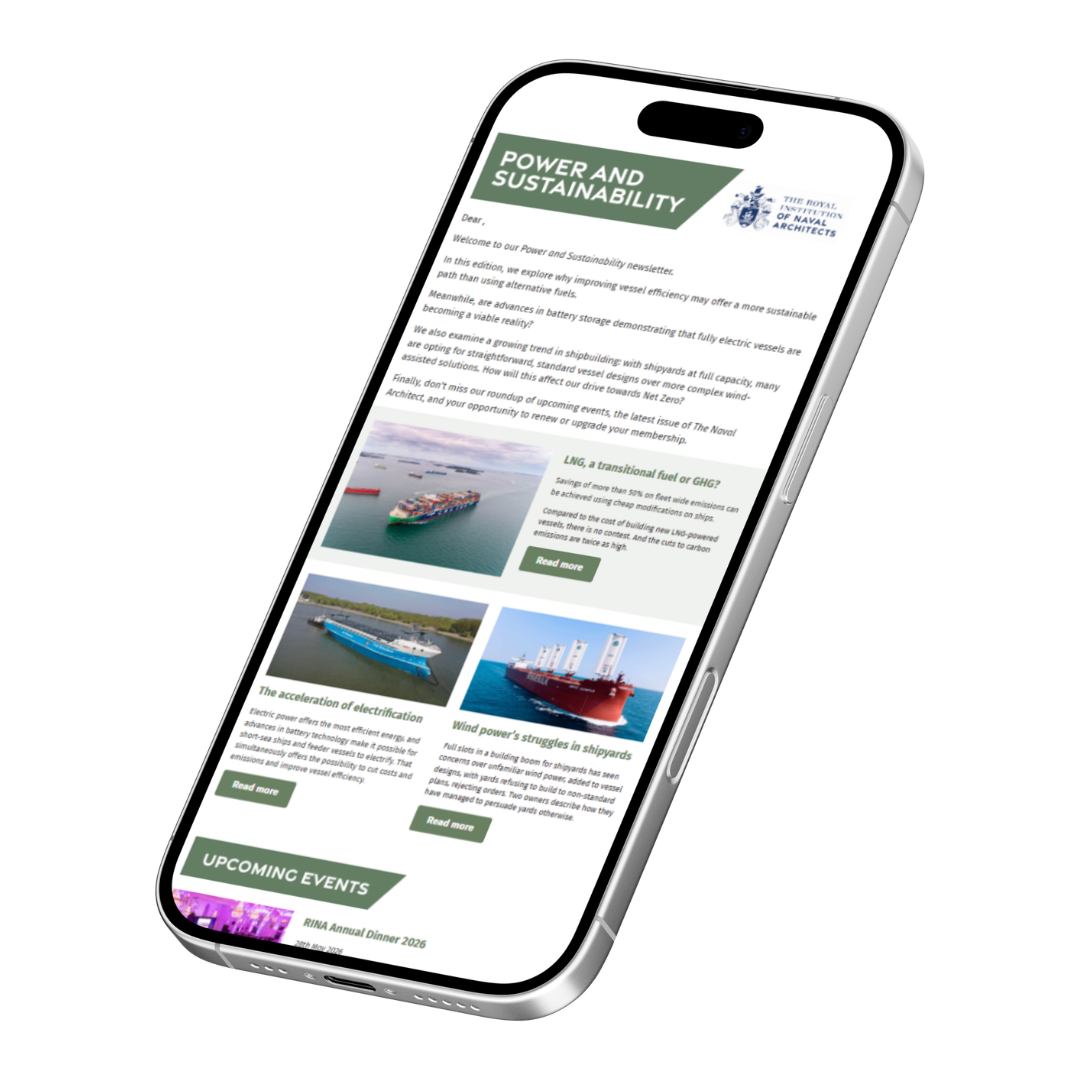
The Naval Architect provides in-depth information on all aspects of vessel design, construction and engineering. Practical applications of latest technology and case studies are accompanied by analysis and foresights. Published every two months, the magazine covers everything from superyachts and short-hop ferries to tankers and heavy-lift vessels; from battery pack installations and sail-assisted solutions to LNG tank retrofits; and from offshore safety to warship resilience.
SIMULATION OF A SHIP WITH PARTIALLY FILLED TANKS ROLLING IN WAVES BY APPLYING MOVING PARTICLE SEMI-IMPLICIT METHOD
Transactions
Understanding the behaviour of liquids with free surfaces is increasingly important in ship design, as sloshing within partially filled tanks can significantly influence vessel motions and stability in waves. Advances in particle-based numerical methods are improving the simulation of complex free-surface phenomena, enabling more realistic assessment of fluid-structure interactions and supporting safer, more effective marine designs.
MOTIONS OF CATAMARANS IN OBLIQUE SEAS AT SPEED
Transactions
Passenger comfort and operational effectiveness are strongly influenced by vessel motions, particularly for high-speed catamarans operating in oblique seas where roll responses can become significant. Continued development and validation of numerical seakeeping prediction methods is improving designers’ ability to assess vessel performance across a range of operating conditions, supporting the optimisation of seakeeping characteristics, passenger comfort, and overall operational capability.
VESSEL TRANS-CRITICAL WAVE WAKE, DIVERGENT WAVE ANGLE AND DECAY
Transactions
Understanding vessel wave wake in shallow and restricted waters remains an important challenge, particularly within the trans-critical depth Froude number range where wave behaviour differs significantly from conventional deep-water conditions. Experimental investigations have improved understanding of how water depth influences catamaran wake characteristics, highlighting changes in wave height, wave angle, and wave decay, while supporting the development of practical methods for predicting wave wake performance in restricted waters.
ULTIMATE STRENGTH PERFORMANCE OF SUEZMAX TANKER STRUCTURES: PRE-CSR VERSUS CSR DESIGNS
Transactions
The introduction of Common Structural Rules has increased focus on the structural performance and long-term reliability of tanker designs. Comparative studies of pre-CSR and CSR vessels are enhancing understanding of collapse strength and corrosion-related degradation, helping designers evaluate the effectiveness of modern rule requirements and supporting the development of safer, more robust double-hull tanker structures.
Newsletters
Stay connected with the global maritime community through RINA’s newsletters.
Whether you are a member or not, you can receive updates from The Naval Architect, alongside selected RINA news, events and industry insights. Members also gain access to a wider portfolio of exclusive newsletters on key topics in the maritime industry.