The Naval Architect provides in-depth information on all aspects of vessel design, construction and engineering. Practical applications of latest technology and case studies are accompanied by analysis and foresights. Published every two months, the magazine covers everything from superyachts and short-hop ferries to tankers and heavy-lift vessels; from battery pack installations and sail-assisted solutions to LNG tank retrofits; and from offshore safety to warship resilience.
Discussion: OFFSHORE AND COASTAL FLOATING HOTELS: FLOTELS
Transactions
Growing demand for offshore accommodation is driving the development of increasingly specialised floating hotel concepts, tailored to environments ranging from sheltered coastal locations to deep-water energy developments. Emerging designs are placing greater emphasis on operability, comfort, and cost efficiency, reflecting the expanding role of floating accommodation in offshore industry, infrastructure, and maritime development.
SUBCRITICAL WAVE WAKE UNSTEADINESS
Transactions
Technical Note: STATIC STABILITY OF AERODYNAMICALLY SUPPORTED PLATFORMS MOVING ABOVE WATER
Transactions
Understanding the stability of high-speed marine vehicles that rely on aerodynamic lift remains a critical challenge as designers explore alternative concepts for fast and efficient over-water transport. Improved insight into the interaction between vehicle geometry, operating conditions, and surface effects is helping to refine stability assessments, supporting the development of safer and more effective ground-effect and air-cushioned marine platforms.
COMPARISON OF LAND-BASED TEST SETUPS FOR A BALLAST WATER MANAGEMENT SYSTEM
Transactions
Effective ballast water management is becoming increasingly important as regulators and operators seek to prevent the spread of invasive aquatic species through global shipping networks. Experience from land-based testing is highlighting the importance of consistent testing procedures and facility configurations, demonstrating how variations in test conditions can influence system performance assessments and regulatory compliance outcomes.
DETERMINATION OF WAVE SLAMMING LOADS ON HIGH-SPEED CATAMARANS BY HYDROELASTIC SEGMENTED MODEL EXPERIMENTS
Transactions
Understanding the slamming behaviour of high-speed catamarans remains essential as operators seek to balance performance, structural integrity, and passenger comfort in demanding sea conditions. Enhanced knowledge of the relationship between vessel motions, wave conditions, and impact loads is supporting more accurate prediction of slamming events, helping to improve design methods and operational guidance for large wave-piercing catamarans.
Newsletters
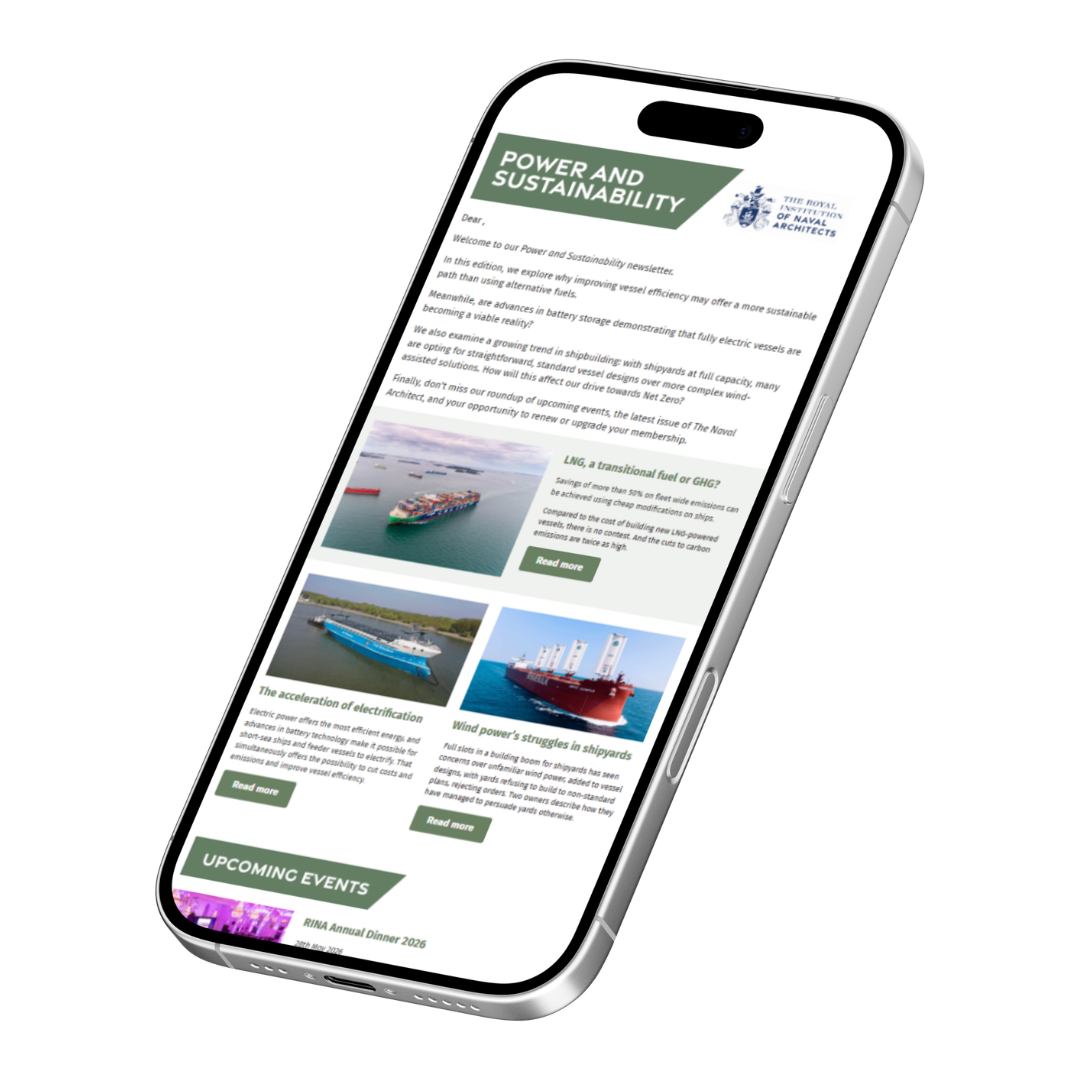
Stay connected with the global maritime community through RINA’s newsletters.
Whether you are a member or not, you can receive updates from The Naval Architect, alongside selected RINA news, events and industry insights. Members also gain access to a wider portfolio of exclusive newsletters on key topics in the maritime industry.