The Naval Architect provides in-depth information on all aspects of vessel design, construction and engineering. Practical applications of latest technology and case studies are accompanied by analysis and foresights. Published every two months, the magazine covers everything from superyachts and short-hop ferries to tankers and heavy-lift vessels; from battery pack installations and sail-assisted solutions to LNG tank retrofits; and from offshore safety to warship resilience.
A SIMPLIFIED PUMP TOWER APPROACH FOR REALISTIC CFD SIMULATION OF SLOSHING IN LNG TANKS
Transactions
As LNG carriers continue to increase in size and carrying capacity, accurately predicting sloshing loads within cargo tanks remains a key challenge for containment system design. Recent advances in numerical modelling are improving understanding of how internal tank structures influence fluid motion and impact pressures, supporting safer and more efficient LNG transport operations.
INFLUENCE OF LIFTING EFFECTS IN SEAKEEPING CALCULATION
Transactions
As ships increasingly rely on appendages such as rudders, fins, and stabilising foils to enhance manoeuvring and seakeeping performance, accurately modelling lift-generating effects has become an important challenge in hydrodynamic analysis. Advances in integrated numerical methods are improving the representation of hull-appendage interactions, supporting more realistic prediction of flow behaviour and helping designers evaluate the influence of lifting surfaces on vessel performance.
WATERJET PERFORMANCE CHARACTERISTICS PREDICTION BASED ON CFD SIMULATION AND BASIC PRINCIPLES OF WATERJET PROPULSION
Transactions
Accurate prediction of waterjet propulsion performance is becoming increasingly important as high-speed vessels demand efficient, responsive, and well-integrated propulsion systems. Advances in computational fluid dynamics are enabling more detailed assessment of pump and waterjet characteristics, supporting performance evaluation from the earliest design stages and providing valuable tools for improving propulsion system selection, vessel operation, and manoeuvring capability.
A THEORETICAL APPROACH TO FACILITATING TRANSITION PHASE MOTION IN A POSITIVELY BUOYANT AUTONOMOUS UNDERWATER VEHICLE
Transactions
As autonomous underwater vehicles take on increasingly complex survey, inspection, and monitoring tasks, improving low-speed manoeuvrability and station-keeping capability has become a key operational requirement. The integration of tunnel thrusters as a supplementary control system offers a potential solution, enhancing vehicle control during transitions between conventional forward-flight modes and hover-like operations while balancing performance against onboard energy demands.
WILLIAM FROUDE - A SACRED DUTY OF DOUBT
Transactions
The career of David K. Brown exemplified the close relationship between naval architecture, scientific research, and practical warship design that has shaped modern naval engineering. Through his contributions to submarine development, hydrodynamics, safety standards, and maritime history, he helped advance understanding of ship design while preserving the legacy of pioneering figures such as William Froude for future generations.
Newsletters
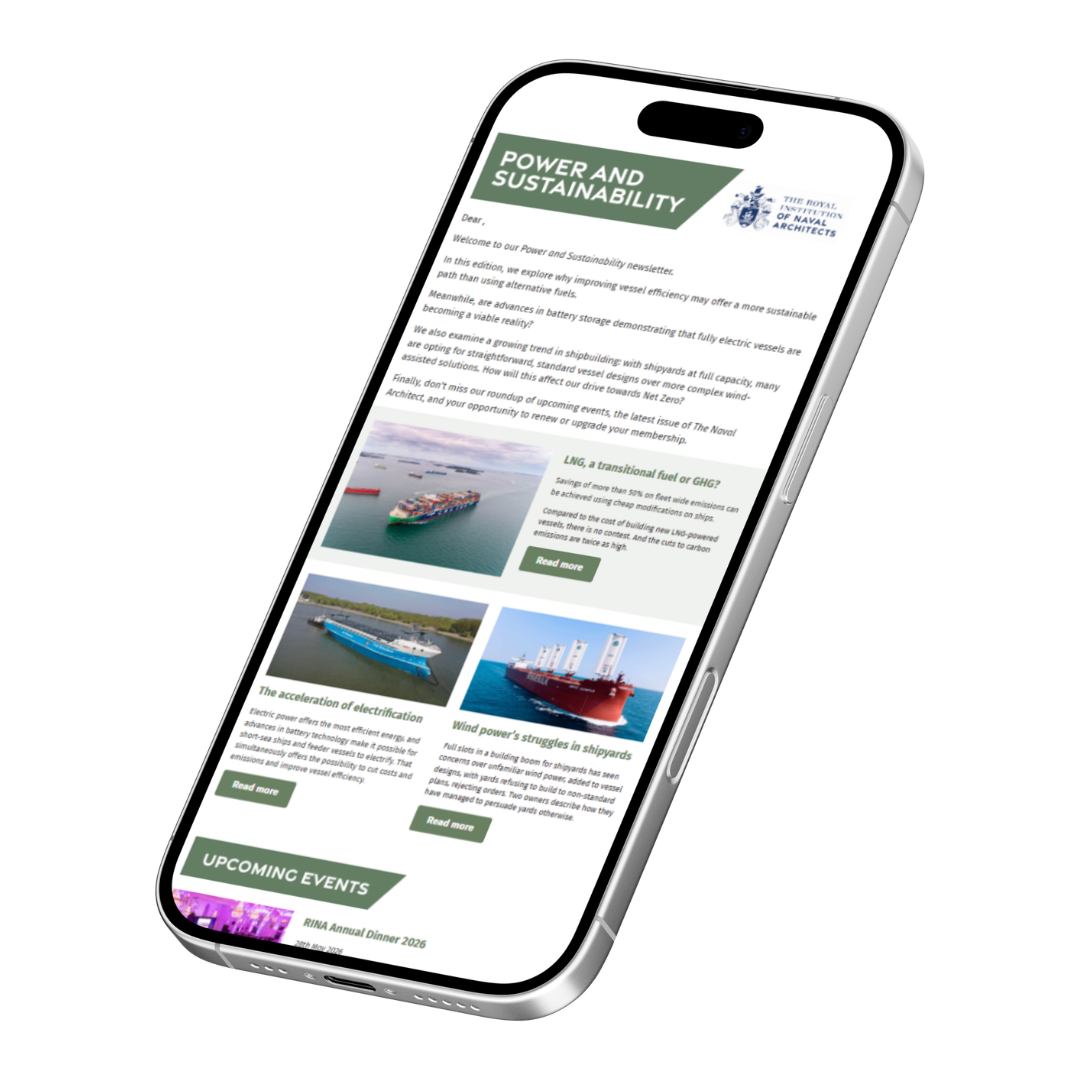
Stay connected with the global maritime community through RINA’s newsletters.
Whether you are a member or not, you can receive updates from The Naval Architect, alongside selected RINA news, events and industry insights. Members also gain access to a wider portfolio of exclusive newsletters on key topics in the maritime industry.