

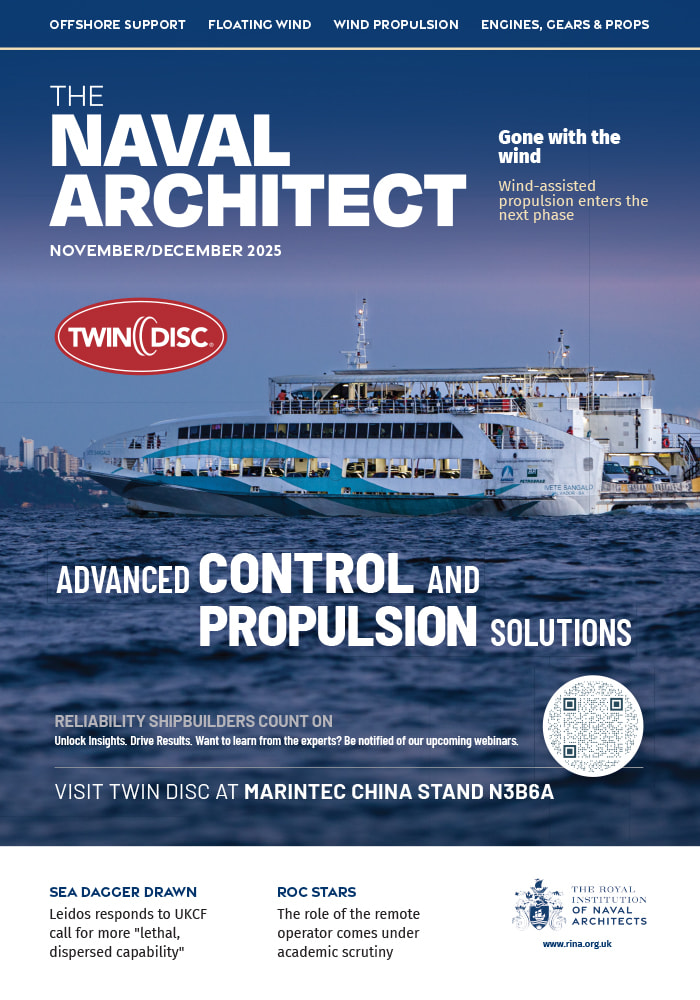
November/December 2025
The last issue of this year's Naval Architect is now available to read online and in print. Highlights from this issue:
Offshore Support
Floating Wind
Wind Propulsion
Engines, Gears & Props
Want to keep up to date with the latest news and developments in the maritime industry? Full articles and in-depth analysis are exclusively available to all RINA members & subscribers.
DELIVERING SUBMARINE AVAILABILITY THROUGH DESIGN
Warship
Submarine availability is increasingly recognised as a decisive factor in delivering effective naval capability. This research argues that maintainability, support infrastructure, workforce capacity, and supply-chain considerations must be embedded from the earliest design stages. By aligning vessel design with lifecycle support planning, navies can improve operational readiness, reduce long-term costs, and maximise fleet effectiveness.
EXPLORATIONS OF NOVEL NUCLEAR PROPULSION FOR SUBMARINES
Warship
Could novel reactor technologies redefine the future of submarine propulsion? Exploring alternatives to conventional pressurised water reactors, this analysis examines advanced Generation IV concepts, design implications, and strategic possibilities. Drawing on innovative submarine studies, it highlights emerging opportunities, technical trade-offs, and the engineering challenges shaping next-generation underwater capability ahead tomorrow.
PATROLLING THE METAVERSE
Warship
The industrial metaverse is emerging as a powerful enabler for submarine design, manufacture, and lifecycle management. By connecting digital twins, virtual collaboration, real-time production data, augmented reality, simulation, and operational feedback in a closed-loop environment, the approach promises smarter decision-making, improved training, enhanced manufacturing efficiency, and more agile submarine programmes. As digital and physical worlds converge, it offers a compelling vision for the future of naval engineering and defence capability.
PRESSURE HULL CORROSION MODELLING AND ASSESSMENT
Warship
Laser-scanning technology is opening new possibilities for submarine maintenance and structural assessment. By integrating detailed corrosion data into nonlinear finite element models of pressure hulls, researchers demonstrated the potential to reduce conservatism in integrity evaluations. The approach could improve decision-making, optimise maintenance strategies, and extend vessel service life significantly today.
DERIVING SUBMARINE SIGNATURE REQUIREMENTS
Warship
Translating submarine stealth into measurable requirements remains a complex systems-engineering challenge. This analysis examines how diverse signature types can be defined, assessed, and managed throughout a vessel’s lifecycle. By linking technical performance to operational effectiveness, the approach supports better design decisions while highlighting the need for pragmatic flexibility in practice.