

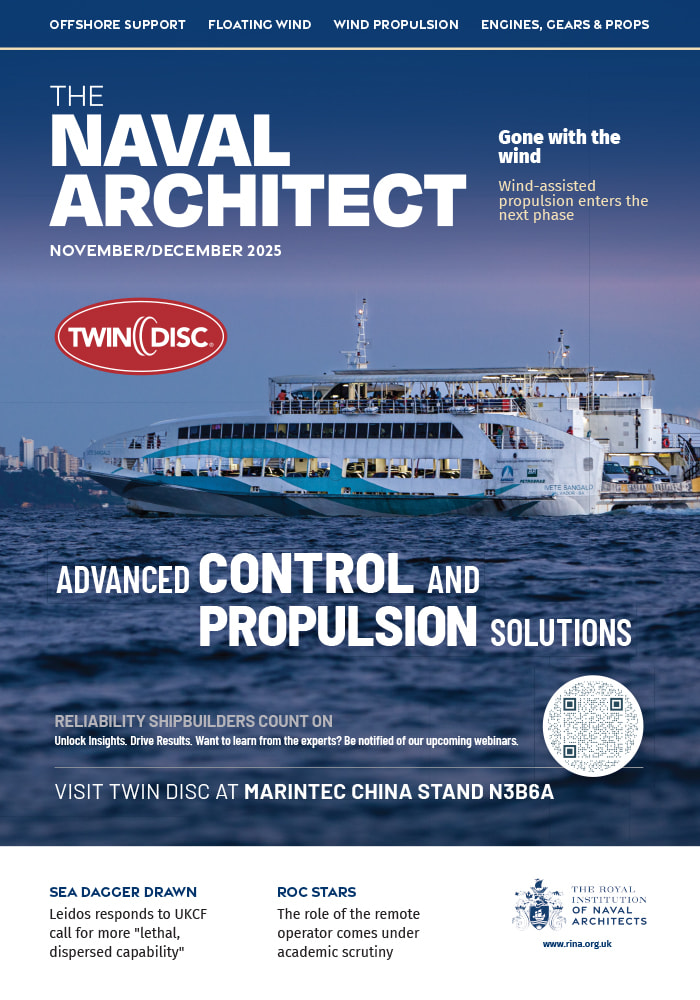
November/December 2025
The last issue of this year's Naval Architect is now available to read online and in print. Highlights from this issue:
Offshore Support
Floating Wind
Wind Propulsion
Engines, Gears & Props
Want to keep up to date with the latest news and developments in the maritime industry? Full articles and in-depth analysis are exclusively available to all RINA members & subscribers.
SS GREAT BRITAIN: VOYAGE TO CARBON NEUTRAL
Historic Ships
SS Great Britain showcases how heritage preservation and sustainability can work together. Advanced conservation engineering maintains the pioneering iron hull within a tightly controlled low-humidity environment, while data-driven optimisation and enhanced system monitoring are reducing emissions. The evolving strategy reveals new pathways to decarbonise complex preservation infrastructure without compromising protection.
PRESERVING OUR SHIPS FOR POSTERITY - A HOLISTIC APPROACH TO MANAGING HISTORIC SHIP PROJECTS
Historic Ships
Historic ships face mounting conservation pressures, from funding constraints and maintenance demands to disappearing specialist skills. The Engineered Conservation approach applies holistic engineering, stakeholder alignment, and proactive asset management to improve sustainability. Drawing on diverse vessel projects, it reveals practical lessons, measurable benefits, and limitations shaping maritime preservation efforts today.
REVERSE ENGINEERING THE NEOLITHIC BOATS OF THE AEGEAN SEA: TYPOLOGICAL CLASSIFICATION, RECONSTRUCTION AND SEAKEEPING ASSESSMENT
Historic Ships
New analysis of hundreds of recently discovered Aegean rock-art boat images is reshaping understanding of early seafaring. By combining reverse engineering, climatic design principles, and ship science, researchers reconstructed and tested Neolithic vessels, revealing sophisticated maritime capabilities and suggesting far earlier, more dynamic networks of trade, connectivity, and innovation.
A CASE STUDY OF HISTORIC SHIPS IN CANADA: THE STEAM TUG MASTER
Historic Ships
A century-old steam tug in British Columbia exposes the challenges facing maritime preservation in Canada. Fragmented policies, inconsistent heritage designation criteria, and limited government support complicate restoration efforts. Through the story of Master, the broader need for a coherent national framework emerges, highlighting risks, opportunities, and urgent conservation priorities today.
BUILDING THE REPLICA THAMES BARGE BLUE MERMAID
Historic Ships
The Blue Mermaid project demonstrates how traditional maritime design can be reimagined for modern needs. Recreating a 1930 engineless Thames Sailing Barge required innovative engineering, regulatory navigation, and operational insight. The vessel’s revival highlights emerging sail cargo opportunities, offering lessons in sustainable transport, heritage preservation, and resilience for future generations.